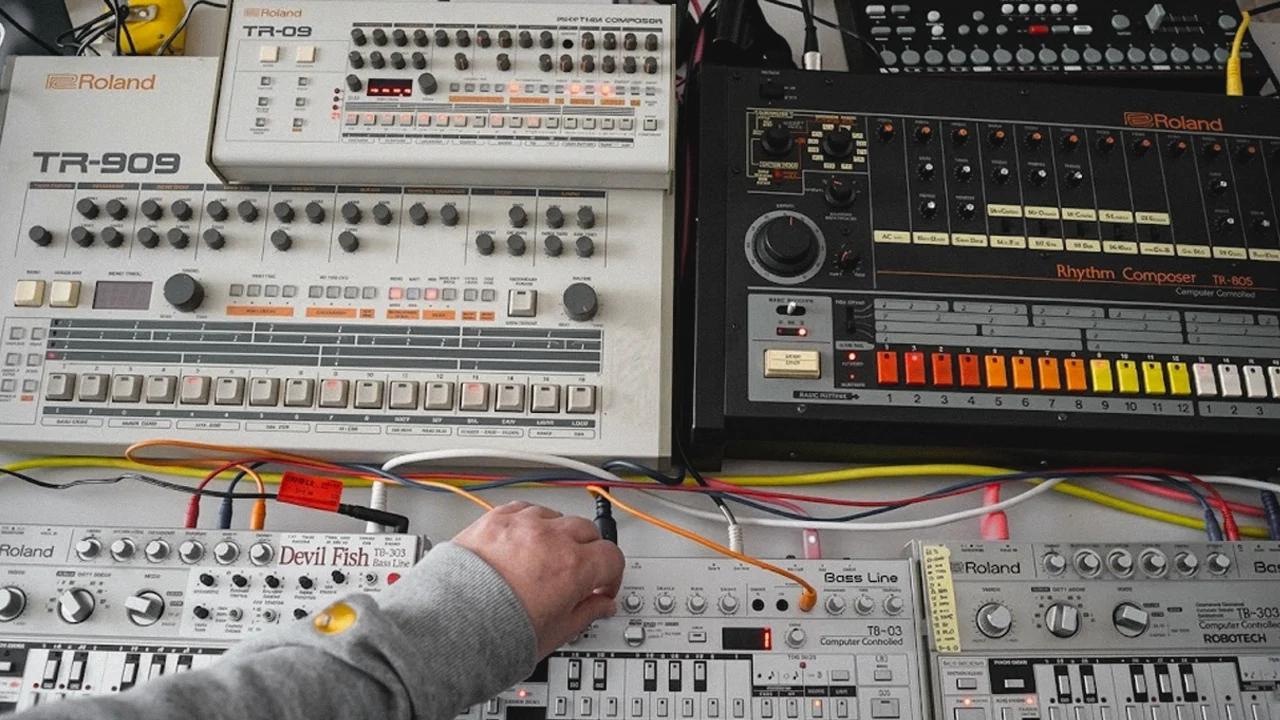

The progression of modern gear is widely understood as a strict march toward greater efficiency and flawless realism. The history of underground dance music offers a radical counter-argument. It proves that vital artistic innovation frequently emerges from commercial failure and the repurposing of discarded equipment. At the center of this phenomenon sit two of the most influential instruments in recorded music history, the Roland TR-808 and TR-909. Initially engineered to serve as accessible accompaniment tools for solo musicians, both machines were swiftly rejected by the mainstream market for their failure to authentically replicate the sound of acoustic drum kits.
This profound commercial rejection triggered a rapid depreciation in the secondary market. It redirected these sophisticated pieces of hardware from high-end recording studios into pawn shops and second-hand stores across post-industrial urban centers like Detroit and Chicago. Stripped of their intended context, the machines were subjected to radical experimentation. Producers did not use them to simulate human drummers. Instead, they weaponized the synthetic and mechanical nature of the devices to forge entirely new rhythmic languages.
Why Were These Drum Machines Rejected by the Mainstream?
In the late 1970s and early 1980s, the gold standard for electronic percussion shifted toward digital sampling. Competitors engineered machines that utilized pulse-code modulation to trigger digital recordings of actual acoustic drums. These competitors sounded like real drummers, but the memory chips required for digital sampling were prohibitively expensive.

To maintain a competitive edge and offer an accessible price point, Roland Corporation founder Ikutaro Kakehashi and his team made a fateful decision. Chief engineer Tadao Kikumoto suggested they avoid expensive digital sampling. Instead, they would utilize analog subtractive synthesis to generate percussion voices for their new rhythm composer, the TR-808. Kikumoto led a small team where engineer Hiro Nakamura was tasked with developing the analog voice circuits. By manipulating electrical currents and noise generators, the engineering team attempted to synthesize the complex harmonic structures of a drum kit.
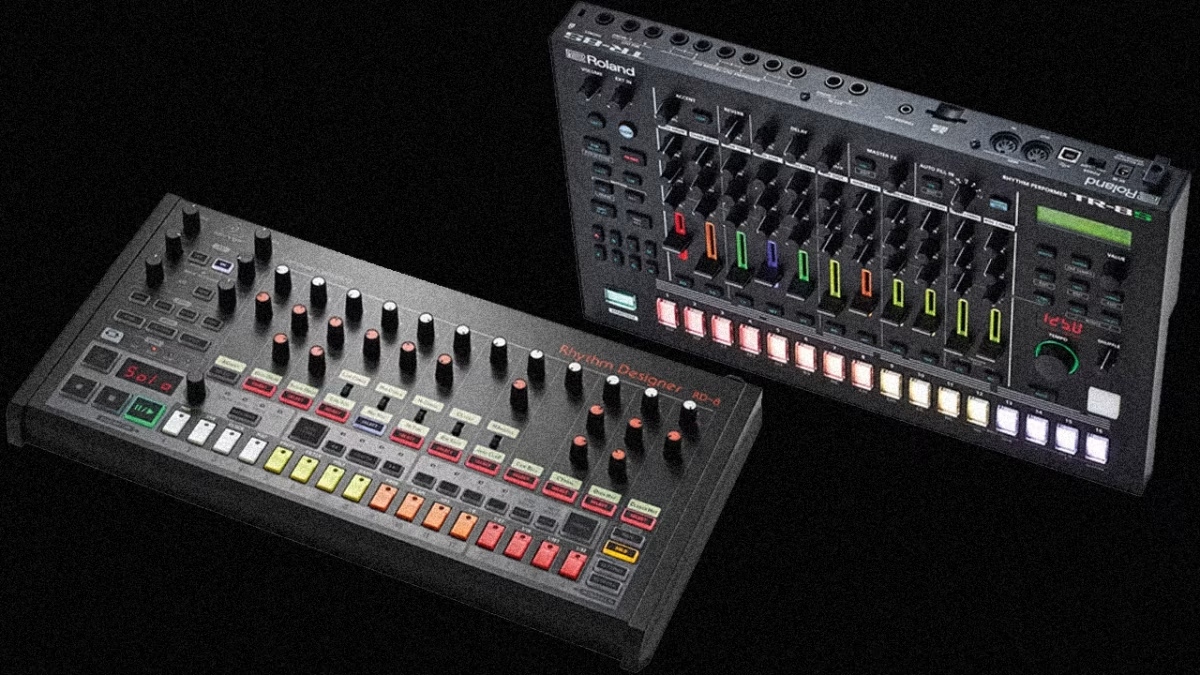
Why Behringer Clones Roland Gear and What It Means for Musicians
The defining aural signature of this first machine was the direct result of a highly specific engineering anomaly. To generate the white noise required for the hi-hats and snare, the engineers required a specific type of transistor. Crucially, they purchased a batch of components that had been rejected by the original manufacturers as faulty because they produced erratic signals. The team realized that these rejected transistors produced a unique splashing sizzle that was impossible to achieve with standard perfect components.
Recognizing the continued demand for greater acoustic realism, Roland returned to the drawing board to develop a successor, the TR-909. Tadao Kikumoto returned to lead the development of this second machine alongside chief engineer Makoto Muroi and voice circuit developer Yoshiro Oue. The new device represented a technological compromise. It was a hybrid system bridging the warmth of analog synthesis with the realism of digital sampling. The kick and snare were generated via newly designed analog circuitry engineered to be punchy and aggressive. The cymbals were low-resolution digital samples recorded by software designer Atsushi Hoshiai.
How Did Cheap Gear Democratize Music Production?
Despite these sophisticated advancements, both devices were unmitigated commercial failures upon their initial releases. Professional studio musicians and traditional bands wholly rejected them. The criticism was rooted in a strict demand for acoustic authenticity. Reviewers dismissed the analog cymbals as sounding like marching insects, while professional drummers viewed the machines with derision.
This dual commercial failure initiated a rapid and severe drop in asset value. Units that originally retailed for over a thousand dollars were traded in and relegated to thrift stores. By the mid-1980s, functioning TR-808 and TR-909 units could be purchased in the secondary market for a fraction of their original cost.
The migration of these machines from pristine commercial recording studios to the dusty shelves of urban pawn shops democratized music production. It transferred the means of rhythmic generation to entirely new demographics. For marginalized communities and working-class youth in places like Detroit and Chicago, traditional avenues of musical production were economically walled off. The sudden presence of affordable programmable drum machines dismantled this financial barrier. Mainstream market efficiency discarded imperfect technology and subsequently built an ecological niche where under-resourced producers could access sophisticated tools.
This Massive Archive Just Saved the 90s Underground Electronic Scene on MTV 120 Minutes
What Role Did the 808 Play in Post-Industrial Dance Music?
In Detroit, a heavily depressed manufacturing metropolis defined by severe economic contraction, a new musical philosophy was incubated. The mass exodus of the automotive industry left behind a terrain of abandoned factories and shuttered warehouses. Influenced by eclectic radio broadcasts, a young generation envisioned a sound that reflected their harsh reality. They viewed technology not as a force of displacement but as a tool for human empowerment.
Producers like Juan Atkins acquired these analog TR-808 machines and utilized their 16-step sequencers to program rigid and syncopated rhythms. The machine-like precision stripped away the organic imperfections of traditional funk and replaced them with a cold and hypnotic groove. The long decay of the analog kick drum produced sub-frequencies that resonated deeply within the concrete walls of underground warehouse parties. The mechanical rhythm literally and metaphorically mirrored the mechanized assembly lines that had once defined the city. The interface invited a non-linear approach to composition where artists could build their own looping patterns and dictate the future of rhythm.
Why Is the 909 Kick Drum the Standard for Club Music?
While producers in Detroit utilized the analog TR-808 to construct a post-industrial science fiction, artists in neighboring Chicago adopted the hybrid TR-909 successor to strip down and mutate the ashes of disco. Following a massive mainstream backlash against disco, the genre retreated firmly into the underground club scene. To maintain the energy on the dancefloor, DJs began utilizing drum machines to layer live synthesized beats over spinning vinyl.
The hybrid TR-909 drum machine was almost supernaturally suited to the specific requirements of this burgeoning underground Chicago club culture. Its kick drum was engineered with a sharp attack that punched violently through dense club sound systems. It provided an unrelenting and driving thud that became the universal standard for dance music. The integration of digital samples for its cymbals provided a crisp high-end that cut through a mix and contrasted beautifully with the warmth of the analog kick. The machine did not just accompany the music. It dictated the physiological response of the dancers.


How Did Producers Push This Gear Beyond Its Limits?
The raw sound of these Roland machines is distinct, but their legendary status is largely a product of how early producers aggressively processed the signal. Producers found that by driving the analog input gain of affordable hardware mixing desks well past the point of clipping, they could radically transform the TR-909 kick drum from a punchy thud into a massive roaring bassline.
This process of analog overdrive squares off the sine wave of the kick drum and introduces aggressive upper harmonics while compressing the initial transient attack. By aggressively equalizing the signal to cut muddy frequencies and boost the fundamental sub-frequency, producers achieved a sound that possessed concussive low-end weight. This blown-out and overdriven kick became the defining aesthetic of harder underground strains.
Elite producers also approached the rigid sequencer as an improvisational live performance instrument. By rapidly riding the tuning and decay knobs and aggressively utilizing the start and stop functions to trigger rapid stutters, they injected the mechanical rigidity with dynamic elasticity. They forced the drum machine to operate with the kinetic energy and unpredictability of a live acoustic drummer.
Which Veteran Artists Mastered These Machines?
The legacy of these instruments is permanently tied to the pioneers who pushed them to their absolute limits. A dedicated group of veteran producers adopted these machines and turned them into the foundation of global club culture.
- Juan Atkins: Often acknowledged as the originator of Detroit techno, Atkins utilized the TR-808 as his primary tool to program rigid and futuristic rhythms.
- Derrick May: A foundational figure in Detroit who famously helped introduce the TR-909 to the Chicago house scene.
- Frankie Knuckles: The legendary Chicago DJ adopted the TR-909 early on to give his underground club sets an unrelenting rhythmic drive.
- Kevin Saunderson: A key pioneer who layered the TR-909 with vocals to push underground dance music into the global mainstream.
- Jeff Mills: A virtuoso of the TR-909 who treats the rigid sequencer as an improvisational live instrument during his performances.
- Larry Heard: Producing under the moniker Mr. Fingers, he utilized the TR-909 to lay the deep house foundation on early classics.
- Joey Beltram: A defining force in harder techno strains who famously pushed the TR-909 kick drum to its aggressive and distorted limits.
What Can We Learn From the Obsolescence Engine?
Early electronic music faced a persistent crisis of authenticity. Manufacturers like Roland operated under a paradigm of simulation where they attempted to build machines that accurately replicated the real world. Under this strict paradigm, these drum machines were objective failures because they sounded artificial.
However, underground producers engaged in a process of artistic subversion. They stripped the instruments of their original acoustic referent and utilized them specifically for their unique synthetic attributes. The artificial drum sound ceased to be an imitation and became an original category of sound. The adoption of pawn-shop technology highlights the vital role of constraints in the artistic process. Utilizing cast-off commercial failures forces a producer to intimately understand the limitations of a specific piece of hardware and extract maximum utility from a restricted palette.
The historical trajectory of these machines confirms a vital thesis. The most profound innovations are not forged by flawless engineering but by human ingenuity operating fearlessly at the intersection of technological failure and subcultural resilience.
Sources & Further Reading
The Roland TR-808: The Boom that Changed Music
- Official Legacy: Roland TR-808 Story — The official history of the 1980 programmable drum machine that defined Hip-Hop and Trap.
- Sonic Iconography: Why the 808 is Iconic (Thomann) — An exploration of its unique analog synthesis and the sub-bass “boom” that digital samples still struggle to replicate.
- Historical Deep Dive: The History of the 808 (5 Mag) — A chronicling of its initial commercial failure followed by its underground rise to global dominance.
- Cultural Impact: Sound Studies: The 808 — An academic look at how a failed “rhythm composer” became the most influential instrument in popular music.
The Roland TR-909: The Pulse of House and Techno
- Official Legacy: Roland TR-909 Story — The official breakdown of the 1983 successor that combined analog drums with digital cymbals.
- The Techno Blueprint: Perfect Circuit: Roland TR-909 — Technical analysis of the 909’s punchy kick and crisp hi-hats that fueled the birth of the Detroit and Chicago warehouse scenes.