


 33
33
Google Search Profiles: The New Decentralized EPK Framework for Electronic Music Artists
JUN. 6 2026
Section
Read Time
Written By
[ EXCERPT ]
Managing a fragmented digital identity across streaming services complicates promoter vetting. Discover how electronic music artists leverage native Google Search profiles to unify decentralized streaming assets into a single, high-authority, booking-optimized digital hub.
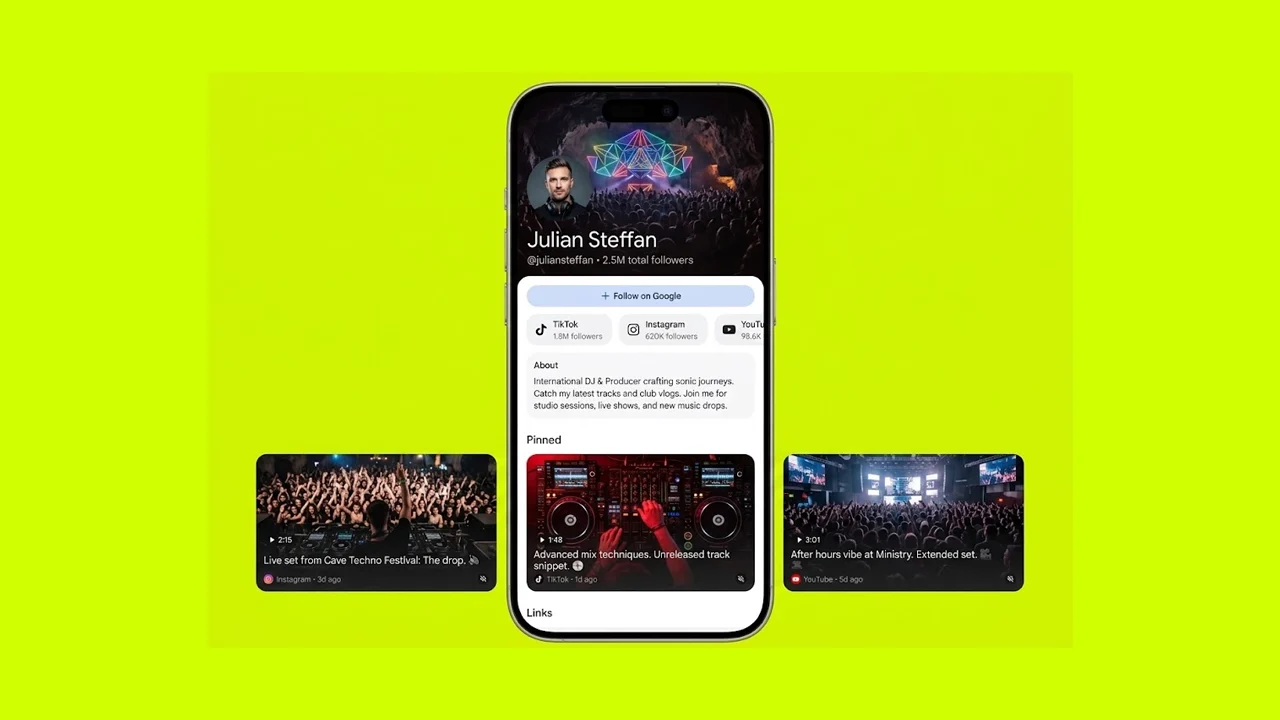
For modern touring artists, managing digital discoverability across fragmented streaming platforms directly impacts booking volume and professional market positioning. If I could use this to completely replace my link-in-bio landing pages like Linktree, and save myself from handing out my EPK in a giant PDF format to just text out a single link to my verified Google profile, this framework would be a massive operational game changer. As an active producer, having a central administrative engine where I can directly edit my details and broadcast automated updates across all my social media pipelines straight from Google would be a crazy feature to scale my workflow.
While independent music acts invest heavily in platform-specific organic social media campaigns, a scattered online identity complicates talent buyer vetting processes. Independent data compiled from digital talent management evaluations shows that source credibility, defined as the structural validation of an artist’s online presence, remains the primary mechanism dictating how talent buyers and global booking agents evaluate the legitimacy of an emerging alias.
The traditional electronic press kit is migrating directly into search engine results pages via semantic infrastructure. Google transitioned its underlying framework from literal string-matching algorithms to structural entity-matching with the implementation of the Google Knowledge Graph in 2012. For electronic music artists whose portfolios are decentralized across streaming services, this technical framework serves as an automated data aggregator. Claiming these nodes directly within search infrastructure allows management to synthesize disparate digital footprints into an authoritative, single point of reference.
TL;DR: Fragmented profiles complicate booking workflows for electronic music artists. By claiming a native Google Search profile, creators with 100,000 followers integrate decentralized open-web assets into a verified search hub. This automated press kit replaces legacy post limits with a dynamic content stream, boosting source credibility and reducing talent buyer vetting friction.
Why Are Electronic Music Digital Footprints Fragmented?
Electronic music distribution structures require multi-platform management. A typical release cycle requires a producer to upload audio files to SoundCloud, list extended plays for sale on Beatport, deploy visual assets on Instagram, and distribute long-form live sets to YouTube. This administrative workflow spreads an artist’s analytical footprint across separate platforms with varying algorithmic distributions. According to empirical studies on music marketing evolution published in 2020, independent acts must establish a centralized digital hub to maximize conversion rates and prevent audience churn. Without technical unification, prospective booking agents experience high click-friction when trying to audit an artist’s current discography and engagement metrics.

Suno And Udio Petition Federal Courts To Seal AI Training Corpus Volume Metrics
Unifying Your Electronic Press Kit on Google Search
A claimed Google Search profile acts as a zero-latency electronic press kit. The verification system requires identity validation using an active Google Search Console account or connected authoritative social networks to shift the asset from an inferred query into a managed knowledge graph node. This structural shift optimizes the spatial organization of the search engine results page. Verified administrators can bypass long-term organic crawling delays by injecting verified information directly into the knowledge panel layout. This optimization stabilizes the public profile, ensuring talent buyers immediately encounter high-margin professional data points instead of outdated forum threads or unofficial third-party uploads.
What Are the Real Verification Thresholds for Music Creators?
The interface architecture of the native Search Profiles hub enforces specific platform metrics for account eligibility. Rather than relying on third-party music badges, creators must possess a minimum threshold of 100,000 followers on YouTube, Instagram, or X or 300,000 followers on TikTok to unlock profile customization. This functionality functions as a real-time micro-portal. Instead of a legacy system capped at exactly eight pinned cards, eligible artists stream their multi-platform content dynamically. This mechanism lowers search friction. Promoters verify routing availability without navigating away from the initial search interface. Incorporating a systematic update workflow for this live stream ensures high-value conversion pathways remain visible during peak booking quarters.


Maximizing Trust and Booking Conversion Rates
Source verification changes user behavior. Independent industry reports confirm that securing a Spotify verified badge directly improves organic conversion and playlist positioning for dance music producers on that specific streaming service. Extending this systematic verification to search infrastructure establishes baseline industry authority. Empirical research published in 2023 regarding online source credibility shows that interactive, verified digital interfaces maximize consumer trust and improve business-to-business transaction velocity. For an electronic music producer, an optimized search presence operates as an inbound lead generation system. Promoters access accurate, verified contact paths, discographies, and social data points instantly, which reduces the time required to complete artist booking agreements.
Sources & Further reading
Google Knowledge Graph Evolution
- Core Fact: Google formally shifted from simple keyword string indexing to semantic network mapping (understanding things, not just strings).
- Source: WordLift Blog: What is a Knowledge Graph?
- Timeline: Launched in May 2012.
Google Search Profile Eligibility Thresholds
- Core Fact: Access to Google’s Search Profile creation tool requires a baseline of 100,000 subscribers or followers on an individual YouTube, Instagram, or X (formerly Twitter) profile.
- Source: Google Help: Create a New Search Profile
TikTok Verification Requirements
- Core Fact: Creators operating primarily on TikTok face an elevated barrier to entry, requiring a minimum of 300,000 followers to trigger eligibility for a Search Profile.
- Source: Google for Creators: Search Profile Portal
Identity Authentication & Management
- Core Fact: Entity ownership and identity authentication are managed natively using connected Google Search Console metadata hooks or direct OAuth sign-ins.
- Source: Google Help: Claim an Existing Search Profile
Academic Research on Digital Trust & Marketing
These peer-reviewed and academic sources provide the structural framework behind Google’s verification ecosystem, proving how centralized hubs and verified badges impact consumer behavior and market efficiency.
Decentralized Distribution Friction (2020)
- Core Fact: Research tracking the shift from traditional to digital music marketing shows that multi-platform, decentralized distribution causes high friction for prospective buyers. This highlights the administrative necessity of single-point discovery hubs.
- Source: Socrates Journal: Music Marketing Evolution from Traditional to Digital Marketing
Influence & Credibility Ecosystems (2023)
- Core Fact: Behavioral data demonstrates that verified digital status badges significantly improve consumer trust patterns and lower transactional friction during the vetting process.
- Source: National Center for Biotechnology Information (NCBI): The Effect of Social Media Influencers’ on Teenagers Behavior


What We Covered

- [2026.07.08] ./Why AI Event Posters are Killing Ticket Presales in 2026
- [2026.07.06] ./Generative AI Migrates From Cloud DAWs Directly to Standalone Performance Hardware
- [2026.07.03] ./Sony Music vs Udio: Judge Rejects 30,000-Track Lawsuit Expansion Motion
- [2026.06.30] ./TIDAL Enacts Zero-Royalty Policy for Fully AI-Generated Music Catalog
- [2026.06.28] ./The End of Anonymous AI Integration in Modern Music Production