


 06
06
Why Boiler Room’s five-minute Dublin announcement backfired completely
JUN. 17 2026
Section
Read Time
Written By
[ EXCERPT ]
When Boiler Room announced its return to Dublin, a rapid backlash forced the post down. Inside the grassroots Irish music rebellion resisting private equity giant KKR and the corporate takeover of alternative dance music spaces.
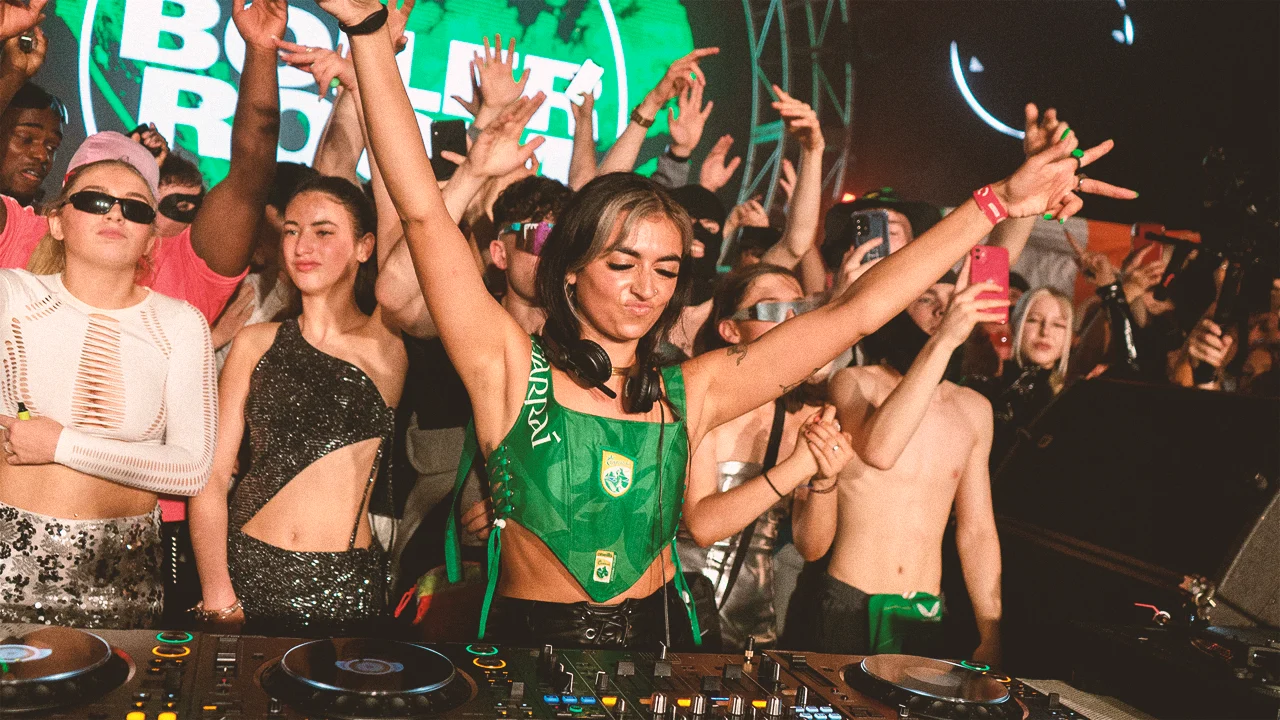
I was staring at my phone on Friday June 5, 2026, when the electronic music feed went wild. A slick graphic popped up: Boiler Room was coming back to Dublin. It looked like any other announcement, but the reaction was immediate and fierce. The comments filled with Palestinian flags, and within five minutes, the post vanished. I watched a massive media campaign get deleted in real-time because a room full of local kids refused to play along.
Underground clubbing has always claimed to be counter-cultural, but the pipelines of global finance have quietly bought up its foundations. This isn’t just a localized social media spat. It is a collision between private equity capital and the actual, living communities that give electronic music its value. When the corporate parent of your favorite party brand is KKR, the illusion of the underground collapses.
Boiler Room’s deleted Dublin announcement exposes the structural limits of corporate-owned club culture. Following its acquisition by private equity firm KKR, the brand faced an immediate boycott from Ireland’s pro-Palestine community, proving that grassroots networks still hold the power to reject the financialisation of independent music spaces.
What happened on June 5?
Boiler Room announced its sudden return to the Irish capital for a free showcase scheduled for the following week. The planned lineup featured UK garage headliner Riordan alongside unnamed special guests. But Boiler Room underestimated the local scene. Within five minutes of the announcement hitting Instagram, the backlash forced them to delete the post entirely.
Prominent local figures like DJ EMA, the booker behind Dublin club Tengu, immediately voiced the community’s refusal to host the corporate entity. While the social post was scrubbed, the digital invite remained live on the Boiler Room Dublin session page for those willing to ignore the boycott. I watched Dublin artists and promoters instantly draw a line in the sand.

Boiler Room’s KKR Problem Just Got Messier: Ukrainian Artist Targeted in Failed Protest
Follow the money to private equity
To understand the anger, we have to look at who actually owns the platform. Boiler Room is no longer a DIY webcast run out of a London utility room. In January 2025, live giant Superstruct Entertainment purchased Boiler Room from ticketing platform DICE for £25 million.
It turns out that when you RSVP to a free warehouse party, your attention is packaged for an asset manager with $758 billion under management. KKR acquired Superstruct in 2024, creating a direct pipeline between underground culture and global finance capital. I believe this complete corporate capture is why founder Blaise Bellville resigned and departed the platform in January 2026.
Why defense contracts don’t mix with dance floors
The friction is not just about general anti-capitalism. KKR holds major investments in global defense and companies tied to illegal Israeli settlements in the West Bank. In September 2023, KKR acquired industrial and defense supplier Circor International for $1.6 billion USD.
They also hold stakes in Novaria Group, a manufacturer specializing in military aerospace hardware. Furthermore, KKR was a major investor in German publisher Axel Springer S.E., which owns the Israeli real estate platform Yad2, a site that facilitated listings in illegal West Bank settlements. This culminated in a landmark Supply Chain Due Diligence Act lawsuit filed on December 10, 2024, by five Palestinian landholders. For a brand that has repeatedly claimed to be “unapologetically pro-Palestine,” these corporate ties are a systemic contradiction.


Reclaiming the alternative culture
Can an underground brand survive when it is owned by a multinational investment firm? Boiler Room attempted to save face in March 2025 with an unsigned statement claiming they had no control over the sale.
They assured fans that they remain committed to BDS guidelines, but I find that explanation incredibly weak. Pioneering UK electronic artists like Ikonika led the charge by canceling their scheduled Boiler Room sets. Even the Palestinian-led mutual aid group The Sameer Project publicly rejected corporate donations from Boiler Room to avoid artwashing. When a global platform treats music as an asset class, it forgets that culture is built on relationships, not balance sheets. Dublin’s immediate, five-minute shutdown of Boiler Room proved that some scenes simply cannot be bought.
Sources & Further reading
The Deleted Dublin Show and Local Nightlife Opposition
- Boiler Room Dublin show pulled from socials after backlash
- Boiler Room announced its return to Dublin on Friday June 5, 2026, with a free tech-house and garage showcase scheduled for June 11, 2026, at an undisclosed location featuring UK headliner Riordan.
The Corporate Pipelines and Financial Structure
- Boiler Room: How a Webcam in East London Built a Global
- Mobile ticketing platform DICE FM Holdings Ltd acquired complete ownership of Boiler Room in October 2021.
- Superstruct Reports Sales Growth But Faces An Operating Loss For 2024
- DICE sold Boiler Room to live event and festival conglomerate Superstruct Entertainment for £25 million in January 2025.
Corporate Leadership Transitions
- Boiler Room founder and CEO Blaise Bellville leaves company
- Founder Blaise Bellville resigned in December 2025 and officially left Boiler Room in January 2026, leaving management to an interim leadership team.
- KKR: From Greece’s “red loans” to the occupied territories of Palestine
- KKR owns several defense suppliers, including specialized aerospace company Novaria Group, advanced robotics firm Advanced Navigation, and fluid controls supplier Circor International, which it bought for $1.6 billion in September 2023.
What We Covered

- [2026.07.08] ./Why AI Event Posters are Killing Ticket Presales in 2026
- [2026.07.06] ./Generative AI Migrates From Cloud DAWs Directly to Standalone Performance Hardware
- [2026.07.03] ./Sony Music vs Udio: Judge Rejects 30,000-Track Lawsuit Expansion Motion
- [2026.06.30] ./TIDAL Enacts Zero-Royalty Policy for Fully AI-Generated Music Catalog
- [2026.06.28] ./The End of Anonymous AI Integration in Modern Music Production