

 90
90
Cornell University Preserves 10,000 Original Rave Flyers Documenting Electronic Music History
MAY. 29 2026
Section
Read Time
Written By
[ EXCERPT ]
Cornell University’s archival collection of over 10,000 original flyers, posters, and ephemera preserves the history of 1990s electronic dance music, establishing underground rave culture as a vital subject for modern academic and sociological research projects.
Academic libraries usually prioritize classical manuscripts. In Ithaca, Cornell chose a different path. The university has quietly compiled a collection of paper ephemera detailing underground rave culture. More than 10,000 original flyers, posters, and newsletters now sit alongside historical relics. This archive treats the late-20th-century dance floor with strict academic seriousness.
The initiative stems from a 2003 policy targeting post-1950s musical subcultures. This framework led to the acquisition of the world’s largest hip-hop archive and significant punk holdings. It also cleared a path for electronic dance music. By treating temporary street advertisements as primary sources, the library preserves historical narratives that physical sound recordings cannot fully convey.
TL;DR: Cornell University’s Division of Rare and Manuscript Collections has preserved over 10,000 original flyers, posters, and pamphlets dating from 1989 through 2002. Focusing on Northern California and the United Kingdom, these materials document the growth of techno and house, securing ephemeral street promotions a permanent place in global music history today.
The Structural Makeup of Collections 8068 and 8010
Cornell organizes its materials into two distinct physical entities. The Rave Collection, listed under Collection Number 8068, holds thousands of flyers from California and Great Britain. Handbills from the San Francisco Bay Area represent early US developments. This specific set contains paper and acetate cards spanning 1989 through 2001. Prominent figures like Moby, Daft Punk, and Todd Terry appear on these cards.
The library also preserved 6,000 English flyers gathered by a participant in the London scene. This large batch shows the scaling of local events into mass commercial operations. In parallel, the Techno Music Poster Collection, cataloged as Collection 8010, captures European developments. Assembled via Thomas Hill, a poster dealer, this archive houses public media from Germany, Hungary, and the Netherlands. It preserves Mayday festival programs from 1992 to 1996, documenting Berlin techno after the fall of the Wall.
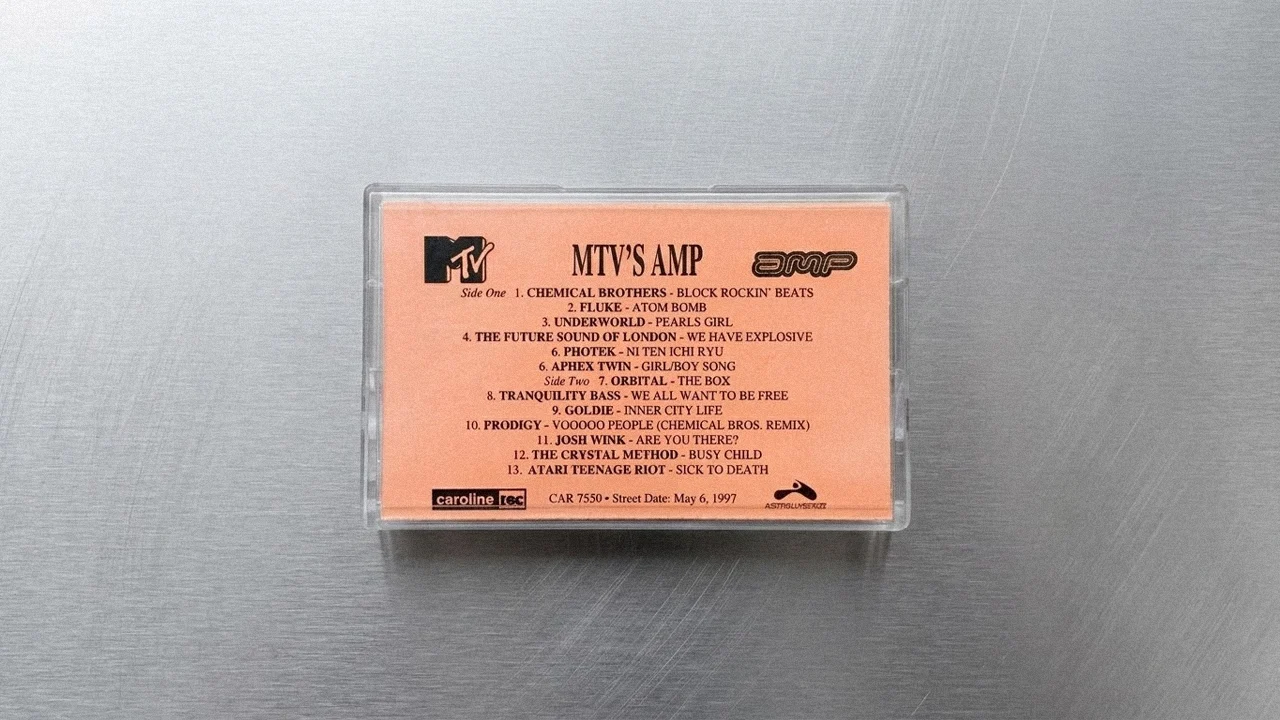
Late-Night Transmissions: How MTV’s AMP Changed Electronic Dance Music
The physical properties of these flyers map a clear graphic evolution. Early promotions in the late 1980s were small, black-and-white A6 cards focusing on basic logistical details. By the mid-1990s, the design evolved into high-gloss, multi-folded card stock and complex digital graphics. These flashy visual layouts reflected a growing obsession with future digital technology.
The preservation of these physical flyers protects a history once broadcast on late-night alternative television networks. These materials provide a visual counterpart to the broadcast music of the era, as detailed in a report on the 90s underground electronic scene. Researchers can now cross-reference these physical documents with historical television archives.
How Did Regional Networks Drive Dance Genre Mutations?
The geographically segmented papers reveal how music styles evolved across borders. Detroit techno and Chicago house migrated to the United Kingdom in the late 1980s, where they merged with local youth countercultures. This combination produced massive warehouse gatherings and outdoor events. The mutated British scene then returned to the United States, directly influencing the aesthetic development of West Coast networks.
Sociological materials in the archive, including fanzines like Rhythmos and Ameba Message, provide raw data on the beliefs of these communities. Rather than showcasing a superficial escape, the flyers represent a complex social structure. Participants constructed their identities in opposition to mass-marketed popular music.
Katherine Reagan, rare books and manuscripts curator, noted the long-term value of preserving these youth cultures.
These underground cultures frequently become mainstream cultures eventually. They also become the subject of books and dissertations that fuel new fields of academic study.
By organizing these materials, the library provides scholars with primary data on post-traditional spirituality and modern youth communication. The dance floor served as a secular gathering space. It united communities through technology and repetition.


Preservation Politics and the Debate Over Grassroots Ownership
The transition of subcultural paper from street waste to high-value academic property has highlighted key structural issues. A collection of 308 North American flyers from the 1990s is currently valued at $3,200. This rising commercial value shows the shifting status of these items. However, the centralization of archives in elite universities can draw criticism.
This issue emerged in 2015 when Cornell acquired the papers of Robert Moog. The Bob Moog Foundation had spent seven years and $150,000 restoring these technical drawings and notes. When Moog’s widow donated the physical papers to Cornell, the local foundation was bypassed. This action disqualified the grassroots foundation from a $600,000 regional development grant.
Collector Johan Kugelberg advocated for treating modern subcultures with the same weight as classic literature.
“Of course we all understand the importance of having a 15th-century Dante in the library or a copy of the Emancipation Proclamation, but the history of hip-hop or the history of the Velvet Underground absolutely belong alongside these materials,” Kugelberg stated. This approach shifts the definition of what constitutes a valuable historical record.
Institutional constraints also impact physical expansion. As of July 1, 2025, the Division of Rare and Manuscript Collections implemented a temporary pause on physical collection gifts. This pause allows the library to focus on sustainable stewardship and existing materials. The future of dance music preservation may lie in digital accessibility rather than physical accumulation. As physical vaults reach capacity, open-access scanning remains the primary method for sharing these transient paper memories with the communities that first produced them.
Sources & Further reading
1. Cornell’s Dance Music Archive (Collection 8068 & 8010)
- Institutional Mandate (2003): Cornell’s Division of Rare and Manuscript Collections designated 20th and 21st-century popular music genres as primary collecting focuses. [Cornell Rare]
- Archive Scale: Holds over 10,000 rave/techno flyers, posters, and pamphlets. [Cornell Rare]
- Rave Collection #8068 (1989–2002): Documents the late 1980s/1990s English rave scene and its expansion, anchored by 6,000 English flyers gathered by an early London participant. [Cornell RMC]
- California Series: Includes San Francisco Bay Area flyers and newsletters spanning 1989 through 2001. [Cornell RMC]
- Techno Music Poster Collection #8010: Preserves European electronic posters, including programs for Germany’s “Mayday: a New Chapter of House and Techno” festival (1992–1996). [Cornell Archives] [Cornell Mayday]
- Commercial Valuation: Private dealer lots showcase the market value of these ephemera; a single lot of 308 North American flyers from the 1990s was valued at $3,200. [ILAB Catalog]
- Policy Benchmark: Academic institutions value these street-level flyers alongside elite 15th-century Dante manuscripts to study cultural movements. [Cornell News]
- Gift Pause (July 1, 2025): The Division of Rare and Manuscript Collections officially paused the acceptance of all new physical collection gifts. [Cornell Archives Policy]
2. The Bob Moog Archive Fallout
- Acquisition (2015): Robert Moog’s personal synthesizer papers, technical drawings, and prototype recordings arrived at Cornell. [Cornell Rare]
- Sunk Costs: Prior to the transfer, the Bob Moog Foundation spent seven years and roughly $150,000 in labor cleaning and restoring the physical materials to archival standards. [CDM]
- Financial Penalty: Because losing physical custody of the papers left them unable to house the materials locally, the Bob Moog Foundation was disqualified from a $600,000 regional development grant from the Buncombe County Tourism Product Development Authority. [CDM]
What We Covered

- [2026.07.02] ./Why the fight against AI music is just history repeating itself on a bigger scale
- [2026.06.30] ./Six-Time Grammy Nominee Fatboy Slim Shares Turning Point in Sobriety
- [2026.06.21] ./The Atlantic AI Watchdog tool unmasks widespread music copyright theft
- [2026.06.15] ./How Gotye Used His Pop Fortune to Restore Electronic Music History
- [2026.06.09] ./Midnight Rebels and &Friends Announce Signal Breach Winners