


 01
01
From Afrika Bambaataa to Drift Phonk: The Four-Decade Evolution of the 808 Cowbell
MAY. 30 2026
Section
Read Time
Written By
[ EXCERPT ]
Explore the analog synthesis and cultural legacy of the Roland TR808 cowbell. From detuned hardware oscillators to the high speed melodic leads of drift phonk, discover how this iconic synthetic clank redefined global electronic music.
Explore the analog synthesis and cultural legacy of the Roland TR808 cowbell. From detuned hardware oscillators to the high speed melodic leads of drift phonk, discover how this iconic synthetic clank redefined global electronic music.
Picture a humid basement in the Bronx in 1982 or a neon-lit bedroom in Moscow in 2026. The air is thick with bass rumble. Then, a cold, metallic clank pierces the haze. It sounds absolutely nothing like a physical cowbell. Yet, this bizarre synthetic accident commands the crowd.
In 1980, the Japanese engineers at Roland faced a brutal budget wall. High-end competitors were recording real acoustic drum hits onto expensive memory chips. Roland opted for cheap, purely analog circuits. They designed stylized outlines of instruments rather than exact replicas. The resulting machine was a commercial failure that changed music history.
TL;DR The legendary Roland TR-808 cowbell was synthesized using detuned square waves and active bandpass filters. Though it failed to mimic real percussion, this happy accident became a cultural anchor. From eighties electro to modern trap and high-speed drift phonk, its metallic clank permanently redefined the global electronic dance music scene.
The Art of the Japanese Woodblock
In the early eighties, digital realism was the industry standard. High-end machines like the Linn LM-1 played back pristine recordings of physical drums. Roland chief engineer Tadao Kikumoto took a different path. He wanted to design a drum synthesizer, not a sample player. He compared his vision to traditional Japanese woodblock prints.
“If you compare it to the world of visual art, the TR-808 sounds are like simple line drawings or illustrations.”
Woodblock artists focused on raw impact rather than photographic detail. Roland followed the same unique constraint. They used analog circuits to draw stylized outlines of sound. The resulting machine cost a fraction of its digital rivals. Yet, major studios rejected it for sounding toy-like.
It was a commercial disaster. Still, this economic flop was the ultimate blessing. Secondhand units flooded pawnshops for under a hundred bucks. Bedroom producers began crate-digging for cheap gear. They quickly grabbed these failed drum machines and wrote the future of street music.
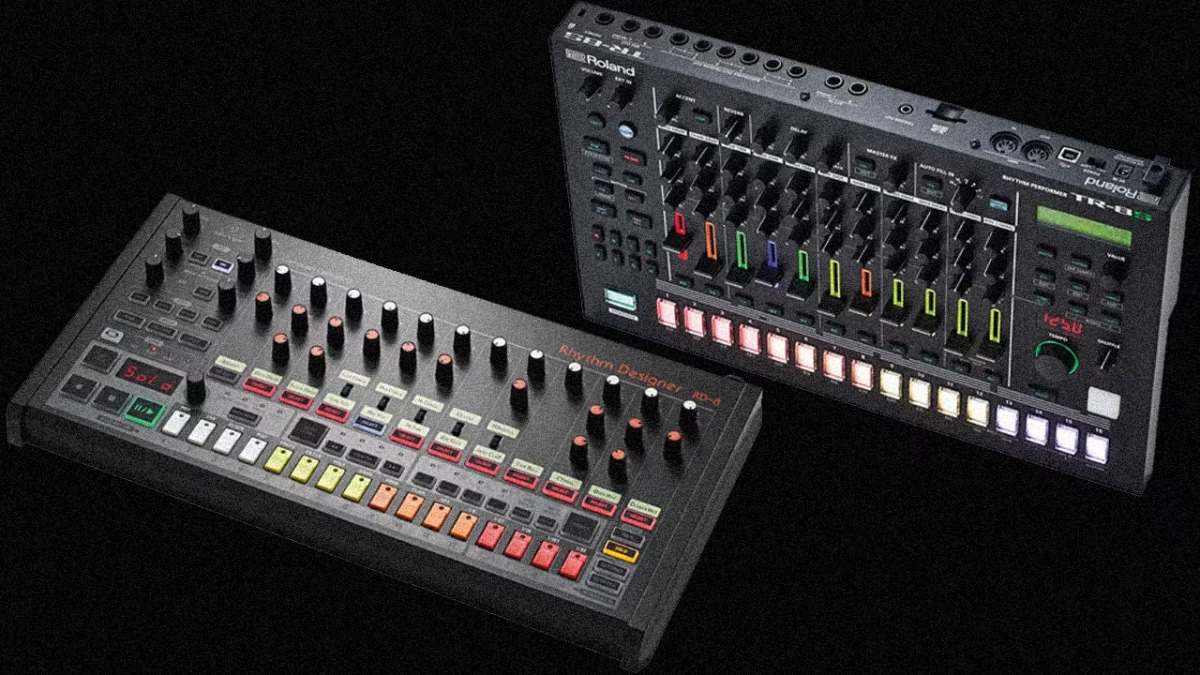
Why Behringer Clones Roland Gear and What It Means for Musicians
The Physics of the Mechanical Clank
The cowbell voice is a marvel of brute-force analog engineering. It does not use samples. Instead, two square-wave oscillators buzz against each other. They are tuned to 540 Hz and 800 Hz. This forms an out-of-tune interval.
This deliberate dissonance yields a clanging, metallic texture. The two square waves pass through separate swing-type voltage-controlled amplifiers. These amplifiers apply a rapid, snappy decay envelope. They also add a subtle, warm analog saturation. Finally, the combined signals hit a bandpass filter centered at 880 Hz.
This active filter cuts out muddy low frequencies. It also tames the harsh, high-frequency hiss. The center frequency is parked just above the higher oscillator. This makes the 800 Hz tone dominate the final mix. The result is a cold, robotic clank with a tight, ringy tail.
Classic and Modern Hits Built on the 808 Cowbell
Here is the list of songs using the Roland TR-808 cowbell, organized by genre and era:
Pop & Soul
- “I Wanna Dance with Somebody (Who Loves Me)” – Whitney Houston (1987)
- “Sexual Healing” – Marvin Gaye (1982)
- “One More Night” – Phil Collins (1984)
Hip-Hop, Electro, & Miami Bass
- “Planet Rock” – Afrika Bambaataa & The Soulsonic Force (1982)
- “Egypt, Egypt” – The Egyptian Lover (1984)
- “Hey Ladies” – Beastie Boys (1989)
House, Techno, & Electronic Dance
- “Just Be Good To Me” – The S.O.S. Band (1983)
- “Confusion” – New Order (1983)
- “No Way Back” – Adonis (1986)
- “Footcrab” – Addison Groove (2010)
Modern Drift Phonk (Melodic Leads)
- “METAMORPHOSIS” – INTERWORLD (2022)
- “RAVE” – Dxrk ◤ (2022)
From Block Parties to Memphis Tapes
The sound was weird, but it worked. In 1982, Afrika Bambaataa dropped the legendary track Planet Rock. The cowbell served as a bright treble counterweight to the booming sub-bass kick. Breakdancers used the sharp transient strike as a visual cue for freezes. Soon, Miami DJs were holding court at roller rinks, playing cowbell-heavy electro.
R&B producers also fell in love. Jimmy Jam and Terry Lewis smuggled the metallic chime into Janet Jackson tracks. Whitney Houston used it to add high-end sparkle to her biggest pop anthems. DJs swapped white label pressings in late-night clubs. The un-bovine bell became a peak-time essential.
By the nineties, the sound moved to Memphis, Tennessee. Underground hip-hop pioneers like Three 6 Mafia programmed rapid-fire cowbell rolls on cheap gear. They recorded mixes onto cassette tapes. The tracks suffered from severe tape hiss and distortion. This raw processing turned the bright ping into an eerie, lo-fi ghost.
The Phonk Melodic Meltdown
Fast-forward to the 2010s. The SoundCloud underground resurrected those dusty Memphis cassettes, birthing the phonk genre. Producers pitched the cowbell sample down into a heavy iron thud. They layered it with smooth jazz loops and chopped rap vocals. It was a slow, hazy groove running at 60 to 80 BPM.
Then, the Eastern European car drift scene hijacked the aesthetic. They accelerated the tempo to an aggressive 130 to 160 BPM. The cowbell was no longer a mere percussive accent. It was loaded into software samplers and played melodically across the piano roll as a lead instrument. Drift phonk was born.
To make the lead cut through, producers apply massive digital distortion. They sidechain the melody directly to blown-out, rumbling basslines. The bass aggressively ducks every time the cowbell strikes. This high-energy loop acts as a relentless metronome. It syncs perfectly with videos of sports cars sliding sideways.
The underground has split into endless battle lines over these developments. Purists argue that high-speed drift tracks are far removed from original hip-hop roots. Yet, kids in backyard garages still run these loops b2b on local streaming channels. Kikumoto once observed that “musical instrument R&D is the art of compromise.” The ongoing evolution of his design proves that the best instruments are never truly finished. They simply adapt to the streets.
Sources & Further reading
1. Engineering the Metallic Accent: The 808 Cowbell Circuit
- Schmitt Trigger Oscillators: The original hardware generates its metallic timbre using two square-wave Schmitt trigger oscillators tuned to mismatched frequencies (~540 Hz and ~800 Hz) to create complex, non-harmonic sidebands. [ResearchGate] [Sound on Sound]
- CMOS Logic Synthesis: Designers mixed these frequencies using logic gates to generate the harsh, metallic disharmony needed for realistic percussion synthesis without sampling. [Hackaday]
- Sallen-Key Bandpass Filter: The combined raw square waves pass through a dedicated Sallen-Key bandpass filter. The filter’s specific component configuration shapes the frequency spectrum, damping the harsh upper harmonics and emphasizing the core metallic ring. [Baratatronix]
- VCA & Envelope Shaping: A simple envelope generator drives a Voltage Controlled Amplifier (VCA) to give the sound its signature rapid attack and abrupt, tight decay. [ResearchGate] [Sound on Sound]
2. Development & Aesthetic Framework
- Ukiyo-e Design Metaphor: Lead developer Tadao Kikumoto approached the TR-808’s architecture using a Japanese ukiyo-e (woodblock print) metaphor—focusing on bold, distinct sonic strokes and impressionistic instrument representations rather than exact acoustic mimicry. [CDM]
- Hardware Synthesis Constraints: Operating within strict analog constraints, the engineering team built custom circuits to synthesize complex acoustic instruments like the handclap and deep bass drum from scratch. [CDM]
- Commercial Failure to Cultural Pivot: Released in 1980, the TR-808 was initially a commercial failure due to its unrealistic, synthetic sounds. It found a second life in the used market, becoming the foundational rhythm machine for hip-hop, techno, and early electronic music. [Wikipedia]
3. Evolution: Electro-Funk to Drift Phonk
- The Electro-Funk Origin: The 808 cowbell became an enduring hip-hop rhythm marker after its appearance in 1982 electro-funk classics like Afrika Bambaataa’s “Planet Rock.” [Medium]
- The Memphis Rap Root: In the 1990s, underground Memphis rap producers repurposed the cowbell, sequencing it into dark, syncopated melodies over raw tape loops. [eMastered]
- The Drift Phonk Mutation: The sound mutated into the internet-driven “drift phonk” genre, where the cowbell is pitched, distorted, and used as the primary lead melody line over high-tempo rhythms. [Medium] [eMastered]
What We Covered

- [2026.07.12] ./Record Labels Are Not a Golden Ticket and Electronic Music Producers Must Stop Signing Bad Deals
- [2026.07.12] ./Festival Transparency Revolt: The End of Hype-Driven Lineups
- [2026.07.10] ./Skrillex shares his honest opinion on the future of AI in the music industry
- [2026.07.08] ./Why AI Event Posters are Killing Ticket Presales in 2026
- [2026.07.06] ./Generative AI Migrates From Cloud DAWs Directly to Standalone Performance Hardware