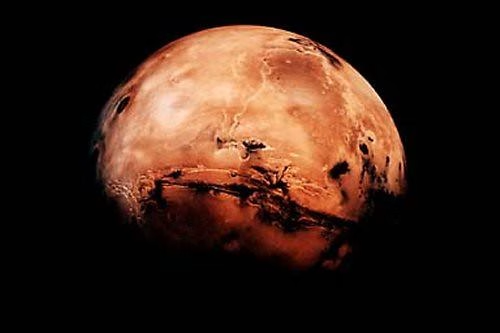

How Sound Travels on Mars: A NASA Discovery
Recent research published in Nature magazine reveals fascinating insights into the propagation of sound on Mars. Data collected by the Perseverance rover during its first five hours of operation unveiled that sound travels differently on the red planet compared to Earth. This difference is attributed to Mars’ thin, cold carbon dioxide atmosphere.
Speed Differences in Martian Sounds
The study found that sound travels more slowly and over shorter distances on Mars. On Earth, sound travels at an average speed of 767 miles per hour (343 meters per second). However, on Mars, the speed varies depending on the frequency of the sound:
- Low-pitched sounds travel at approximately 537 mph (240 meters per second).
- High-pitched sounds travel at around 559 mph (250 meters per second).
This disparity in speeds causes a noticeable delay effect in audio recordings from Mars.
Sounds Recorded by the Perseverance Rover
The sounds captured by the Perseverance rover included a variety of noises, providing valuable data for scientific analysis. These recordings included the distinctive sounds of:
- The SuperCam laser striking rocks.
- The Ingenuity helicopter’s rotors in motion.
This diverse range of sounds provides a richer understanding of the Martian soundscape.
Audio Recordings from Mars
Listen to some of the sounds recorded by NASA’s Perseverance rover in the video below:
Read also: How Soon Will AI Replace DJs?
Understanding the Martian Atmosphere
The unique characteristics of Mars’ atmosphere are key to understanding these speed differences. The thin atmosphere and its composition of primarily carbon dioxide directly impact how sound waves propagate. Further research using data from Perseverance will undoubtedly yield more insights into the Martian environment.
* generate randomized username
- COMMENT_FIRST
- #1 Lord_Nikon [12]
- #2 Void_Reaper [10]
- #3 Cereal_Killer [10]
- #4 Dark_Pulse [9]
- #5 Void_Strike [8]
- #6 Phantom_Phreak [7]
- #7 Data_Drifter [7]
- #8 Cipher_Blade [6]


