

 22
22
The $10 Million Bot Farm: Inside The First Criminal Prosecution Of AI Streaming Fraud
FEB. 1 2026
Section
Read Time
Written By
[ EXCERPT ]
North Carolina musician Michael Smith faces federal charges for a $10 million streaming fraud scheme. Prosecutors allege he used AI to generate thousands of songs and deployed bot armies to siphon royalties from major platforms like Spotify.
North Carolina musician Michael Smith faces federal charges for a $10 million streaming fraud scheme. Prosecutors allege he used AI to generate thousands of songs and deployed bot armies to siphon royalties from major platforms like Spotify.
If you’ve ever suspected that the “Chill Lo-Fi Beats to Study To” playlist was staring back at you with dead, algorithmic eyes, you were right. The Southern District of New York has unsealed an explosive indictment that reads less like a legal document and more like a cyberpunk manifesto for the end of human creativity. Michael Smith, a 52-year-old musician and producer from North Carolina, stands accused of executing a “brazen” $10 million wire fraud scheme—using AI to generate hundreds of thousands of songs and then forcing armies of bots to listen to them billions of times. 1
Smith didn’t just game the system; he accelerated it to its logical, nihilistic conclusion. In a streaming economy that values volume over engagement and background noise over art, Smith allegedly built the perfect closed loop: machines making music for other machines to enjoy, while he collected the check.
“This Is Not Music, It’s Instant Music”
The smoking gun in the case isn’t a weapon or a bag of cash; it’s an email from 2019. Writing to the CEO of an unnamed AI music company (identified in court docs only as “CC-3”), Smith laid out the aesthetic philosophy of his operation: “Keep in mind what we’re doing musically here… this is not ‘music,’ it’s ‘instant music’ ;)”. 2
That winking emoticon is doing a lot of heavy lifting. It signifies the moment music officially detached from humanity and became pure asset class. Smith—who, ironically, has legitimate credits producing for artists like Snoop Dogg and Billy Ray Cyrus—wasn’t trying to write the next OK Computer. He was trying to generate data packets that could pass a spectral analysis test.
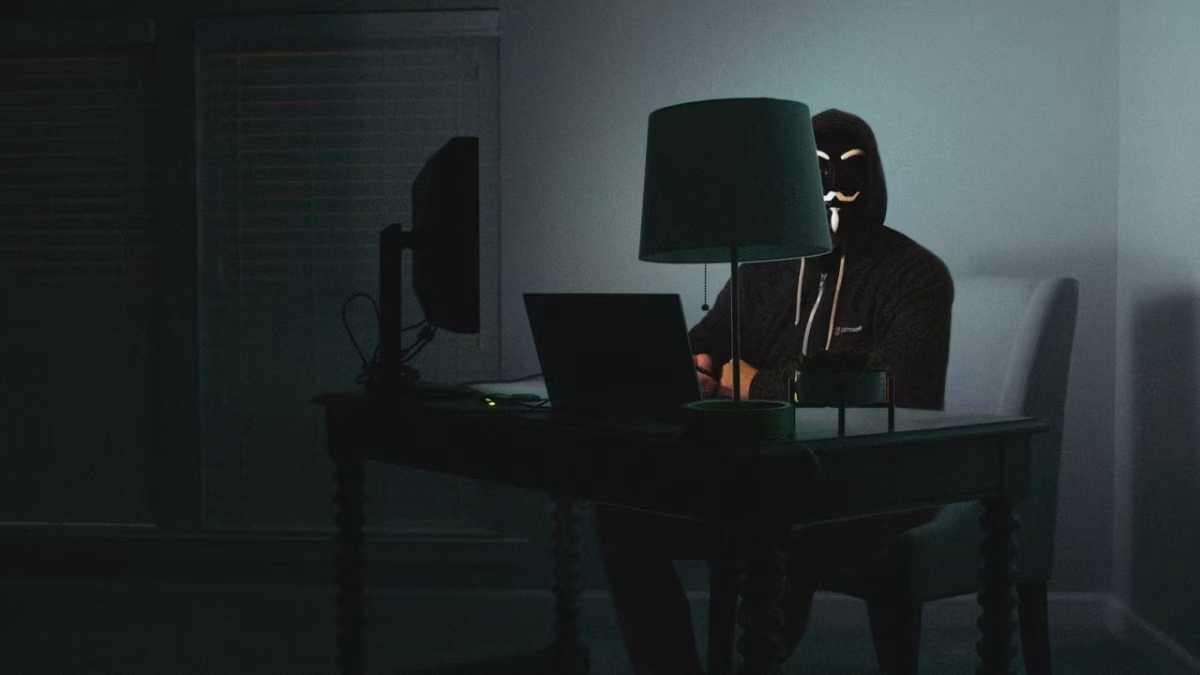
The Fake DJ Blueprint: How Scammers Are Generating Tracks, Automixing Sets, and Taking the Credit
He needed quantity, not quality. He needed “Zygotic Washstands,” “Calm The Super,” and “Zymotechnical”—actual band names Smith allegedly generated to populate his phantom catalog. This wasn’t an artistic statement; it was a denial-of-service attack on the concept of listening.
So, You Want to Be a Robot Rockstar?
To understand the scale of the grift, you have to appreciate the banality of the infrastructure. This wasn’t a hoodie-wearing hacker in a basement; it was a logistical masterpiece of suburban boredom.

According to the indictment, Smith operated 52 cloud service accounts, which hosted thousands of bot accounts. These weren’t just scripts running in a void; he allegedly used debit cards registered to fake names (shout out to “Mike D. Smith” and “Michael E. Smith”) to sign up for Family Plans on platforms like Spotify, Apple Music, and Amazon Music. By stacking family plans, he could maximize the number of “listeners” per credit card swipe.
But here’s the genius—or the tragedy—of the “dilution” strategy. Smith knew that if his fake band “Zygophyceae” suddenly got a billion streams, the algorithm would flag it. So, he went wide. He uploaded hundreds of thousands of AI-generated tracks. His bots would stream a song once, move on, and maybe loop back weeks later. Each track got a trickle of plays, but the river flowed $1.2 million a year into Smith’s pockets. It was a “long tail” strategy weaponized against the platforms that invented it.
The “Zygophyceae” Aesthetic
We have to talk about the names. To avoid detection, Smith needed his AI sludge to look like a diverse ecosystem of indie artists. He fed the machine a dictionary and let it rip. The result is a discography that sounds like a taxonomy textbook having a stroke: “Zygophyllaceae,” “Zygopteraceae,” “Zygopteron”.
There is something hauntingly beautiful about the band name “Calm The Super”. It sounds like a mistranslated instruction from a medication bottle, or perhaps a plea to the AI itself. The audio files were just as functional—filenames like n_7a2b2d74-1621-4385-895d-b1e4af78d860.mp3 renamed to “Artist – Song” pairs by a script.
This is the Dead Internet Theory materialized. We’ve long joked that the internet is mostly bots talking to bots, but Smith allegedly proved it could be monetized. He created a hermetically sealed world where the creator (AI), the distributor (Smith), and the audience (bots) were all synthetic. The only real thing in the loop was the money.


Stealing From the Poor to Pay the Robots
It’s tempting to view Smith as a Robin Hood figure, sticking it to the faceless corporate DSPs (Digital Service Providers). But the math doesn’t support that romanticism. Streaming royalties are a zero-sum game known as the “pro-rata” model. All the money goes into one big pot and is divided by the total number of global streams.
When Smith injected billions of fake streams into the pool, he diluted the value of every legitimate stream. He wasn’t stealing from Daniel Ek’s stock options; he was stealing from the indie band in Brooklyn fighting for $0.003 per play. The $10 million Smith allegedly pocketed was siphoned directly from the pockets of actual human beings trying to make art in a late-capitalist hellscape.
The Mechanical Licensing Collective (MLC) finally pulled the plug in 2023, spotting the irregularities and freezing payments. Spotify claims they caught on early, stating Smith only managed to extract about $60,000 from their specific platform. But for seven years, across the broader ecosystem, “instant music” won. 3
The Future Is Quiet (and Expensive)
Michael Smith faces up to 60 years in prison if convicted on all counts of wire fraud and money laundering conspiracy. But locking him up won’t fix the glitch. The glitch is the business model.
As long as platforms incentivize passive listening and prioritize algorithmic engagement over human connection, there will always be a “Zygophyceae.” Smith just happened to be the first one to get caught doing it at industrial scale using the new toys. We are barreling toward a future where the charts are a Turing test that nobody passes, and the only way to prove you’re a real listener is to endure a captcha before every chorus.
Until then, pour one out for “Calm The Super.” They never played a live show, but for a few glorious years, they were the hardest working bots in show business.
What We Covered

- [2026.07.14] ./Music Industry Leaders Launch Unified Voluntary Labels for AI-Generated Tracks
- [2026.07.12] ./Record Labels Are Not a Golden Ticket and Electronic Music Producers Must Stop Signing Bad Deals
- [2026.07.12] ./Festival Transparency Revolt: The End of Hype-Driven Lineups
- [2026.07.10] ./Skrillex shares his honest opinion on the future of AI in the music industry
- [2026.07.08] ./Why AI Event Posters are Killing Ticket Presales in 2026