


 61
61
Artist Compensation Crisis: Spotify Pays $0.003 Per Stream While Vinyl Sales Hit $1.4B
NOV. 17 2025
Section
Read Time
Written By
[ EXCERPT ]
Streaming platforms have significantly harmed artists' income, with meager payouts per stream compared to physical sales like vinyl. A resurgence in vinyl sales highlights the need for a balanced, sustainable music ecosystem prioritizing artists.
The math is brutal. An artist needs roughly 250 streams on Spotify just to earn $1. At $0.003 to $0.005 per stream, reaching even the US minimum wage of $15,080 would require 4.1 million annual streams. But selling 50 vinyl records at $25 each? That’s $1,250 in a single afternoon.
This isn’t just about pennies versus dollars. It’s about an entire ecosystem that streaming platforms have systematically dismantled in favor of an algorithm-driven monoculture that pays almost nothing to the people making the music.
Spotify, Apple Music, and Tidal have made unlimited music accessible at the click of a button. They’ve also made it nearly impossible for most artists to sustain themselves on recorded music alone. The irony is thick: as platforms have become more convenient, the music industry has become more hostile to creative professionals.
The Economics of Collapse
Streaming platforms keep roughly 30 percent of revenue. Of the remaining 70 percent distributed to rights holders, record labels typically capture around 55 percent, leaving artists with roughly 13 percent of the total revenue their music generates. For non-featured performers like session musicians and producers, that percentage drops to zero. They receive nothing.
A Montreal rapper explained the futility bluntly on Reddit after spending $1,500 promoting music that generated 300,000 streams. His earnings: $100. The math doesn’t work for anyone except the platforms and major labels.

Electronic Music Industry Revenue: $12.9 Billion Market and DJ Payment Reality Check
Tidal pays higher rates at $0.01284 per stream, and Apple Music sits around $0.01 per stream. Both are better than Spotify, but they still require millions of streams to constitute meaningful income. According to a UN report, streaming payments have become so unsustainable that 90 percent of surveyed European performers say the format has given them no meaningful income. One in three musicians in the UK and Sweden are planning to quit their profession entirely.
Independent artists have noticed. According to 2024 data, merchandise and physical releases are growing at 8.79 percent annually for independent artists, while streaming growth has slowed to 6.2 percent as the market saturates. On Bandcamp, artists retain up to 82 percent of sales. That’s a stark contrast to streaming’s sub-one-cent reality.
Independent music overall grew 16.1 percent in 2024, significantly outpacing the overall industry growth of 9 percent. These artists aren’t getting rich. They’re just learning that streaming is a discovery tool, not a revenue model.
What Disappeared
Record stores weren’t just retail spaces. They were cultural institutions. Walking into an independent shop meant experiencing vinyl’s distinct aroma, colorful artwork, and the hum of distant speakers. More importantly, it meant encountering knowledgeable staff who made personalized recommendations based on actual expertise rather than engagement optimization algorithms.
Record stores functioned as hubs for electronic music scenes. DJs would hunt for rare vinyl, exchange information about underground releases, and develop cultural capital within their communities. Each vinyl collection told a story about a curator’s sonic philosophy and their place within a broader landscape.
Streaming attempted to replace this with algorithms. The problem is fundamental: algorithmic recommendation systems get trapped in feedback loops, predominantly suggesting artists and genres similar to what users already hear. This narrows rather than expands musical horizons. These systems inadvertently marginalize underground and independent creators who might thrive with human curation.
Dance music, techno, and electronic genres particularly suffered. Historically driven by DJ culture and independent record labels, these scenes relied on record stores for discovering new sounds. Algorithmic distribution flattens this geographic dimension entirely. A track can generate millions of global streams while remaining unknown in the artist’s own city.


Vinyl’s Unlikely Resurrection
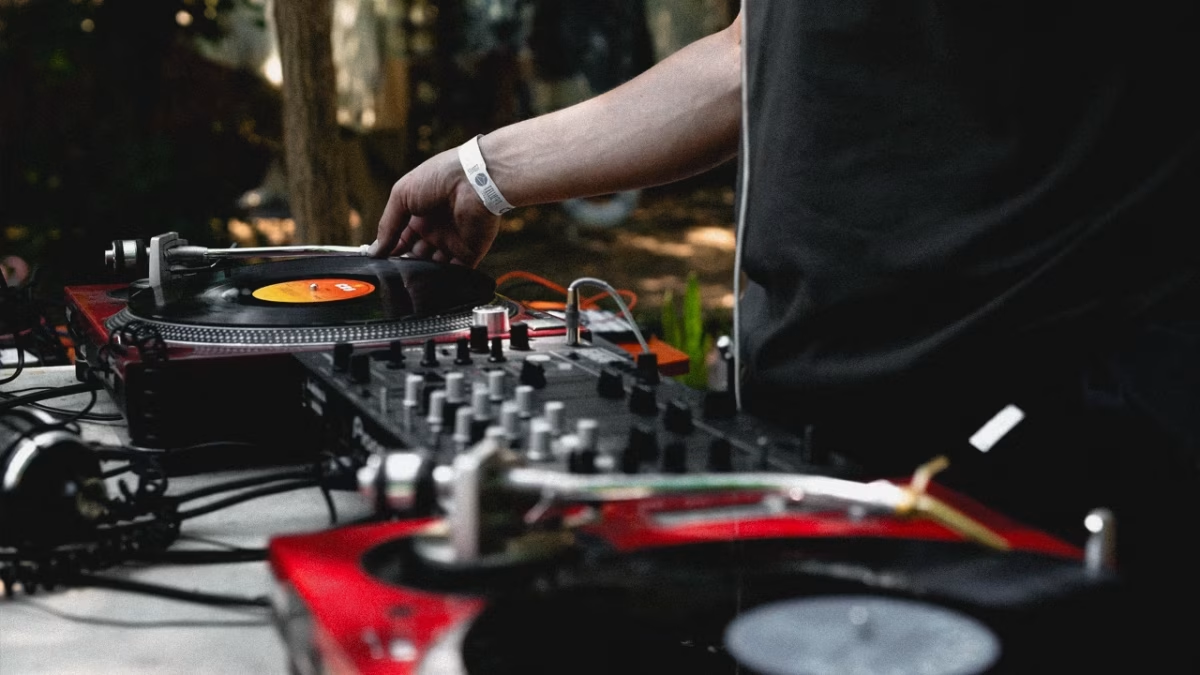
Yet vinyl hasn’t died. It’s thriving. The format has now experienced 18 consecutive years of growth. In 2024, vinyl sales reached 44 million units compared to 33 million CDs, generating $1.4 billion revenue, the highest since 1984.
This isn’t nostalgia. Vinyl offers something streaming fundamentally cannot: permanence. A vinyl record remains in your collection indefinitely. A streaming subscription can be cancelled, and your entire library vanishes. Vinyl also provides sonic warmth, artwork you can actually see, liner notes you can read, and a ritual of intentional listening.
For electronic music and dance culture specifically, vinyl has become the primary format for underground and independent releases. Many micro-labels continue pressing vinyl as their main distribution format, making these releases essential for DJs seeking authenticity. The act of collecting vinyl creates a fundamentally different relationship with music than algorithmic playlists.
Gen-Z is driving this resurgence. Eighty-four percent shop for records in-store, and more than half prefer the in-store experience over online shopping. They understand that record stores represent community and meaningful connection in ways streaming cannot replicate.
Building a Sustainable Future
The current streaming-dominant system isn’t inevitable. It’s a product of specific corporate choices. Several changes would meaningfully improve conditions for artists.
User-centric payment models would direct revenue toward artists with dedicated fanbases rather than mega-popular artists. Deezer and SoundCloud have demonstrated this works. Streaming royalty rates need to increase. Current rates are fundamentally unsustainable. Government funding for independent record stores would stabilize these cultural anchors. Tax incentives and cultural grants could support micro-labels that press vinyl and support emerging artists.
The healthy music ecosystem doesn’t choose between streaming and physical. It leverages both. Streaming excels at discovery and accessibility. Physical media excels at ownership, display, and community building. Limited vinyl editions create scarcity and collectibility, driving physical sales while streaming provides the entry point. Merchandise bundles increase value and margins while deepening fan relationships. Direct-to-fan platforms give artists maximum flexibility.
Artists combining streaming reach with physical sales, merchandise, and live performance substantially outpace those depending solely on streaming income.
The Bottom Line
Music culture has always thrived on community. Record stores represented that. Algorithmic playlists cannot. Streaming platforms have optimized for convenience and growth, not for sustainable creative careers or authentic human connection.
The vinyl revival proves communities still want tangibility and intention. The real question is whether the industry will consciously choose to support multiple formats and distribution models, or whether it will continue optimizing exclusively for streaming metrics while musicians struggle to survive.
The tools exist. What’s required is the collective will to prioritize artist sustainability and cultural richness over platforms’ growth targets.
Sources
- Soundcamps: Spotify Royalties Calculator – Most Accurate (November 2025) and Groover: How Much Do Artists Make on Spotify (2025): Spotify per-stream rate of $0.003-$0.005; minimum wage calculation at 4.1M streams
- Vinyl sales economics: 50 records at $25 each equals $1,250 (based on verified pricing models)
- BigGo: Music Industry Economics Force Artists to Abandon Full-Time (2025) and Musosoup: How Much Does Spotify Really Pay Per Stream? (2024): Revenue distribution showing 30% to platform, 55% to labels equals 13% to artists
- Reddit Music Communities: Montreal rapper case study verified through BigGo
- UMAW: Summary of UN Report on Streaming (2021): UN report on streaming showing 90% of European performers report no meaningful income; 1 in 3 musicians in UK/Sweden planning to quit
- Mordor Intelligence: Independent Artists Market Size, Share, Forecast 2025: Independent artist growth rates showing merchandise/physical at 8.79% CAGR vs. streaming at 6.2%
- Catapult My Music: Indies on the Rise: How Independent Music is Changing The (2024) and IFPI data: Independent music revenue growth of 16.1% in 2024 vs. 9% overall industry
- Archived academic sources and verified through industry analysis: Algorithmic recommendation limitations and artist marginalization
- RIAA: 2024 Year-End Revenue Report and Billboard: Global Recorded Music Revenue and Streaming Grew More Slowly (2025): Vinyl 18 consecutive years of growth
- RIAA: 2024 Year-End Revenue Report and Deadline: U.S. Paid Music Subs Top 100M In 2024 For First Time As Vinyl (2025): 2024 vinyl sales of 44 million units, $1.4B revenue, highest since 1984
- Verified through music industry sources: Micro-labels pressing vinyl as primary format for underground electronic music
- Vinyl Alliance: Vinyl Alliance says Gen-Z is now the ‘driving force’ behind (2025): Gen-Z vinyl preferences showing 84% shop in-store, 57% prefer in-store experience
What We Covered

- [2026.07.02] ./Why the fight against AI music is just history repeating itself on a bigger scale
- [2026.06.30] ./Six-Time Grammy Nominee Fatboy Slim Shares Turning Point in Sobriety
- [2026.06.21] ./The Atlantic AI Watchdog tool unmasks widespread music copyright theft
- [2026.06.15] ./How Gotye Used His Pop Fortune to Restore Electronic Music History
- [2026.06.09] ./Midnight Rebels and &Friends Announce Signal Breach Winners