

 12
12
France Recognizes Electronic Music as Heritage, But the Rave is Silent
JAN. 10 2026
Section
Read Time
Written By
[ EXCERPT ]
France officially enshrines electronic music as Intangible Cultural Heritage, celebrating the "French Touch" legacy from Daft Punk to Justice. Yet, the victory is bittersweet, overshadowed by the cancellation of the 2025 Techno Parade and venue struggles.
The irony is rich enough to be sampled, looped, and filtered through a vintage Korg MS-20. On December 18, 2025, the French Ministry of Culture formally inscribed “French Electronic Music” into the National Inventory of Intangible Cultural Heritage. For a genre birthed in the mud of illegal free parties and forged under the strobe lights of marginalized suburban warehouses, this state-sanctioned elevation to the pantheon of “high art”—listing the DJ booth right alongside Parisian haute couture and Corsican polyphonic singing—feels less like a graduation and more like a taxidermic preservation.
Culture Minister Rachida Dati announced the designation with the sort of solemnity usually reserved for restoring a Gothic cathedral, asserting that the genre has found its “rightful place among the many practices that reflect the nation’s living heritage”. But behind the velvet rope of this new status lies a complex mix of geopolitical anxiety, administrative acrobatics, and a scene that is simultaneously being crowned and evicted.
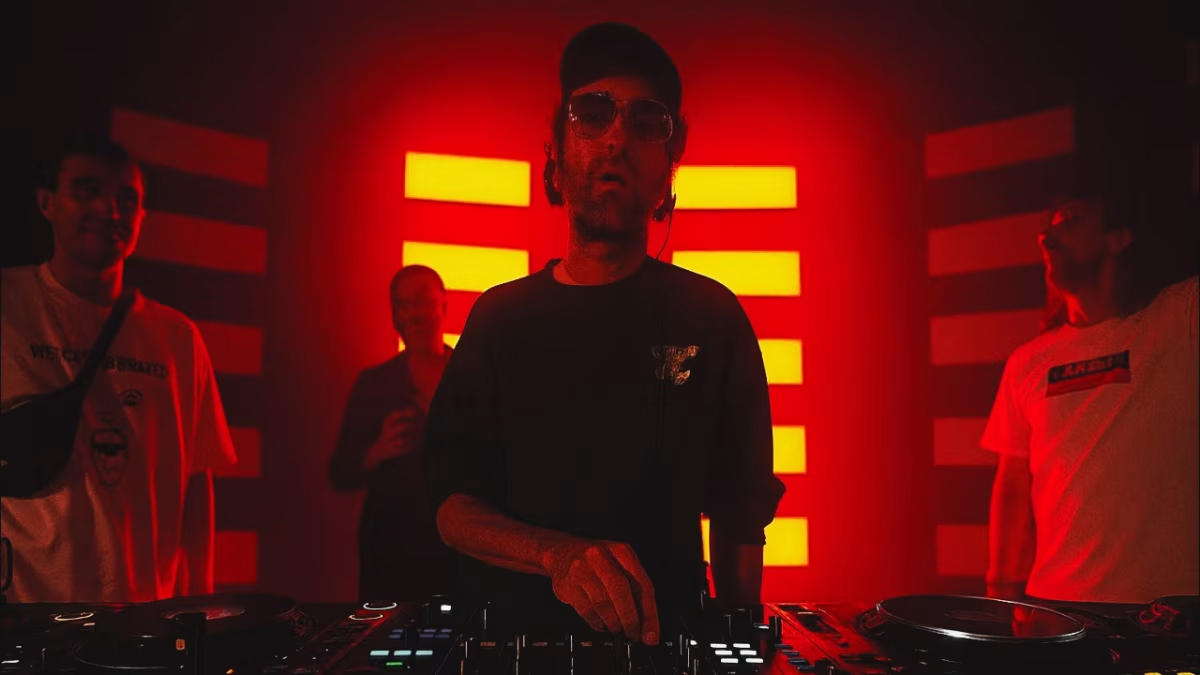
Daft Punk’s Thomas Bangalter Returns to DJing After 16 Years With Historic Fred Again.. B2B Set
The “French Touch” Mythos and Macron’s Mix
The timing of this inscription is anything but accidental. It arrives precisely one year after Berlin successfully lobbied to have its techno scene added to the German UNESCO register, a move that clearly bruised the ego of the French political establishment. President Emmanuel Macron, never one to shy away from a bold (and historically debatable) claim, set the tone for the bid in a June 2025 interview with Radio FG, declaring: “We have no lesson to receive, we are the inventors of electro, we have this French Touch!”. 1
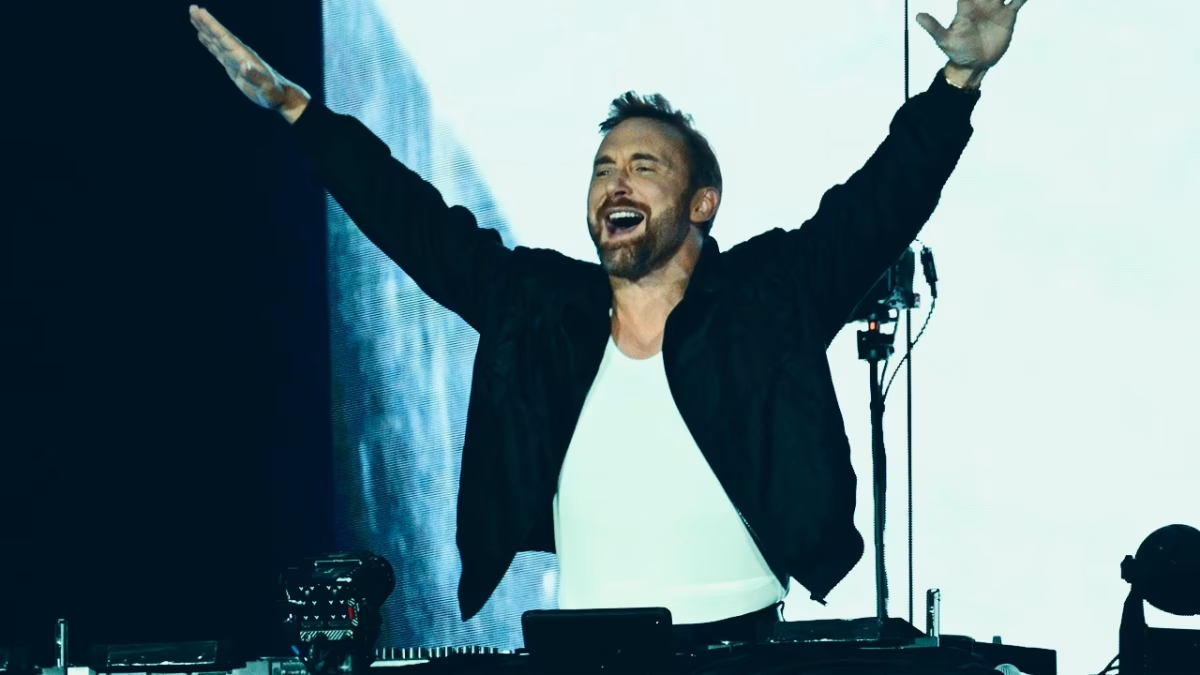
This narrative construction relies heavily on a specific genealogy. It draws a straight, unwavering line from the avant-garde musique concrète of Pierre Schaeffer and the 1928 Ondes Martenot directly to the robot helmets of Daft Punk and the stadium-filling EDM of David Guetta. It is a convenient compression of history that sanitizes the genre’s messy, drug-fueled, and often anti-establishment roots, repackaging them as a coherent export product—a “living aesthetic” characterized by the filtered disco loops and emotional maximalism that conquered the global charts in the late 90s.
The “Club Culture” Label: Subsidies or Gentrification?
Operationalizing this heritage status is the newly minted “Club Culture” label. No longer mere watering holes for the night shift, eligible nightclubs are now designated as “places of artistic expression and celebration”. This bureaucratic stamp is the Holy Grail for venue owners; it unlocks access to funding from the Centre National de la Musique (CNM) and provides crucial legal ammunition against the “noise gentrification” that has silenced so many dancefloors across Europe.
To qualify, clubs must prove they are bastions of “artistic independence” and social responsibility, adhering to strict protocols regarding gender-based violence and substance use. It’s a move that mirrors Berlin’s strategy, where clubs gained protection by being recognized as cultural venues rather than entertainment parlors. However, critics argue this creates a two-tier system: the state-approved “cultural” club that plays by the rules, and the raw, underground sweathouse that remains vulnerable to police raids and closure orders. 2
The Paradox: Heritage Without a Parade
Here lies the scratching sound on the record: while the state was busy printing heritage certificates, the actual streets of Paris were silent. For the second consecutive year, the Techno Parade—the very event that brought electronic music out of the shadows and drew 400,000 people to the asphalt—was cancelled in September 2025 due to a “lack of budget” and the withdrawal of private partners. 3
Jack Lang, the former Culture Minister who helped launch the parade in 1998, termed the cancellation a “humiliation for Paris,” exposing the gaping disconnect between symbolic gestures and material reality. As one commentator astutely noted, “Heritage starts to sound like a premium sticker slapped onto a club door that’s closing”. The government is eager to claim the cultural capital of the “French Touch” for its soft power diplomacy, yet the logistical infrastructure required to sustain its most visible public ritual has been allowed to collapse. 4

From “High Risk” to National Treasure
For those who remember the 1990s, the government’s embrace is dizzying. This is the same state that once issued the infamous “Mariani Amendment” in 2001, effectively criminalizing the free party movement and authorizing the seizure of sound systems. For decades, techno was treated as a public order threat, a sonic pollutant to be contained by riot police. 5
Now, with the blessing of Jean-Michel Jarre—the genre’s indefatigable UNESCO ambassador—electronic music has been scrubbed clean and placed in the museum case. The recognition is undeniably a victory for the pioneers who fought for legitimacy, organizations like Technopol who lobbied for decades to turn the “noise” into “music” in the eyes of the law. But as the “French Touch” prepares for its final ascent to the UNESCO Representative List of the Intangible Cultural Heritage of Humanity, one has to wonder: once a counter-culture becomes a national monument, is it still allowed to move?
The challenge for 2026 will be to ensure that this “intangible heritage” remains loud, messy, and alive, rather than becoming a quiet exhibit in the gallery of French exceptionalism.
- https://www.skiddle.com/news/all/Electronic-music-added-to-Frances-Intangible-Cultural-Heritage-list/61076/ ↩︎
- https://www.culture.gouv.fr/aides-demarches/protections-labels-et-appellations/la-reconnaissance-club-culture-lieu-d-expression-artistique-et-de-fete ↩︎
- https://www.sortiraparis.com/en/what-to-see-in-paris/concerts-music-festival/articles/30970-techno-parade-in-paris-the-electro-parade-will-be-cancelled-in-2024 ↩︎
- https://ra.co/news/83216 ↩︎
- https://www.publicsenat.fr/actualites/non-classe/free-party-les-senateurs-lr-veulent-renforcer-les-sanctions-jusqu-a-3-mois-de ↩︎
What We Covered

- [2026.07.02] ./Why the fight against AI music is just history repeating itself on a bigger scale
- [2026.06.30] ./Six-Time Grammy Nominee Fatboy Slim Shares Turning Point in Sobriety
- [2026.06.21] ./The Atlantic AI Watchdog tool unmasks widespread music copyright theft
- [2026.06.15] ./How Gotye Used His Pop Fortune to Restore Electronic Music History
- [2026.06.09] ./Midnight Rebels and &Friends Announce Signal Breach Winners