

The world’s two largest music companies, Universal Music Group (UMG) and Sony Music, have announced a partnership with a research lab called SoundPatrol. Their plan is to use a new technology called “neural fingerprinting” to detect copyright infringement in AI-generated music. This move is a major development in the ongoing battle between the music industry and generative AI platforms.
This alliance comes at a time when major record labels are already in a legal fight with AI music startups like Suno and Udio. The labels accuse these companies of training their AI models on vast catalogs of copyrighted songs without permission or payment.
How Neural Fingerprinting Works
To understand why this new technology is a big deal, it helps to compare it to older methods. Traditional audio fingerprinting, used by apps like Shazam, works by matching exact audio snippets. It creates a digital signature of a song and looks for an identical match in a database. This is great for identifying a song playing in a cafe, but it can’t detect derivative works like covers, remixes, or AI-generated music that is merely “inspired by” an original track. 1
Neural fingerprinting is different. Instead of matching exact sounds, it analyzes the deeper musical ideas within a song, such as melody, harmony, rhythm, and style. It converts these musical elements into a numerical representation, allowing it to identify “semantic relationships” between tracks. This means it can flag a new AI song that borrows heavily from an existing artist’s style, even if no direct sampling occurred. 2
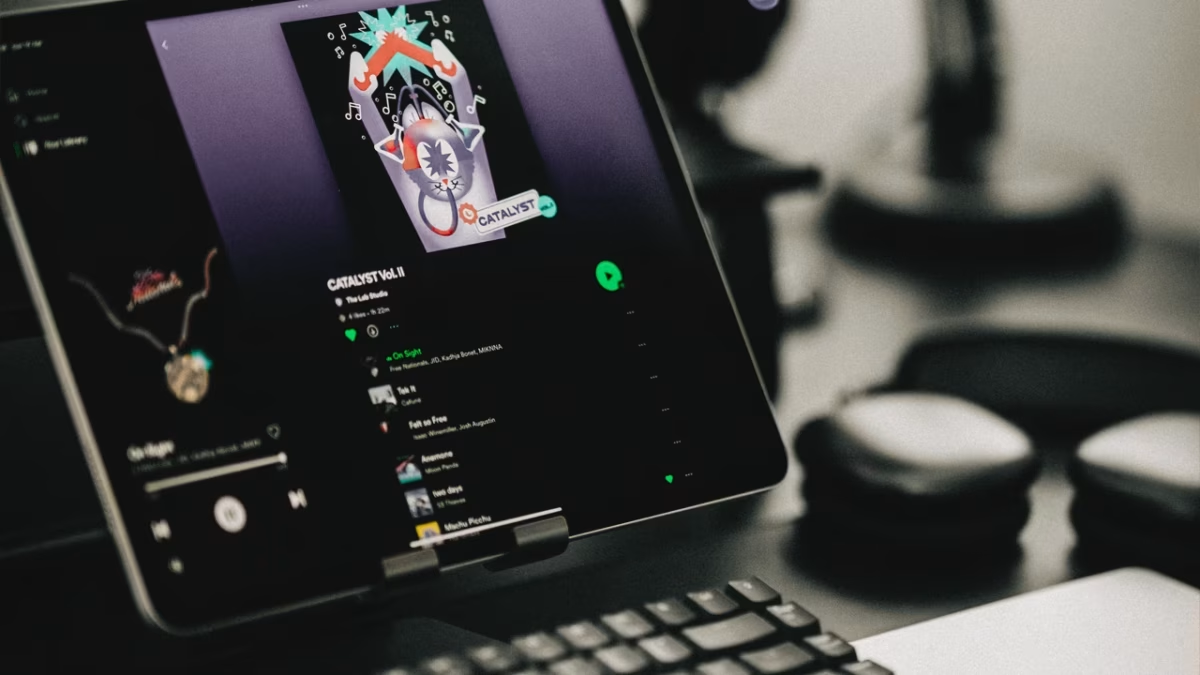
Spotify Deletes 75 Million Spam Tracks in Massive AI Music Crackdown
The Industry’s Strategy: Control, Not Elimination
The partnership with SoundPatrol is part of a larger strategy. The music industry is currently suing AI companies that they allege have used copyrighted music for training without a license. A common defense from AI companies is that training their models constitutes “fair use,” a legal doctrine that permits limited use of copyrighted material. 3
SoundPatrol’s technology is designed to give the labels a powerful new tool. It can provide algorithmic data to back up their claims of infringement in court, making their legal arguments much stronger. 4
It’s clear the major labels are not trying to eliminate AI music entirely. As one online commenter noted, “they just wanna make sure they can have complete control of it”. By suing unlicensed AI companies while partnering with “ethical” AI startups, the industry is pushing for a future where AI music is built on a licensing model, with the major labels acting as the essential gatekeepers to the most valuable training data.
What Do People Think? Community Reactions
The news has sparked a wide range of reactions from artists, creators, and listeners.
- Independent Artists: Many musicians are worried that a flood of AI-generated content will devalue their work and threaten their livelihoods. Some have even joined class-action lawsuits against AI companies, arguing their work was used without consent.
- AI Music Creators: In online communities like Reddit, the opinions are more divided. Some creators who use AI tools welcome the idea of fingerprinting, hoping it will stop users who are just “masquerading & mimicking established acts”. However, many others are suspicious of the major labels’ motives, fearing it’s a move by “billionaires and large corporations to control the artists output” that could stifle their own creativity.
- The Public: Casual listeners often don’t care whether a song was made by a human or an AI, as long as they enjoy it. At the same time, many people value the human connection to art and support calls for clear labeling of AI-generated content. 5


Impact on Streaming and Potential Risks
Streaming platforms are already struggling with a massive influx of low-quality AI music, often called “AI slop”. In the past year, Spotify had to remove over 75 million spam tracks from its service. This kind of content degrades the user experience and can dilute the royalty pool, meaning less money for human artists.
Detection technology like SoundPatrol’s offers a way for platforms to filter out this content. Spotify has already announced new policies to fight AI misuse, including a new spam filter and support for industry-standard AI disclosures in song credits.
However, this new technology is not without risks. A major concern is the potential for errors. AI detection systems are known to produce “false positives,” which means they could incorrectly flag a human artist’s original work as AI-generated. For an independent musician, being wrongly flagged could lead to their music being taken down or demonetized, with little recourse against an automated system. This creates a “guilty until proven innocent” scenario that could discourage creative experimentation. Despite these concerns, the legal pressure to police copyright infringement will likely make such detection systems a standard feature across all major music platforms.
- https://arxiv.org/pdf/2402.13957 ↩︎
- https://aijourn.com/soundpatrol-collaborates-with-universal-music-group-and-sony-music-to-deploy-groundbreaking-neural-fingerprinting-technologies-for-detecting-copyright-infringement-in-music-including-ai-generated-wor/ ↩︎
- https://www.crowell.com/en/insights/client-alerts/major-american-music-labels-sue-generative-ai-music-platforms-in-first-case-of-its-kind-over-ai-audio ↩︎
- https://www.musicbusinessworldwide.com/universal-and-sony-music-partner-with-new-platform-to-detect-ai-music-copyright-theft-using-groundbreaking-neural-fingerprinting-technology/ ↩︎
- https://www.reddit.com/r/SunoAI/comments/1huwtcl/what_do_you_think_of_his_opinion_about_ai_music/ ↩︎
* generate randomized username
- COMMENT_FIRST
- #1 Lord_Nikon [12]
- #2 Void_Reaper [10]
- #3 Cereal_Killer [10]
- #4 Dark_Pulse [9]
- #5 Void_Strike [8]
- #6 Phantom_Phreak [7]
- #7 Data_Drifter [7]
- #8 Zero_Cool [7]


