
Imagine a massive music festival. The bass is powerful enough to feel in your chest. A world-famous DJ is playing a beat that has thousands of people moving together. This is a multi-million dollar event full of light and sound. The core of that powerful beat was not created in a modern studio. It was born in a Japanese electronics factory in the 1980s.
The history of electronic dance music (EDM) often focuses on artists from Chicago, Detroit, and New York. But that story is missing a quiet hero: Japan. Before EDM became a global business, Japanese companies like Roland, Yamaha, and Korg were building the tools that started a musical revolution. They were not trying to make the soundtrack for the future of nightlife. They were just building machines. In doing so, they quietly created the foundation for the entire modern dance music scene.
The Sound of the Future Was a Commercial Failure
In the late 1970s and early 1980s, Japanese electronics were growing fast. This growth was driven by a focus on precision engineering and constant improvement. Companies like Roland wanted to create drum machines and synthesizers. Their goal was to make reliable and affordable instruments for musicians.
Their most famous creations were commercial failures. The reason was simple. They did not sound “real.” Musicians at the time wanted a drum machine that sounded like a real drummer. These Japanese machines sounded different. They sounded robotic, futuristic, and strange. That is exactly why they became legendary. 1
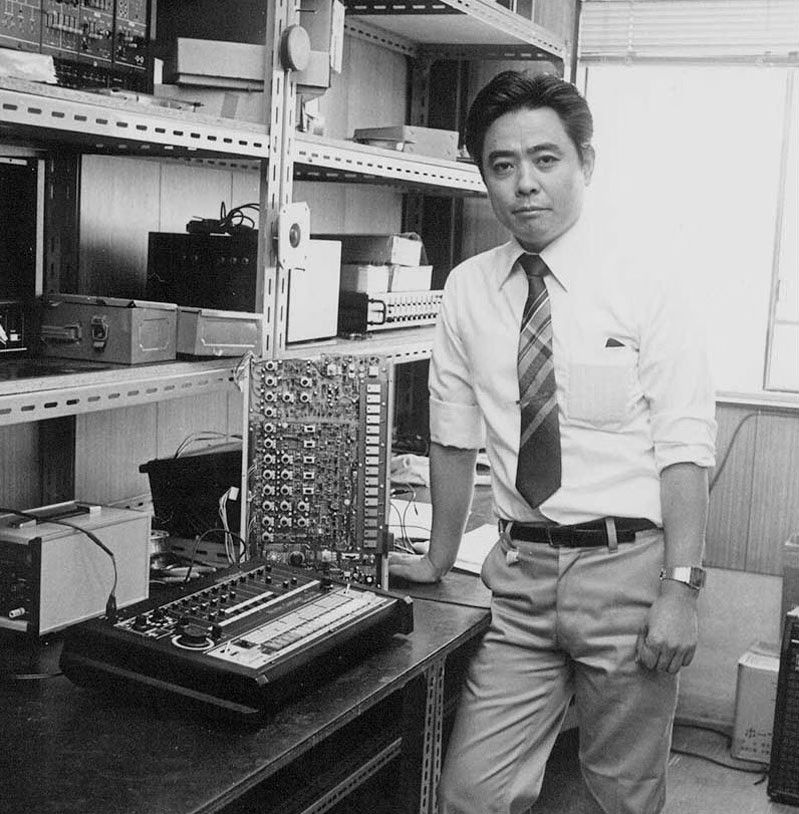
Three “Failures” That Changed Music
The sound of EDM can be traced to three iconic pieces of Japanese gear that did not sell well at first.
1. The Roland TR-808: The Beat of Hip-Hop and Electro
Roland released the TR-808 in 1980. It was a programmable drum machine that let users create their own beats. But its synthesized sounds were not popular. Critics called its drums “robotic”. Roland stopped making it after selling only about 12,000 units.

Then something interesting happened. The discontinued 808s showed up in pawn shops and became very cheap. This allowed a new generation of underground artists in the U.S. to buy them. These artists could not afford the expensive, “realistic” drum machines. In 1982, 2 Afrika Bambaataa & The Soulsonic Force used an 808 to create the beat for “Planet Rock.” A new genre, electro, was born. The 808’s deep, booming bass drum became the signature sound of hip-hop, used by artists from Run-D.M.C. to Kanye West.

2. The Roland TR-909: The Pulse of House and Techno
Roland tried again in 1983 with the TR-909. It was more advanced and used small digital samples for its cymbals. But it still did not sound “real” enough for the mainstream market. Like the 808, it was discontinued after selling just 10,000 units. 3
Again, this failure led to creative success. The cheap, used 909s were bought by producers in Chicago and Detroit. Its punchy kick drum and sharp hi-hats became the steady four-on-the-floor beat of house music and the driving pulse of techno. Tracks like Derrick May’s “Strings of Life” and Mr. Fingers’ “Can You Feel It” are powered by the 909’s sound. That sound still defines dance music today.

3. The Roland TB-303: The Accidental Sound of Acid
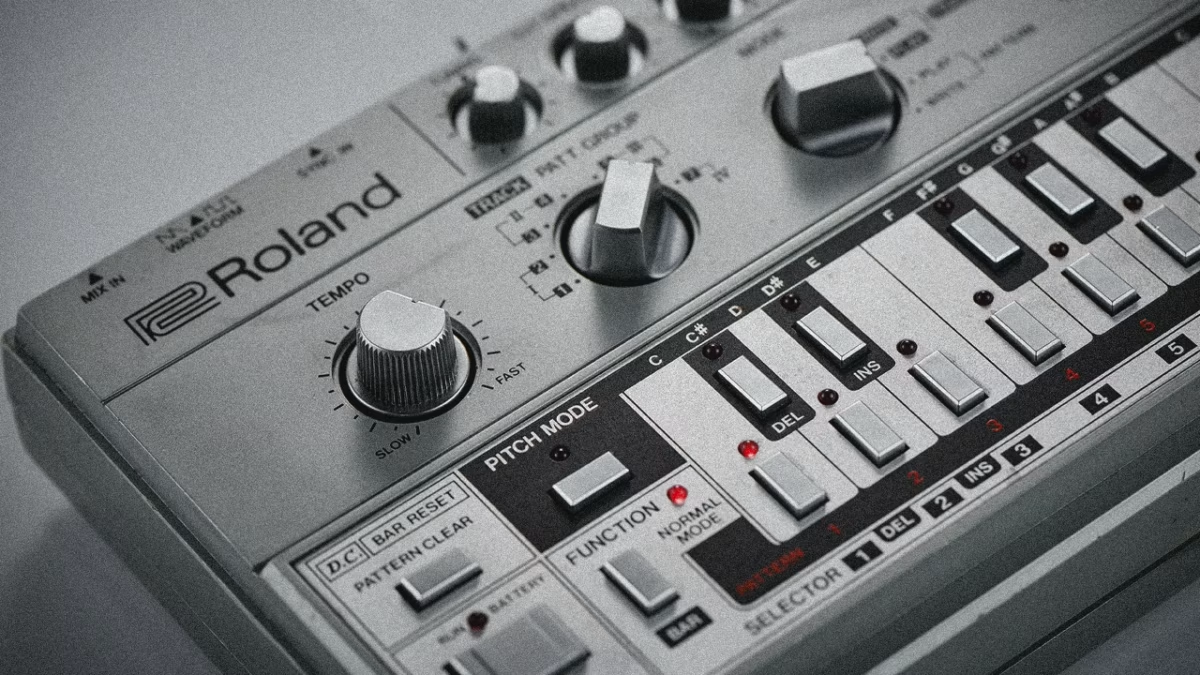
The story of the TB-303 is the most unlikely of all. This small silver box was designed in 1982 as a practice tool. It was meant to replace a bass guitarist. It was a complete failure. It sounded nothing like a bass guitar. It produced a strange, “squelching” noise and was very hard to program. 4
The TB-303 was quickly forgotten and sold in bargain bins. A Chicago group called Phuture found one for a very low price. They did not know how to program it, so they just started twisting the knobs while a sequence played. The wild, liquid sound that resulted was completely new. They used it on a track called “Acid Tracks.” An entire genre, acid house, was born by accident. 5
From a Quiet Factory to a Global Scene
The key factor in this story is affordability. American and European companies built very expensive gear for famous musicians. 6 Japanese manufacturers unintentionally made music production accessible to everyone. Their “failed” products became so affordable that they allowed young artists in cities to create new genres of music.
Today, those “unrealistic” and “robotic” sounds are the standard. The “808 kick” is used in everything from trap to pop music. The pulse of the 909 is the default for most house and techno. Every modern music software includes digital versions of these classic machines. 7
So, the next time you hear that beat at a festival, remember the quiet engineers in Japan. They may not have planned to start a global party. But by designing a few successful failures, they gave electronic music its voice. Japan’s role in EDM history is not just a small detail. It is the beat itself.
Frequently Asked Questions
Which Japanese instruments were most important for electronic dance music?
Three of the most important instruments were made by Roland in the 1980s. The TR-808 drum machine became the heartbeat of hip-hop and electro. The TR-909 drum machine provided the driving four-on-the-floor pulse for house and techno music. Finally, the TB-303 bass synthesizer accidentally created the unique “squelching” sound that defined the acid house genre.
Why did these Japanese instruments become so popular if they were commercial failures?
These instruments were initially commercial failures because their sounds were not considered “realistic” enough for the mainstream market of the early 1980s. Because they did not sell well, they were discontinued and ended up in second-hand pawn shops at very low prices. This affordability made them accessible to a new generation of underground artists in cities like Chicago and Detroit, who could not afford the expensive American-made equipment. These artists embraced the unique, futuristic sounds to create entirely new genres of music.
Why is Japan’s role in EDM history often overlooked?
Japan’s role is often overlooked because historical accounts tend to focus on the Western artists who used the instruments, rather than the Japanese engineers who created them. The narrative celebrates the creative genius of producers in Chicago, Detroit, and New York, often treating the Japanese machines as simple tools they discovered. This perspective downplays how the unique and often unconventional designs of the TR-808, TR-909, and TB-303 actively shaped the sound and direction of the music itself.
- https://imusician.pro/en/resources/guides/history-evolution-electronic-music ↩︎
- https://hip-hop-history.com/a-journey-through-the-history-of-the-roland-tr-808/ ↩︎
- https://www.urbanrebelpr.com/resources/roland-tr-909-dance-music-history/ ↩︎
- https://bassgorilla.com/acid-house/ ↩︎
- https://reverb.com/news/the-earliest-synths-to-come-out-of-japan ↩︎
- https://www.reddit.com/r/synthesizers/comments/1579y66/synth_price_lists_that_buyers_would_have_chosen/ ↩︎
- https://www.funktasy.com/music-business/japans-influence/ ↩︎
* generate randomized username
- COMMENT_FIRST
- #1 Lord_Nikon [12]
- #2 Void_Reaper [10]
- #3 Cereal_Killer [10]
- #4 Dark_Pulse [9]
- #5 Void_Strike [8]
- #6 Phantom_Phreak [7]
- #7 Data_Drifter [7]
- #8 Zero_Cool [7]


Don’t forget AKAI. That company was founded in around 1930, released the S1000 sampler in the mid eighties and the company have gone from strength to strength – albeit under new owners – ever since.