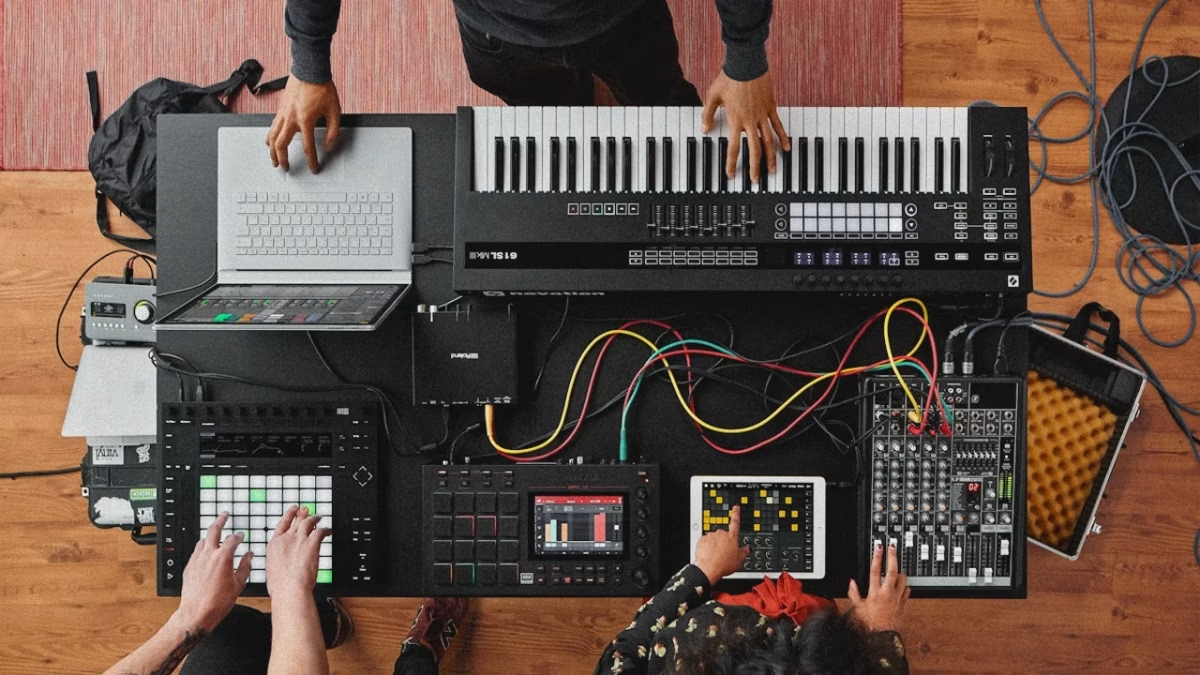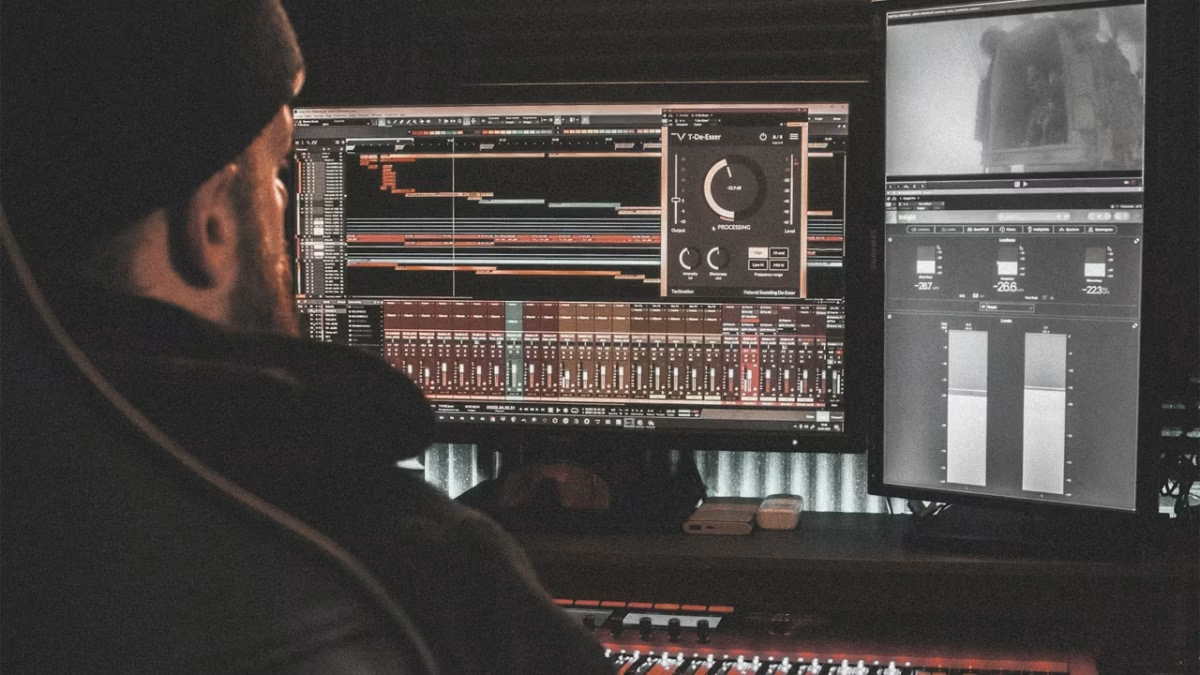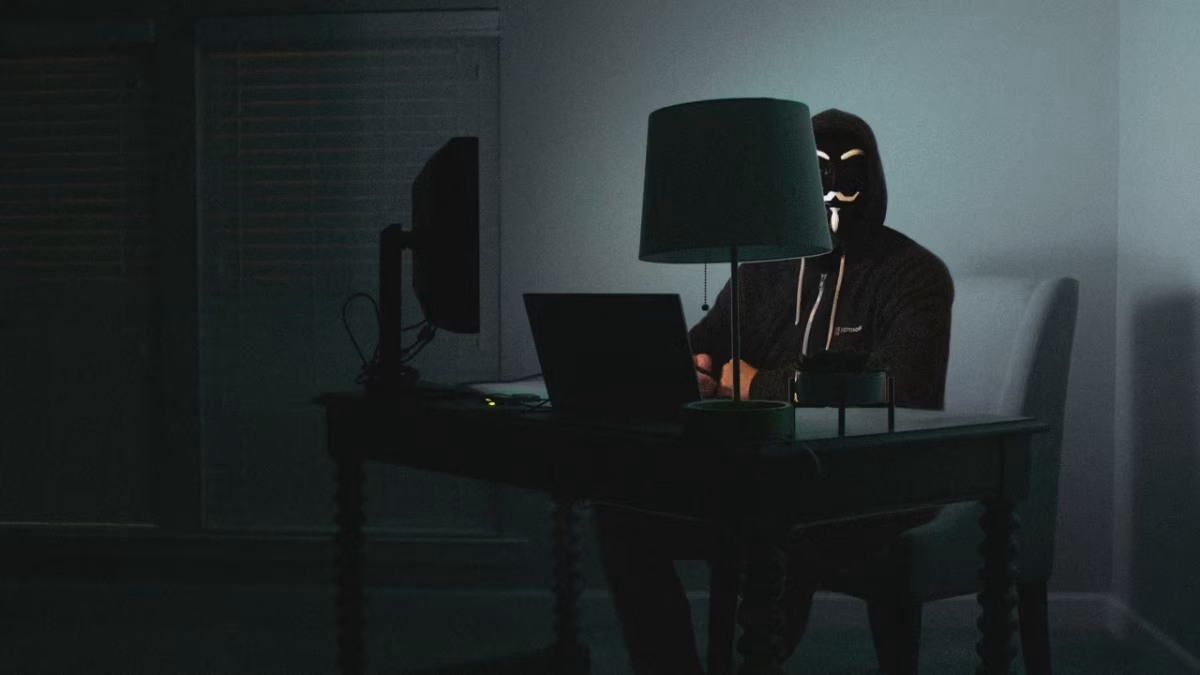

Welcome to 2025, where your favorite new underground artist might be a server farm, and that “deep house” playlist you’re vibing to was generated by a guy named Ryan in his lunch break. Here’s how the AI music grift is turning the industry into a digital hall of mirrors.
It used to be that if you wanted to be a fake DJ, you at least had to learn how to stand behind a Pioneer deck and twist a knob that wasn’t connected to anything. It was a noble grift. It required presence. It required a black V-neck t-shirt and the ability to jump on beat.
But in 2025, the bar for being a musical fraud has been lowered so far it’s currently sitting in the Mariana Trench.
We are living through the golden age of the “Fake Artist”—a phenomenon where hustlers, tech-bros, and scammers are using AI platforms like Suno and Udio to generate radio-ready tracks in seconds, slapping a Midjourney-generated face on the album art, and uploading it to Spotify. They aren’t just faking the performance; they’re faking the creation. And the worst part? You’re probably listening to them right now.

Suno Faces a Staggering Demand: $150,000 for Every Single Song in Copyright Lawsuit
The “Prompt-to-Playlist” Pipeline
If you haven’t messed around with Suno or Udio yet, imagine ChatGPT but for bangers. You type in “sad boy lo-fi hip hop for studying 85 bpm,” and within thirty seconds, the AI spits out a track that is terrifyingly competent. It’s fully mixed, mastered, and arranged. 1
For actual musicians, this is an existential nightmare. For the “passive income” gurus on YouTube, it’s a gold rush.
Here’s the playbook:
- Generate: Spend an afternoon prompting an AI to spit out 50 tracks of generic “Chill House” or “Phonk.”
- Package: Use another AI to generate a cool, mysterious artist persona. Let’s call him “Neon Void.” Give him a backstory about growing up in Berlin.
- Distribute: Upload the slop to DistroKid or CD Baby.
- Profit: Sit back and wait for the algorithmic playlists to pick it up, or—if you’re feeling spicy—buy a bot farm to stream it for you.
We saw this play out hilariously (and depressingly) with The Velvet Sundown, a “band” that racked up half a million monthly listeners on Spotify before anyone realized they didn’t exist. Deezer’s tech eventually flagged 100% of their tracks as AI-generated. It was the musical equivalent of three raccoons in a trench coat trying to buy beer, and for a while, it worked.
The $10 Million Ghost in the Machine
You might think, “Who cares? It’s just background noise.” But there is real money being stolen here.
Take the case of Michael Smith, a guy who allegedly used AI to generate hundreds of thousands of songs and then used bot farms to stream them billions of times. The feds say he walked away with $10 million in royalties. 2
This isn’t a victimless crime. Spotify and Apple Music pay out from a shared pool of money. Every time a bot streams an AI track generated by “Neon Void,” that’s a fraction of a cent taken out of the pocket of a real kid in a garage trying to pay off their synthesizer.
Deezer reports that roughly 180,000 AI-generated songs are uploaded every single week. That is a tsunami of content designed to drown out human creativity. It’s “stream-ripping” on an industrial scale, clogging the pipes of the music industry with digital sewage. 3
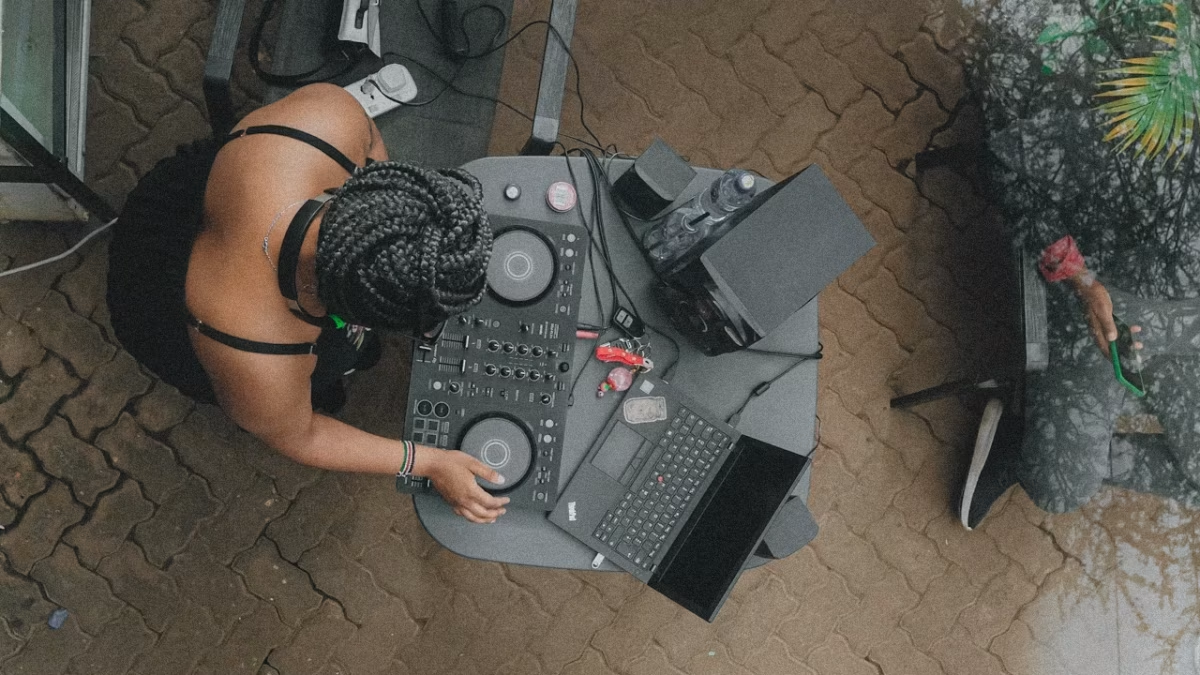
The “DJ Set” Deception
The grift gets even weirder when it moves from Spotify to the DJ booth.
For decades, the electronic music scene has whispered about “ghost producers”—famous DJs who pay nerds in studios to write their hits. It was the scene’s dirty little secret. But AI has birthed the “Ghostless Producer.”
We are seeing a rise in ‘DJs’ who have swapped crate-digging for software automation. They aren’t scouring Beatport for hidden gems; they’re prompting an AI to spit out twenty distinct ‘Peak Time Techno’ tracks, dumping the files into DJ.Studio, and letting its automix algorithm beat-match and transition the whole thing perfectly. It’s a seamless, hour-long performance where the only human effort involved was exporting the MP3. 4
The community is reacting exactly how you’d expect: with pure, unadulterated rage.
On r/SunoAI and r/EDMProduction, the vibe is apocalyptic. One producer summed it up perfectly: “We pour our heart and soul into our craft… When someone else uses AI-generated music, claims it as their own, and achieves massive hits, it’s disheartening”. 5
It’s the ultimate appropriation. You don’t need to know music theory. You don’t need to know how to mix. You just need a credit card and a lack of shame.
The “Soul” Problem
The defenders of this tech will tell you it’s just a tool, like the synthesizer or the drum machine was in the 80s. They’ll say, “Democratizing music creation is good!” 6
But there’s a massive difference between using a drum machine to program a beat you wrote, and asking an algorithm to “make me a song that sounds like The Weeknd” and then claiming you wrote it.
There is a distinct “uncanny valley” feeling to a lot of this music. It’s technically perfect but emotionally hollow. It hits the right frequencies, but it doesn’t feel like anything. It’s music for elevators in the Metaverse.
A survey found that 80% of listeners want AI tracks clearly labeled. We want to know if we’re crying to a song written by a heartbroken human or a server farm in Virginia.


The Cat-and-Mouse Game
Platforms are trying to fight back, but it’s like playing Whac-A-Mole with a hydra.
Spotify and Deezer are rolling out detection tech. Deezer claims they can spot AI tracks and are even pulling them from royalty-generating playlists. Beatport is tightening its guidelines.
But the AI is getting better. Early models had weird artifacts—glitchy vocals, metallic snares. Now? In blind tests, 97% of listeners can’t tell the difference. 7
We’re heading toward a future where “Human Made” becomes a premium label, like “Organic” or “Non-GMO.” You’ll pay extra for a Spotify tier that guarantees the artist actually has a pulse.
Here’s one channel from YouTube, though the person behind it actually included a disclaimer: ‘All songs, lyrics, compositions, visuals, and recordings created using artificial intelligence and published by AI DJ are the intellectual property of AI DJ.'”
The Future of the Grift
So, where does this leave us?
The music industry is splitting in two. On one side, you have the Content Sludge: infinite, AI-generated background music designed for productivity playlists and gym sessions. This will be owned by tech giants and “fake artists,” and it will be worth billions.
On the other side, you have The Real. Live shows. Vinyl. Sweat. Mistakes.
The irony is that by flooding the market with perfect, soulless fake music, AI might actually make real human connection more valuable. If a DJ set can be generated in 5 minutes, the only thing that matters is the person standing in front of you. Can they read the crowd? Can they throw a cake at you (à la Steve Aoki)?
As one underground journalist put it, authenticity in 2025 isn’t found on a playlist; it’s found “in basement shows, in cracked vocals… in bands who can’t afford PR teams”.8
The fake artists are coming, and they are bringing their generated beats with them. But they can’t fake the one thing that actually matters: being there.
So, keep supporting your local weirdo noise musician. They might be bad, but at least they’re real.
- https://doneforyou.com/suno-ai-music-generation-review/ ↩︎
- https://trolley.com/learning-center/ai-is-creating-a-music-streaming-fraud-crisis-can-it-also-solve-it/ ↩︎
- https://www.nbcnews.com/tech/tech-news/the-velvet-sundown-indie-band-spotify-ai-accusations-speculation-rcna216728 ↩︎
- https://dj.studio/blog/create-pro-quality-mixes ↩︎
- https://www.reddit.com/r/MusicPromotion/comments/1pdfpwr/producers_whats_your_take_on_transparency_for/ ↩︎
- https://deepmind.google/blog/new-generative-ai-tools-open-the-doors-of-music-creation/ ↩︎
- https://www.decodedmagazine.com/2025-moved-faster-than-anyone-predicted-thoughts-on-ai-authenticity-and-whats-worth-protecting-in-2026/ ↩︎
- https://echorebel.co.uk/does-authenticity-matter-in-2025-or-is-image-everything/ ↩︎
* generate randomized username
- COMMENT_FIRST
- #1 Lord_Nikon [12]
- #2 Void_Reaper [10]
- #3 Cereal_Killer [10]
- #4 Dark_Pulse [9]
- #5 Void_Strike [8]
- #6 Phantom_Phreak [7]
- #7 Data_Drifter [7]
- #8 Cipher_Blade [6]