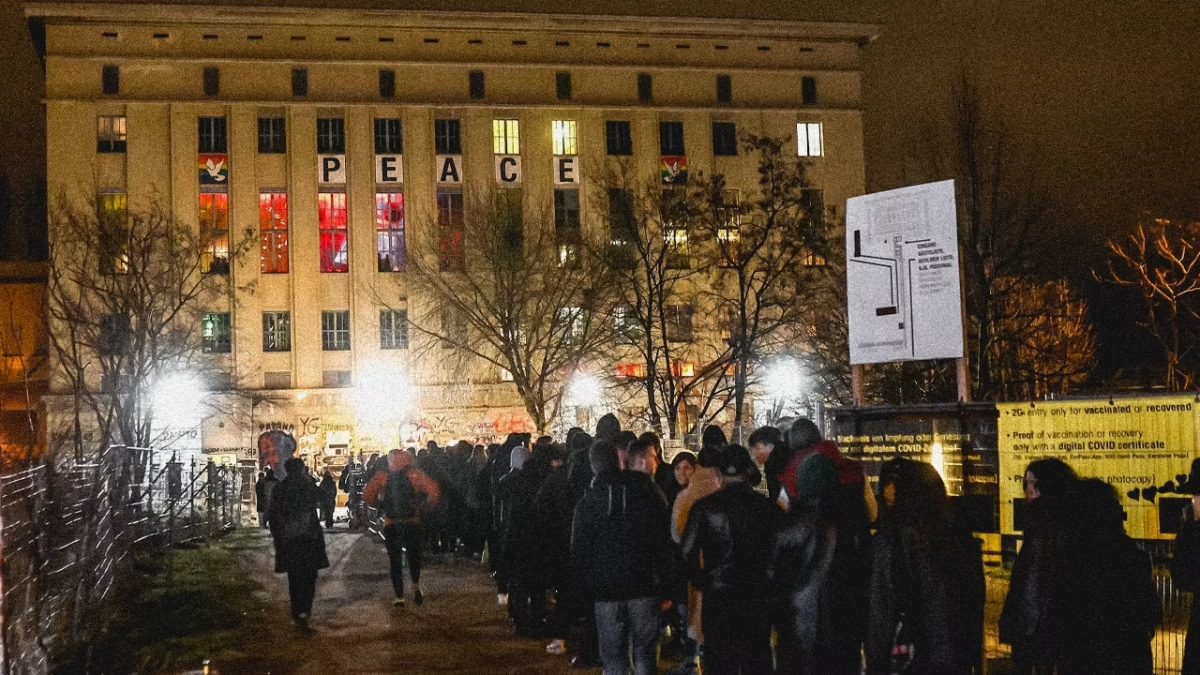
If you were anywhere near the intersection of Flatbush and DeKalb in Brooklyn this past June, you didn’t see a concert queue. You saw a humanitarian crisis of vibes.
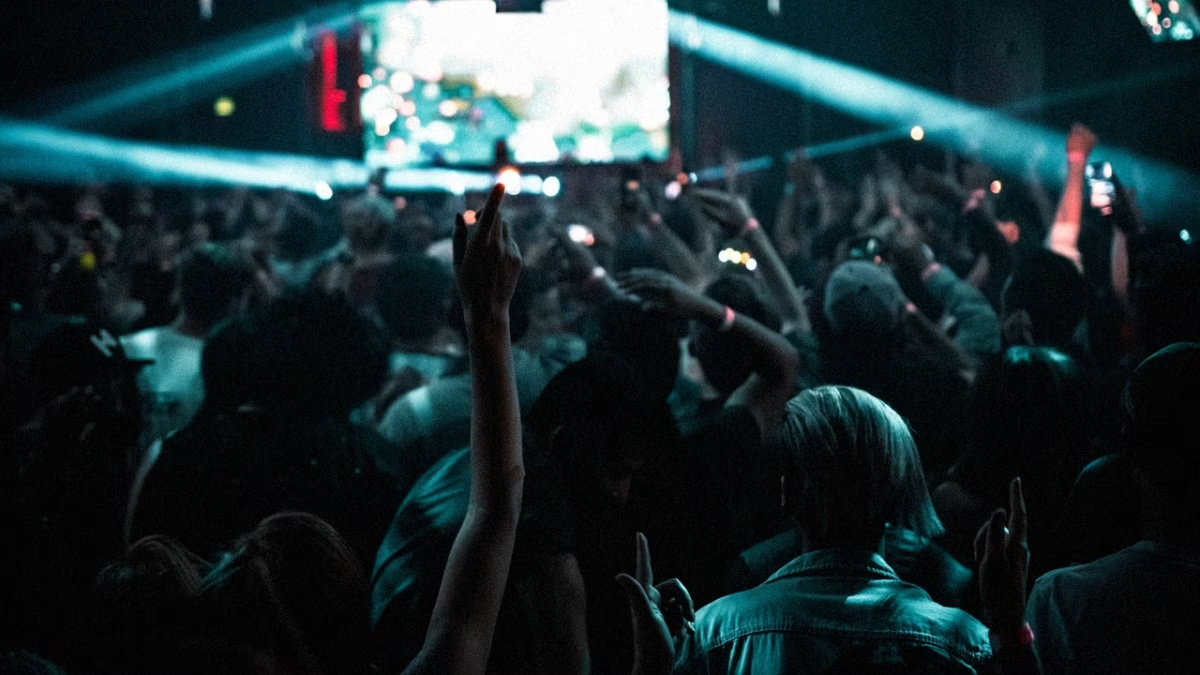
More than 80,000 people were attempting to cram themselves into the Brooklyn Paramount—a venue that legally holds about 2,700—for a “pop-up” show that Fred Again.. had announced barely hours prior. The FDNY eventually threatened a “semi-evacuation” as the streets became a crush of sweaty, desperate bodies. It was dangerous, it was disorganized, and it was arguably the most successful marketing stunt of the year. 1
Welcome to the post-streaming music industry, where the “album rollout” is dead, and the “scavenger hunt” is king.
For the last two years, Fred Again.. (Frederick Gibson) and Skrillex (Sonny Moore) have been dismantling the traditional machinery of music promotion with the precision of a controlled demolition. They have ditched the six-month PR campaigns, the magazine covers, and the polite “link in bio” pre-sales. In their place? A feral brand of guerrilla marketing that relies on digital scarcity, cryptic WhatsApp messages, and the kind of FOMO that makes grown adults sprint through Times Square on a Tuesday afternoon.
It works because the music industry is broken. But it also works because, in 2025, we are all addicted to the panic.

Fred Again.., Yousuke Yukimatsu, Skrillex and ISOXO Break the Mold with B2B Sets
The Architecture of Chaos
To understand why this strategy is rewriting the rules of the nightlife economy, you have to look at the “OMG MSG” run of early 2023. It was the blueprint. Skrillex, Fred Again.., and Four Tet didn’t just book Madison Square Garden; they manifested it out of thin air in five days.
They started in a 400-capacity club (Good Room), moved to a 700-capacity venue (Le Poisson Rouge), threw a rave inside a literal school bus in Times Square, and then sold out MSG in minutes. It was a masterclass in scaling intimacy. By the time they hit the arena, it didn’t feel like a corporate event; it felt like you were crashing a party with 20,000 of your closest friends. 2
But in 2025, they’ve taken this logic to its extreme conclusion.
Take Skrillex’s surprise appearance at Lightning in a Bottle 2024. There was no headline slot on the poster. No press release. Just a rumor rippling through the dusty festival grounds until he materialized at 3:00 A.M. on the “Lightning” stage, turning a chill West Coast festival into a high-octane rave. 3
Or look at his April 1, 2025, album drop. In a move that would give a traditional label exec an aneurysm, Skrillex leaked his own album, Fck U Skrillex You Think Ur Andy Warhol but Ur Not!! <3*, via a Dropbox link and Discord blast before it even hit streaming services. It featured “Voltage,” a track fans had been begging for since 2011. Even his most recent Hit Me Where It Hurts X. The five-song project includes collaborations with Caroline Polachek and 100 gecs’ Dylan Brady (on the recently shared title song), Varg2™, Nakeesha, and others.
The message was clear: The platform is not Spotify. The platform is the internet itself.
The “USB” Dealer: Selling Audio Like It’s Contraband
Fred Again.. has pivoted even harder into what we can call “Dark Social” distribution.
Instead of fighting the algorithm on TikTok, Fred is building a walled garden. His “USB” project—an “infinite, ever-evolving album”—isn’t just a playlist; it’s a loyalty test. He drops tracks like he’s handing out contraband.
If you’re on the “USB” mailing list or in the WhatsApp community, you might get a WeTransfer link to a.wav file at a random hour. No artwork, no fanfare, just a file named USB002_City_10.wav. It mimics the intimacy of a text from a friend saying, “Yo, listen to this.” 4
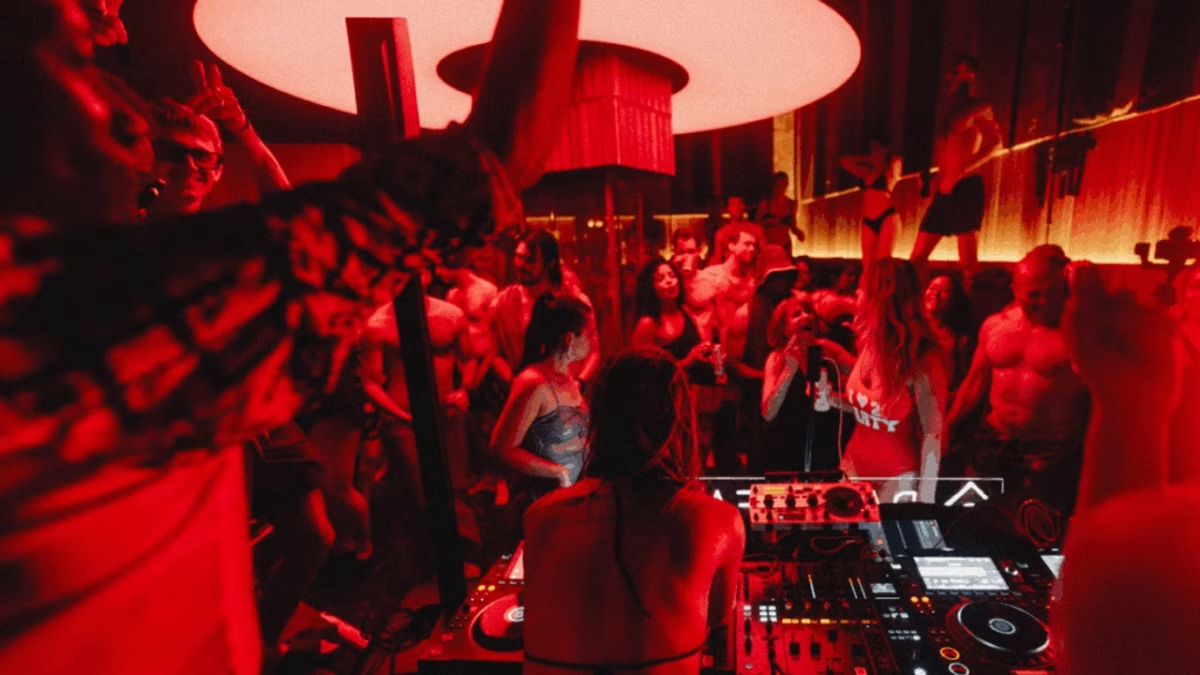
Morning Raves, Sauna Clubs, and the Soft Clubbing Scene You’re Already Missing Out On
In September 2025, Fred announced “USB002” with a cryptic billboard simply reading “10 weeks, 10 cities, 10 songs”. Fans were left to decipher whether this meant ten shows, ten file drops, or ten coordinates on a map.
This creates a “Scarcity Loop.” You can’t just casually listen to Fred Again.. anymore. You have to track him. You have to be “terminally online” just to get a ticket. And if you succeed? You aren’t just a fan; you’re an insider. You beat the system (and the scalper bots).
When The Vibe Shifts (and the Fire Department Shows Up)
However, this “guerrilla” style has a body count. The “Victory Lap” show in Brooklyn this past June exposed the ugly underbelly of the pop-up model.
The premise was classic Fred: announce a show last minute, make it “for the locals,” and let the internet do the rest. But the internet did too much.
Fans spent hours decoding clues from a Twitch stream, “scrambling across Brooklyn” in a real-life Amazing Race, only for the Ticketmaster link to break ten minutes before the drop. By the time the dust settled, scalpers were flipping $60 tickets for $11,000, and thousands of fans were left stranded outside the venue, watching influencers get ushered in the side door.
“It was a case study in mismanagement,” one fan wrote. “Letting influencers in and not even your own fans”.
This is the tension at the heart of the model. You can’t be both “underground” and massive. You can’t simulate the grit of a warehouse rave when you have the demand of a Taylor Swift stadium tour. When you try, you don’t get a cool party; you get a public safety hazard.


Why We Love The Abuse
So why does it work? Why do we let them treat us like this?
Because in the digital era, music has no value. You can stream every song ever recorded for $10 a month. It’s too accessible. It’s boring.
What Fred and Skrillex are selling isn’t music; it’s presence. It’s the “I was there” badge. In the “Experience Economy,” the harder it is to get into the event, the more social capital you gain by being there.
When Skrillex plays a surprise set at 3 A.M., he is offering a remedy to the sanitized, pre-packaged festival experience. He is offering danger. He is offering the possibility that anything could happen.
The nightlife industry is desperate for this energy. Venues like the Knockdown Center or the Good Room survive on these injections of hype. A pop-up show generates weeks of buzz and tourism dollars that a standard calendar listing never could. 5
But let’s be real: We are just NPCs in their game. We are refreshing the page, decoding the emojis, and running through the streets because we are terrified of missing the moment.
And honestly? We’ll probably do it again next week.
- https://weraveyou.com/2025/06/fans-criticize-fred-again-over-chaotic-nyc-pop-up-show-rollout/ ↩︎
- https://sociallysounddj.com/feed/skrillex-album-launch ↩︎
- https://edm.com/events/lightning-in-a-bottle-festival-recap-2024/ ↩︎
- https://www.reddit.com/r/fredagain/comments/1o7bc7u/fred_again_usb_tour_stopped_receiving/ ↩︎
- https://www.researchgate.net/publication/384427794_The_Economic_Impact_of_Music_Festivals_Cultural_Events_and_Local_Commerce ↩︎
* generate randomized username
- COMMENT_FIRST
- #1 Lord_Nikon [12]
- #2 Void_Reaper [10]
- #3 Cereal_Killer [10]
- #4 Dark_Pulse [9]
- #5 Void_Strike [8]
- #6 Phantom_Phreak [7]
- #7 Data_Drifter [7]
- #8 Zero_Cool [7]