

I live a double life. By day, I’m an occupational therapist, helping patients relearn how to navigate a world that often feels broken. By night, I’m a DJ and producer, engineering the very beats that help people escape it. For years, I thought these two sides of my life were contradictory. In the clinic, we focus on regulation, sensory processing, and meaningful activity. In the club, it’s usually about sticky floors, dilated pupils, and a collective chase for a dopamine hit that evaporates by Tuesday.
We’ve always looked at the DJ as the High Priest of Hedonism – a figure designed to help us forget the world, not fix it. But if you look past the pyro and the cake-throwing, something weird is happening to the rave scene. It’s growing a conscience.
The same guys who used to brag about private jets and six-figure bar tabs are now quietly funding brain research labs, building schools in Guatemala, and – in a move that hits incredibly close to home for me – playing samba drums with psychiatric patients in Sussex. We are witnessing the rise of EDM philanthropy – a shift where the massive commercial machinery of dance music is being weaponized for humanitarian aid.
Here are 8 artists who are proving that you can save the world and still drop the bass.

1. Fatboy Slim: The Norman Cook Redemption
The Cause: Mental Health & Suicide Prevention The Vibe: Occupational Therapy with a 4/4 kick.
If you were alive in the 90s, Norman Cook (aka Fatboy Slim) was the guy convincing you to party on Brighton Beach until you collapsed. He was the poster child for “Eat, Sleep, Rave, Repeat.” But talk to him now, and the conversation isn’t about the afterparty; it’s about mental health awareness.
Cook has teamed up with “Heads On,” the charity arm of the Sussex Partnership NHS Foundation Trust, to do something that sounds like a fever dream but is actually clinical genius: he’s running drumming workshops for patients with severe mental illness. We’re not talking about a celebrity photo-op where he shakes a few hands and leaves. He’s in the room, sitting in a circle, banging on a samba drum with people who are often at the lowest points of their lives.

Inside Fatboy Slim’s Funded DJ Workshops: A New Approach to Severe Mental Illness
The project is called “The Beat Goes On,” and it’s based on the idea that when you’re fighting psychosis or severe depression, talking is hard, but rhythm is primal. It bypasses the intellect and hits the nervous system directly. Cook, who has been open about his own battles with addiction and rehab, isn’t there as a superstar; he’s there as a peer. As one participant put it, “You can just vanish into nothingness in creativity, but you need to just hang on somehow… it makes you feel like you’re part of something”. 1
By trading the turntable for a tambourine, Cook is doing the heavy lifting to destigmatize mental health in a scene that often causes the very burnout he’s trying to treat.

2. Avicii: The Legacy We Wish We Didn’t Need
The Cause: Suicide Prevention & Global Health Policy The Vibe: A tragic wake-up call turned into a global movement.
It’s impossible to talk about mental health in music without talking about Tim Bergling. When Avicii died by suicide in 2018, it shattered the illusion that the “Superstar DJ” life was sustainable. But from that wreckage, his parents, Klas Bergling and Anki Lidén, built the Tim Bergling Foundation.
This isn’t your standard “raise awareness” charity. The Foundation is aggressive. They are lobbying to have suicide classified as a global health emergency. They are showing up at industry summits in Ibiza and telling promoters, “You are killing these kids.” 2
The release of his posthumous album, Tim, wasn’t just a cash grab; the proceeds went to organizations preventing suicide and addressing mental health issues. The Foundation has since expanded into climate change and wildlife conservation, proving that Tim’s vision was always bigger than the booth. It’s the most heartbreaking success story in music: a legacy that is saving lives because we couldn’t save his. 3
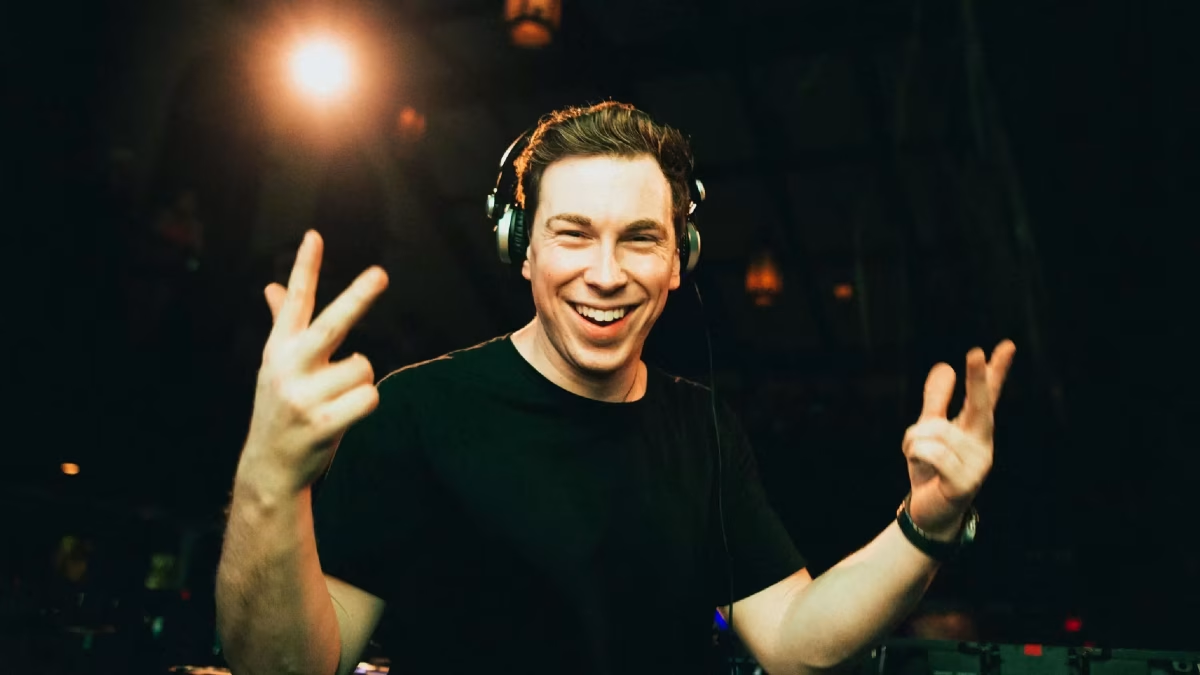
3. Hardwell: The Guestlist God
The Cause: Education for Underprivileged Children The Vibe: Weaponizing the velvet rope for social good.
In club culture, the “guestlist” is usually a tool for exclusion – it’s for the models, the influencers, the people who know a guy. Hardwell (Robbert van de Corput) looked at that dynamic and flipped it on its head.
At the peak of his fame as the World’s #1 DJ, he launched the United We Are Foundation with a simple but massive stunt: The “World’s Biggest Guestlist” in Mumbai. He waived his appearance fee (which is astronomical, by the way) and opened the gates to nearly 75,000 fans for free. The catch? The event was a massive fundraiser for the Magic Bus program, which guides children from childhood all the way to adulthood. 4
The result? He didn’t just raise money; he secured enough funding to educate over 100,000 children. He literally took the “guestlist” – a symbol of vanity – and turned it into a vehicle for mass literacy.
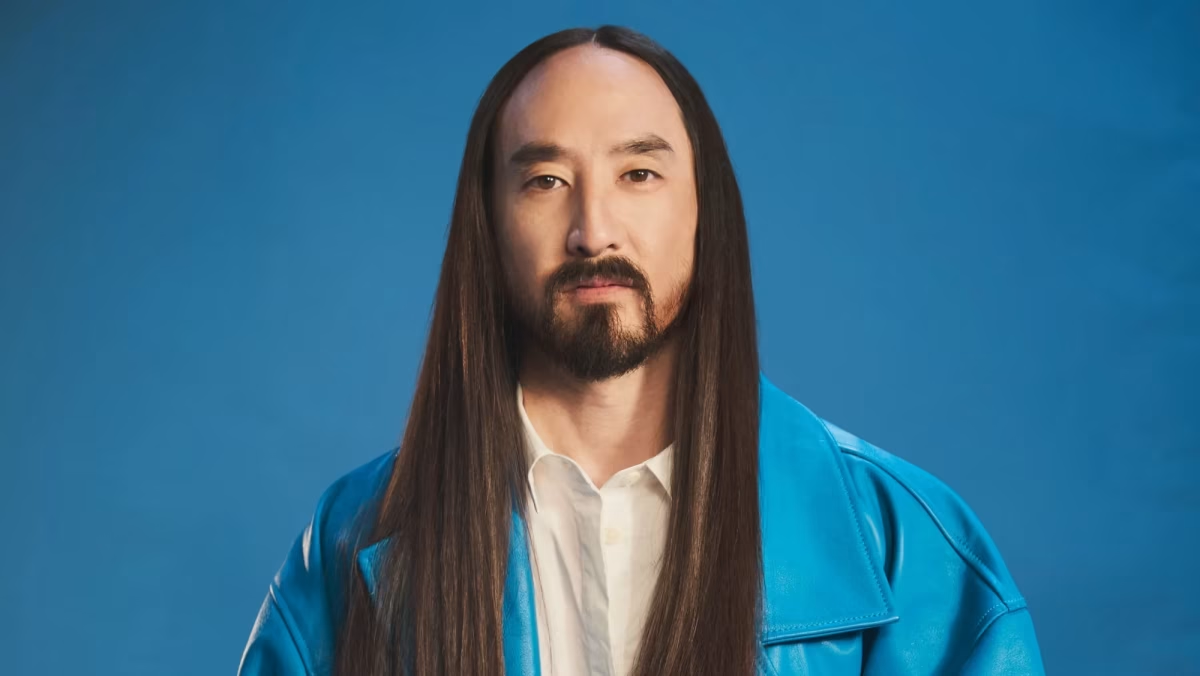
4. Steve Aoki: The Futurist Fighting Mortality
The Cause: Brain Science & Regenerative Medicine The Vibe: Sci-fi philanthropy.
Steve Aoki is easy to meme. He throws cakes. He rafts over crowds. He plays 300 shows a year. But while you’re watching the spectacle, Aoki is quietly funding the kind of science that sounds like it belongs in 2050.
Through the Aoki Foundation, he is pouring money into regenerative medicine and brain preservation. We’re talking about funding research into “neurogenesis” – the ability of the brain to grow new neurons – and looking for cures for degenerative diseases like Alzheimer’s. 5
Aoki’s approach to fundraising is perfectly tailored to the internet generation. He’s not hosting stuffy galas; he’s doing Pokémon card box breaks on Twitch and hosting “Bowling for Brains” tournaments. He understands that if you want to get the youth to care about geriatric brain health, you have to gamify it. It’s “Neon Future” science funded by Pokemon cards, and honestly, it’s brilliant.

5. GRiZ: The Hometown Hero
The Cause: Community Revitalization & Arts Education The Vibe: Detroit vs. Everybody (in the most loving way possible).
While some DJs try to save the world, GRiZ (Grant Kwiecinski) is just trying to save Detroit. And he’s doing it with a level of community engagement that puts most local politicians to shame.
Every year, he hosts the “12 Days of GRiZMAS.” It’s not just a concert; it’s a two-week takeover of the city. We’re talking charity dodgeball tournaments, coding workshops for kids, roller discos, and community yoga sessions.
All the money goes to Seven Mile, a non-profit that puts music and arts education back into Detroit’s public schools – programs that have been systematically gutted by budget cuts. Since 2014, he’s raised over $750,000. As an openly gay artist in a scene that can sometimes feel aggressively bro-y, GRiZ isn’t just funding schools; he’s creating safe spaces and visibility for LGBTQ+ youth in the Motor City. 6
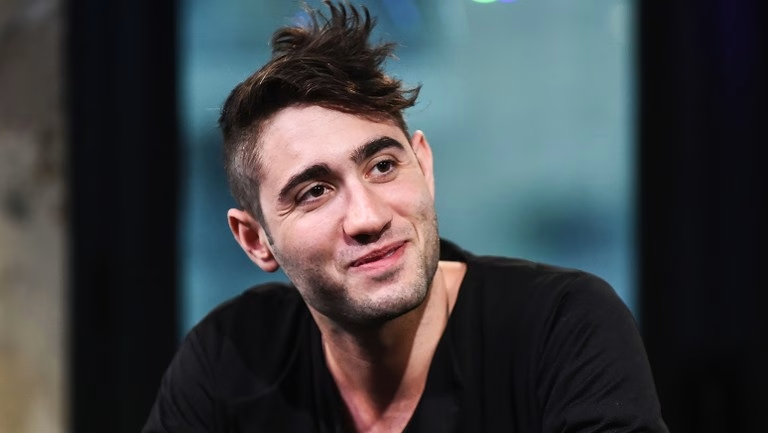
6. 3LAU: The Blockchain Benevolent
The Cause: Global Education Infrastructure The Vibe: Crypto wealth actually doing something tangible.
Justin Blau (3LAU) was talking about Bitcoin when most DJs were still figuring out how to sync their iPods. But unlike the wave of “crypto bros” who vanished when the market crashed, 3LAU built a philanthropic engine that actually produces brick-and-mortar results.
He partnered with Pencils of Promise, a non-profit that builds schools in the developing world. But he didn’t just cut a check; he leveraged his entire business model. His label, Blume Records, is the first non-profit dance music label – streaming revenue from tracks flows directly into charitable accounts. 7

Why 31% of Emerging DJs Are Quitting Music Due to Social Media Pressure
The result is undeniable: Schools built in Guatemala, fully funded by beats and blockchain. One school, the Justo Rufino Primary School, was paid for by a remix. In a world where crypto often feels like a scam, 3LAU is proving that digital currency can create physical literacy.

7. Martin Garrix: The Kid Who Printed His Own Money
The Cause: War Child & SOS Children’s Villages The Vibe: Gen Z diplomacy.
Martin Garrix became a superstar when he was basically a child himself, so it makes sense that his philanthropy focuses on kids caught in the crossfire of adult conflicts.
Garrix is a massive supporter of War Child and SOS Children’s Villages, organizations that support children in conflict zones. But his fundraising is legitimately creative. At the Amsterdam Dance Event (ADE), he didn’t just ask for donations; he created his own currency. The “Garrix 10” was a collectible banknote featuring his face and a list of all his songs, which fans could buy as a donation.
More recently, he donated the use of his track “Aurora” to a UN campaign called “Stomping for Peace,” creating a visual of kids from 38 countries dancing to demand the enforcement of their rights. It’s soft power at its finest: using a pop drop to make you think about the UN Convention on the Rights of the Child. 8

8. David Guetta: The Rooftop Savior
The Cause: COVID-19 Relief The Vibe: Dystopian optimism.
Remember 2020? The world shut down, the clubs closed, and we were all stuck inside doom-scrolling. Enter David Guetta, standing alone on a rooftop in Miami, playing hits to a skyline of empty hotels and people dancing on their balconies.
It was easy to be cynical about the “United At Home” livestreams. It looked like a scene from a sci-fi movie where the rich DJ plays while the world burns. But the numbers don’t lie. Guetta’s livestreams from Miami, NYC, Paris, and Dubai raised over $1.5 million for the World Health Organization and Feeding America. 9
He personally matched donations, turning a digital spectacle into millions of meals for people who had lost their jobs. It was cheesy, it was over-the-top, and it was exactly what the world needed at that moment.



The Comedown
So, what does this all mean? It means the “PLUR” (Peace, Love, Unity, Respect) ethos of the 90s wasn’t just a slogan on a kandi bracelet – it just took a few decades to mature into actual policy.
These artists are rewriting the social contract of the music industry. They are proving that you can command a crowd of 100,000 people and use that energy for something other than selling energy drinks. Whether it’s Fatboy Slim treating psychosis with samba drums or Hardwell educating a generation in India, the beat is finally doing what it was always supposed to do: heal.
Disclaimer: This article was generated using research on artist philanthropy. Donation figures and specific event details are based on available public records.
- https://www.theguardian.com/music/2022/jun/21/twiddle-knob-make-a-face-norman-cook-fatboy-slim-mental-health-dj-classes ↩︎
- https://en.wikipedia.org/wiki/Tim_Bergling_Foundation ↩︎
- https://www.theguardian.com/music/2019/jun/06/i-had-to-honour-him-the-friends-who-finished-avicii-final-album ↩︎
- https://www.youtube.com/watch?v=uBXvJOcJ0uM ↩︎
- https://aokifoundation.org/grants/ ↩︎
- https://ravelink.tv/articles/dmn/17_featured-dance-music-news/grizmas-turns-10-detroit-holiday-fundraiser-gears-up-for-biggest-celebration-yet-r18190/ ↩︎
- https://medium.com/best-in-class-featured-fundraisers/justin-blau-changing-the-music-industry-for-good-b507366e74e1 ↩︎
- https://www.sos-childrensvillages.org/news/stomping-for-peace-at-un ↩︎
- https://outnowmagazine.com/david-guetta-united-at-home/ ↩︎


