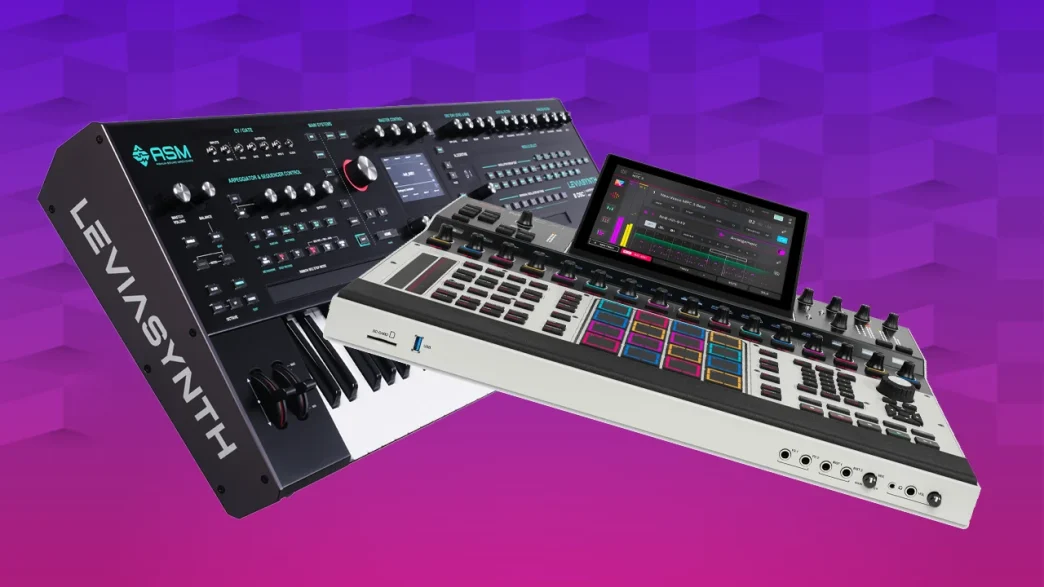
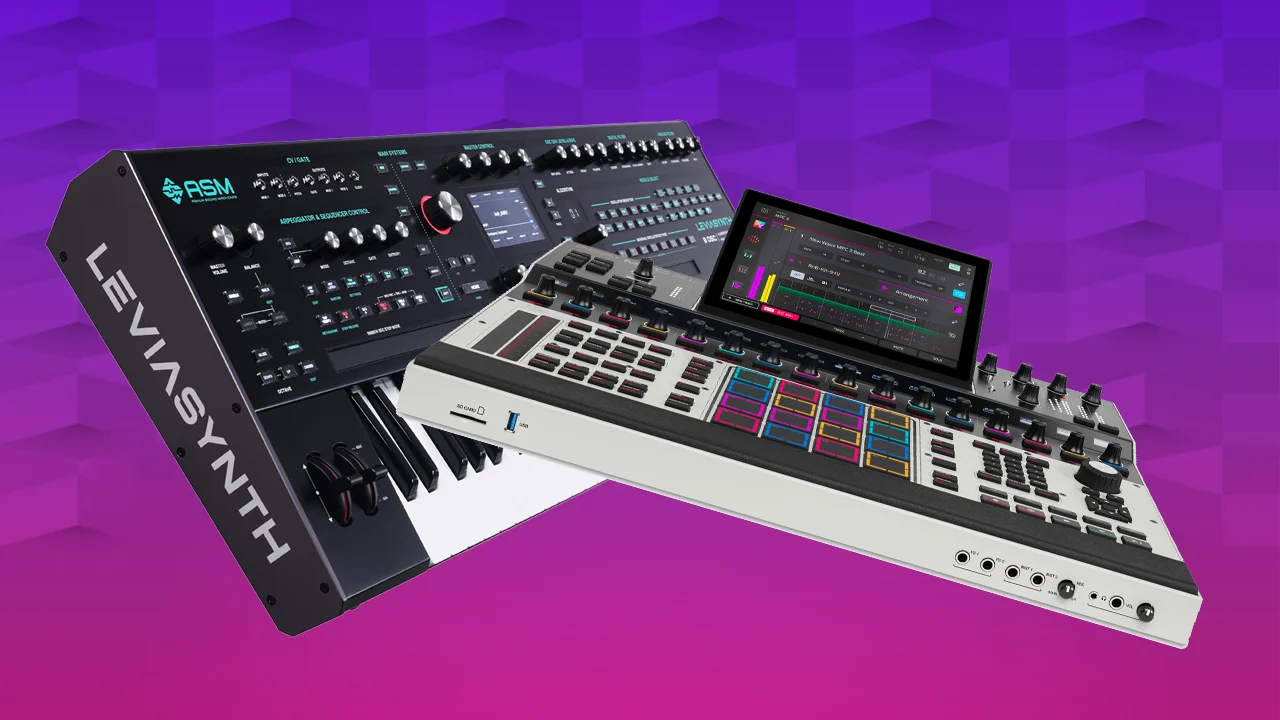

If NAMM 2026 proved anything this week, it’s that the “DAWless” revolution has finally graduated from a hobbyist niche to a high-stakes industrial arms race. As the dust settles at the Anaheim Convention Center, celebrating the show’s 125th anniversary, two massive flagship announcements, the ASM Leviasynth and Akai Professional MPC XL, have sucked all the oxygen out of the room. 1
We are no longer looking at simple grooveboxes or nostalgic retro-clones. We are witnessing the era of the “Total Workstation,” where manufacturers are betting you’ll pay nearly $3,000 to leave your MacBook Pro at home. But as the specs (and prices) skyrocket, the community is asking a critical question: is the hardware renaissance hitting a ceiling, or is this the new standard for professional production?
ASM’s Leviasynth Is Not Playing Fair
When Ashun Sound Machines (ASM) dropped the Hydrasynth in 2020, they disrupted the market by offering flagship sound design features at a mid-tier price. At NAMM 2026, they stopped playing the underdog. The Leviasynth is an aggressive bid for the “best synthesizer 2026” crown, pivoting from wave-morphing to what ASM calls Hybrid Algorithmic Synthesis. 2
128 Oscillators? Sure, Why Not.
While the market has been flooded with wavetable clones, the Leviasynth’s architecture is distinct. It boasts a 16-voice polyphonic engine where each voice is comprised of eight oscillators. That’s 128 oscillators running simultaneously. The core innovation here is “non-linear morphing” between algorithms, moving beyond the static FM structures popularized by Yamaha in the 80s to create evolving, living textures.
Critically, ASM addressed the biggest complaint about their previous hardware, the “cold” digital sound. The Leviasynth introduces a true hybrid signal path, pairing its digital engine with a warm four-pole analog low-pass filter on every voice. This combination of digital precision and analog grunt targets the exact pain point of modern sound designers who want the flexibility of software with the physical weight of voltage.

Audiomack Hits 50 Million Users: What It Means for Indie Artists
A “Holy Grail” with a Tiny Screen?
Early reaction on community hubs like Gearspace has been fervent. Users are calling the hybrid engine a “Holy Grail” feature, finally bridging the gap that kept the Hydrasynth from replacing analog polysynths in some studios.
However, the hardware choices have sparked debate. While the 61-key version includes a massive four-octave ribbon controller and MPE-compatible PolyTouch keys, the lack of individual voice outputs on a “pro” instrument has raised eyebrows among studio engineers. Additionally, for a synth this deep, some users expressed “screen envy,” wishing for a larger display to navigate the 32-slot modulation matrix, noting that the 4.3″ screen feels cramped compared to the tablet-like interfaces of competitors. Priced at $2,499, it undercuts rivals like the Groove Synthesis 3rd Wave, but it’s no longer the budget miracle the original Hydrasynth was.
Akai MPC XL: The Laptop Killer We Were Promised?
If ASM is targeting the sound designer, Akai Professional is gunning for the producer who wants to fire their laptop. The MPC XL is not just an update; it is a brute-force statement that standalone hardware can handle “real” production.
16GB RAM: The Upgrade We Actually Wanted
For years, the Achilles’ heel of standalone units was memory. You could barely load a decent piano library without maxing out the 2GB or 4GB limits. The MPC XL obliterates this bottleneck with 16GB of RAM and a Gen 2 8-core processor, which Akai claims delivers four times the processing power of previous models. 3
This isn’t just a spec bump. It changes the device’s fundamental utility. With this headroom, the MPC XL can run up to 32 plugin instruments and 16 audio tracks simultaneously. It supports stem separation natively (a feature essential for the modern remix economy) and integrates MPCe technology into its pads, allowing for positional X/Y sensing similar to MPE controllers.
Spitfire Audio: The Secret Weapon
The most interesting business move at NAMM wasn’t a piece of hardware, but a partnership. Akai announced deep integration with Spitfire Audio, bringing high-end orchestral libraries like “Originals Intimate Strings” into the MPC ecosystem. 4
This is a clear signal that Akai is trying to expand its demographic beyond beatmakers to film composers and serious arrangers. The 16GB RAM is the technical enabler here; without it, running Spitfire’s sample-heavy libraries would be impossible.
Is It Worth the “MacBook Pro” Price Tag?
Here is the friction point. At $2,899 (approx. €2,799), the MPC XL is priced dangerously close to a high-end Mac Studio setup. The community backlash was immediate. On r/mpcusers, threads flared up questioning the value proposition, with one user calling it the “Downfall of Akai?” and noting, “At close to $3k how much better is it than the One?”.
Critics argue that for $3,000, one could acquire a top-tier laptop and a controller like the Push 3. However, defenders emphasize the “walled garden” benefit: a latency-optimized, distraction-free environment. For live performance, where the XL’s 24-channel USB audio support and 8 CV/Gate outputs make it a literal studio hub, the reliability may justify the cost.
Compared to the Ableton Push 3 Standalone (~$1,999), the MPC XL offers double the RAM (fixed vs upgradable on Push) and superior I/O connectivity, positioning it as the more “studio-centric” of the two, while Push remains the king of clip-launching portability.



So, Should You Sell Your Laptop?
NAMM 2026 proved that the hardware market isn’t shrinking; it’s bifurcating. Entry-level gear is getting cheaper, but the flagship tier is becoming incredibly sophisticated and expensive.
- Buy the ASM Leviasynth if: You are a sound designer bored by standard wavetables and want the deepest modulation matrix on the market, backed by real analog filters.
- Buy the MPC XL if: You are a professional producer who needs a reliable, zero-latency center for a hybrid studio and demands enough RAM to run orchestral libraries without crashing.
The “laptop killer” has arrived. The only question left is whether you can afford to pull the trigger.
Frequently Asked Questions
How much do the ASM Leviasynth and Akai MPC XL cost?
The ASM Leviasynth is priced at $2,499 for the 61-key version and $1,799 for the desktop module. The Akai MPC XL carries a suggested retail price of $2,899. Both are positioned as premium flagship instruments.
Can the Akai MPC XL actually replace a computer DAW?
For many producers, yes. With 16GB of RAM and a Gen 2 8-core processor, the MPC XL solves the memory limitations that plagued previous standalone units. It can run up to 32 plugin instruments and 16 audio tracks simultaneously, and with the new Spitfire Audio integration, it can handle orchestral scoring tasks that previously required a laptop. However, it still lacks the unrestricted third-party plugin flexibility (VST/AU) of a traditional computer.
What is “Hybrid Algorithmic Synthesis” on the Leviasynth?
This is ASM’s new engine that moves beyond standard FM synthesis. While it uses 8 oscillators per voice (like FM operators), the Leviasynth allows for non-linear morphing between algorithms. This means the signal path and how oscillators modulate each other can change over time, creating evolving textures that traditional static algorithms cannot produce. It pairs this digital engine with real analog 4-pole filters for warmth.
How does the MPC XL compare to the Ableton Push 3 Standalone?
The MPC XL ($2,899) is built as a “studio hub” with superior I/O connectivity (24-channel USB audio, 8 CV/Gate outputs, phono inputs) and significantly more RAM out of the box (16GB vs 8GB on the base Push 3). The Push 3 Standalone ($1,999) focuses on portability (battery-powered) and the unique expressiveness of its 64 MPE pads. If you need a centerpiece to run a room full of gear, the MPC XL wins; if you need a portable creative sketchpad for Ableton Live, the Push 3 wins.
Is the Leviasynth just a bigger Hydrasynth?
No. While it shares the “Polytouch” keybed and user interface philosophy, the sound engine is fundamentally different. The Hydrasynth is a Wave Morphing synthesizer (3 oscillators), whereas the Leviasynth is an Algorithmic synthesizer (8 oscillators) designed for complex cross-modulation. Additionally, the Leviasynth includes real analog filters, a feature completely absent from the all-digital Hydrasynth.
- https://www.musicradar.com/music-tech/represents-the-evolution-of-everything-weve-learned-from-decades-of-innovation-in-music-production-akais-mpc-xl-is-its-new-flagship-watch-our-first-look-review ↩︎
- https://www.gearnews.com/asm-leviasynth/ ↩︎
- https://www.akaipro.com/mpc-xl/ ↩︎
- https://rekkerd.org/spitfire-audio-and-akai-professional-announce-partnership-bringing-premium-sounds-to-the-mpc-ecosystem/ ↩︎
* generate randomized username
- COMMENT_FIRST
- #1 Lord_Nikon [12]
- #2 Void_Reaper [10]
- #3 Cereal_Killer [10]
- #4 Dark_Pulse [9]
- #5 Void_Strike [8]
- #6 Phantom_Phreak [7]
- #7 Data_Drifter [7]
- #8 Cipher_Blade [6]