
If you listen closely to the edges of the Billboard Hot 100 this month, you can hear it. It’s a faint hiss, a ghostly crackle, or the distinct sound of a signal chain dying a slow, beautiful death. In the year 2025, the most valuable commodity in music production is no longer fidelity. It is failure.
For the better part of a century, audio engineers chased a mathematical asymptote: the “straight wire with gain.” This was a signal path so pure it would be indistinguishable from silence. By 2024, thanks to 32-bit floating-point processing and AI-assisted mixing, we effectively caught the car. We achieved the perfect, noise-free void. And the collective response from the music world? A hard pivot back into the mud.
According to the latest trend forecasts from industry heavyweights like Native Instruments and Beatportal, we are deep in the throes of a “Dirty Aesthetic.” This isn’t just a retro-gaze revival of “Indie Sleaze” or a TikTok micro-trend. It is a full-blown existential rebellion. As artificial intelligence democratizes the ability to create “perfect” radio-ready mixes in seconds, human producers are deliberately sabotaging their audio by crushing bits, over-saturating tape, and welcoming distortion to prove that there is still a pulse behind the machine. 1
The Uncanny Valley of the Quantized Soul
To understand why everyone from bedroom producers to stadium headliners is suddenly obsessed with “grit,” you have to look at the alternative. The tools of 2025 are terrifyingly competent. AI mastering suites like iZotope’s Ozone 11 can balance a frequency spectrum with a cold precision that human ears struggle to match. But this competence has birthed a new anxiety, specifically the fear of the “robotic” mix. 2
Scour the threads of r/musicproduction, and you’ll find the symptoms of this digital malaise. Users describe their own perfectly quantized tracks as “bloodless” and “boring,” lamenting that the DAW (Digital Audio Workstation) has scrubbed the life out of their art. One user, in a moment of clarity that reads like a Cyberpunk parable, recounted generating an entire Christmas album using the AI tool Suno. The AI spat out structurally perfect swing songs in seconds. The producer’s reaction? “Impressed and horrified.” to make the music bearable, they had to manually degrade the stems, adding “amateur FX tweaks” just to drag the sound out of the uncanny valley and into the realm of “passable mall shop music”. 3
This is the paradox of 2025: To make the artificial sound real, we must first make it sound bad.
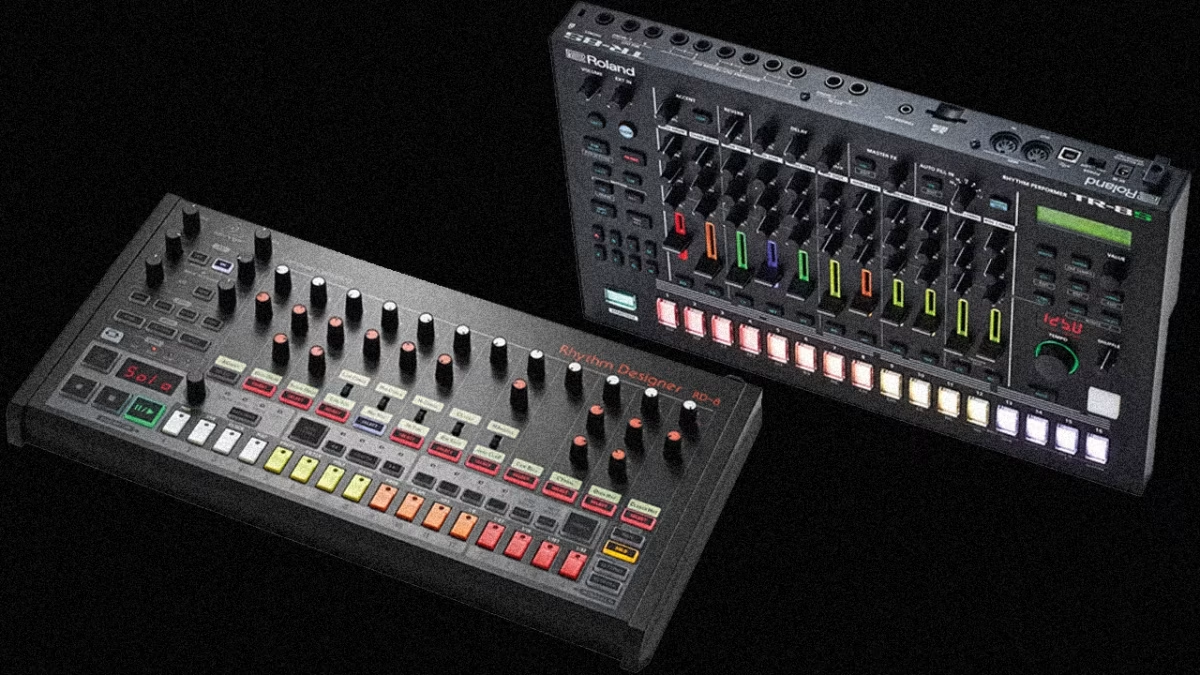
Why Behringer Clones Roland Gear and What It Means for Musicians
The Gear Fetish: A Totem of Authenticity
In this war against the algorithm, distortion is the primary weapon. But not just any distortion, as this is a connoisseur’s noise. It’s the difference between the harsh, digital clip of a CPU overloading and the warm, even-order harmonic saturation of a tube amp running hot.
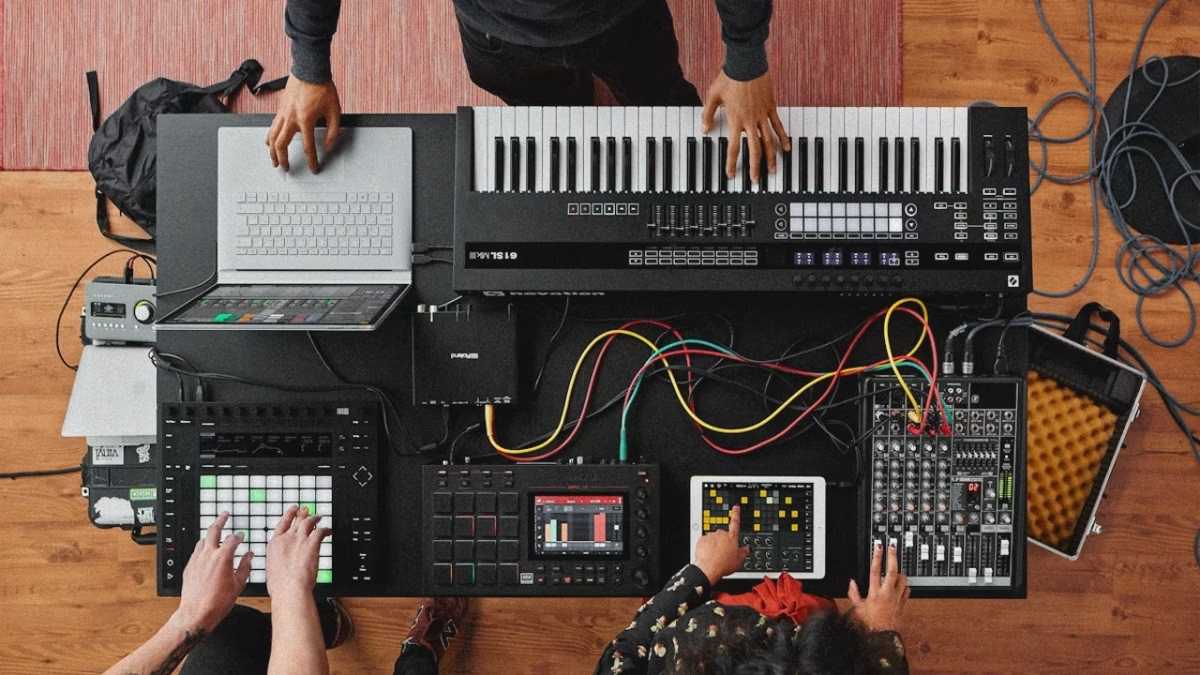
Producers are fetishizing hardware that introduces “happy accidents.” The Fulltone Tube Tape Echo has become a holy grail not because it delays sound, but because its magnetic tape degrades, stretches, and warps pitch in ways that code struggles to emulate authentically. The Neumann M147 tube condenser microphone is prized for adding “chest” and “grit” rather than clinical transparency. 4
For those without five-figure studio budgets, the software market has cannibalized this desire for decay. Plugins like XLN Audio’s RC-20 Retro Color and Soundtoys’ Decapitator are ubiquitous, functioning as “aging agents” that spray a patina of history onto sterile digital synths. Native Instruments has explicitly pivoted their product strategy to cater to this, releasing expansions that focus on “dusty” samples and the “Indie Sleaze” revival. This is a callback to the early 2000s era of trashy glamour that feels refreshingly sloppy compared to today’s hyper-curated feeds. 5
Scenes from the Underground: The Sound of “Tech Noir”
This aesthetic shift is reshaping genres in real-time. In the Techno capital of Berlin, the “Business Techno” of the late 2010s, which was clean, compressed, and safe, is being dismantled by a “Raw” movement. Artists like Shlomi Aber and FJAAK are championing a sound that is intentionally abrasive, favoring industrial textures and distorted kick drums that feel like they were recorded in a concrete bunker rather than a shimmering studio. It’s a sonic rejection of the “corporate rave” and a return to the genre’s grimy, subversive roots. 6
Meanwhile, on the global stage, Brazilian Funk (Funk Carioca) has gone viral precisely because of its hostility to polish. The genre’s blown-out, distorted basslines and aggressive rhythmic chops cut through the noise of social media algorithms specifically because they sound broken. It’s raw, it’s loud, and it refuses to be polite. It serves as a direct counter-narrative to the “chill lo-fi beats” that dominated the pandemic era.
Even the visual arts are mirroring this. There is a growing nostalgia for the “dirty aesthetic” of 90s cel animation and the “Tech Noir” of early cyberpunk. These are worlds defined by “hi-tech and low life,” where the future is advanced but everything is covered in a layer of grime. It parallels the “Mimeograph Revolution” of the 60s, where the smudged ink and cheap paper of counter-culture zines became a visual signifier of authenticity and urgency.

The Post-Digital Primitivism
What we are witnessing in 2025 is the dawn of Post-Digital Primitivism. The definition of “high fidelity” has flipped. It no longer implies a faithful reproduction of a source, but a faithful reproduction of an emotion, and emotions are messy.
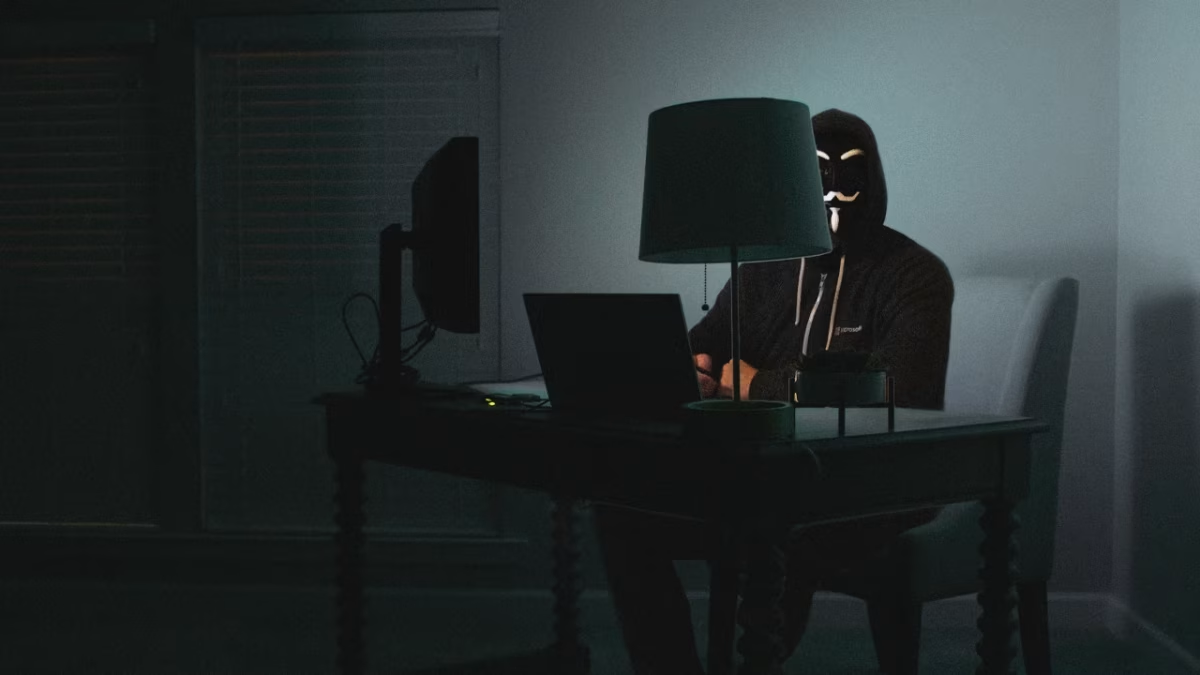
As AI takes over the “clean” jobs of perfecting the mix, generating the filler, and balancing the levels, the human artist is left with the dirty work. We are becoming the curators of entropy, the guardians of the glitch. The “Dirty Aesthetic” isn’t just a trend; it’s a frantic, necessary assertion of humanity. We are breaking our audio to prove that we are still the ones holding the hammer.
- https://noisemachines.studio/the-dirty-aesthetic/ ↩︎
- https://blog.native-instruments.com/ai-powered-plugins/ ↩︎
- https://www.reddit.com/r/musicproduction/comments/1hkjh31/i_produced_an_entire_christmas_album_in_less_than/ ↩︎
- https://noisemachines.studio/the-dirty-aesthetic/ ↩︎
- https://www.musictectonics.com/post/building-music-communities-with-native-instruments ↩︎
- https://www.beatportal.com/playlists/847230-playlist-of-the-week-shlomi-aber ↩︎
* generate randomized username
- i'm not entirely convinced. this feels like a cyclical trend more than a fundamental shift. hasn't music always had a push and pull between clean and dirty sounds? claiming AI is solely responsible seems like an oversimplification of artistic expression.
- So, basically, becaus AI can make things perfect, everyone's running back to making things sound like garbage? i'm not convinced this "dirty aesthetic" is anything more than a marketing ploy to sell more plugins that 'break' audio. Seems kinda cyclical, no?
- #1 Lord_Nikon [12]
- #2 Void_Reaper [10]
- #3 Cereal_Killer [10]
- #4 Dark_Pulse [9]
- #5 Void_Strike [8]
- #6 Phantom_Phreak [7]
- #7 Data_Drifter [7]
- #8 Zero_Cool [7]