
ChatGPT’s parent company is developing a Suno competitor while artists fight for survival against an algorithm that’s already stealing their work
OpenAI, the company that gave us ChatGPT and basically kicked off the entire AI panic we’re currently living through, is now coming for musicians. According to a report from The Information on October 24, the Sam Altman-run company is quietly developing its own AI music generator that could rival platforms like Suno and Udio. And if you think the music industry is already a dystopian hellscape for working artists, just wait until 800 million ChatGPT users can churn out radio-ready tracks with a single text prompt.
Here’s what we know: OpenAI engineers are collaborating with students from Juilliard School to annotate musical scores and build training data for the new AI model. The system will reportedly let users generate soundtracks or add instrumental accompaniments to existing tracks through text or audio prompts.
The company hasn’t announced a launch date or confirmed whether this’ll be a standalone app or get folded into ChatGPT or their video generator Sora. But the strategic math is simple: OpenAI has more users than most countries have citizens, and they’re positioning themselves to compete directly with Google and the AI music startups that are already getting sued into oblivion by major record labels.

Suno AI Just Hit a $2 Billion Valuation While Getting Sued for Music Piracy
The Copyright Clusterf*ck
Let’s talk about Suno and Udio, the current market leaders in AI music generation that OpenAI is trying to steamroll. Both platforms let you type in a prompt and get back a complete song (vocals, instrumentals, lyrics, the whole package) in minutes. Suno raised $125 million and got integrated into Microsoft Copilot, pulling in about 4 million monthly visits. Udio is backed by Andreessen Horowitz and went viral when someone used it to create “BBL Drizzy,” a parody track mocking Drake.
But here’s the thing: both companies are currently getting absolutely demolished in court by the Recording Industry Association of America (RIAA). In June 2024, major labels including Sony, Universal, and Warner filed copyright infringement lawsuits alleging that Suno and Udio used copyrighted recordings without permission to train their models. The RIAA is seeking up to $150,000 per work infringed, which could amount to billions of dollars.
In August 2024, both companies basically admitted they did exactly what they’re accused of. Suno’s court filing stated that its “training data includes essentially all music files of reasonable quality that are accessible on the open Internet”. They’re arguing it’s “fair use,” which is the legal equivalent of showing up to court and saying “yeah I did it but I don’t think it’s illegal”.
The RIAA wasn’t having it. CEO Mitch Glazier put it bluntly: “Unlicensed services like Suno and Udio that claim it’s ‘fair’ to copy an artist’s life’s work, and exploit it for their own profit without consent or pay, set back the promise of genuinely innovative AI for us all”.
In October 2025, independent artists filed additional lawsuits in Illinois, accusing these AI firms of “stream-ripping” music directly from YouTube and bypassing anti-piracy protections. Country singer Tony Justice sued Suno in September, calling their practices “abuse and exploitation of the worst kind”. 1

YouTube is Finally Demonetizing Inauthentic AI Music and Videos
Here’s the kicker: a 2025 investigation found that OpenAI itself (along with Google, Microsoft, and Meta) has been scraping copyrighted music from platforms like YouTube without authorization. So OpenAI is about to enter a market where the existing players are drowning in lawsuits, and they’re already on the hook for the same shady training data practices.
“Utterly Depressed”: What Musicians Are Actually Saying
While tech companies are racing to automate creativity out of existence, actual musicians are watching their livelihoods evaporate in real time.
In February 2025, over 1,000 British musicians (including Kate Bush, Annie Lennox, and members of Radiohead and Bastille) released a protest album called Is This What We Want?. The album is 12 tracks of complete silence. The song titles combine to deliver a message: “The British government must not legalize music theft to benefit AI companies”. 2
Kate Bush asked a question that should haunt anyone paying attention: “In the music of the future, will our voices go unheard?”
Singer-songwriter Naomi Kimpenu was even more direct: “I fear that we will become the last generation of artists that can build careers in UK music. We cannot be abandoned by the government and have our work stolen for the profit of Big Tech”.
Back in April 2024, 200+ artists including Billie Eilish, Nicki Minaj, Stevie Wonder, and Katy Perry signed an open letter warning against the “predatory use of AI” in music.
On Reddit, the despair is palpable. One musician wrote: “Ever since we arrived at the point where you can just type in a prompt and let machines create images and music for you, I’ve been feeling quite depressed. It’s gotten so bad, that sometimes I even think ‘what’s the point of making music anymore?’ because it seems to be so devalued now”. 3
Tilly Louise, a 25-year-old alternative pop musician with millions of Spotify streams, told CNBC she still needs a full-time job to support herself while competing with AI-generated bands.
When The Velvet Sundown (an AI-generated band) gained over 850,000 Spotify followers in just weeks, musician Kristian Heironimus said: “I’ve been working for about six years, constantly releasing music while managing my day job. It’s disheartening to see an AI band garnering 500,000 monthly listeners in just two weeks”. He called their music “soulless”.
In September 2025, at least 75 Chicago musicians pulled their music from Spotify over concerns about AI-generated content and inadequate compensation. Rapper Mykele Deville summed it up: “That is the biggest kind of disrespect to a lot of us. It shows us that we’re replaceable“.

Pennies for Artists, Millions for Missiles: The Real Reason Musicians Are Leaving Spotify
The Economic Reality: Musicians Are About to Lose Billions
The numbers are genuinely terrifying. A 2024 economic study commissioned by CISAC projects that music creators could lose 24% of their revenues by 2028 due to AI-generated content (a cumulative loss of €10 billion over five years). The study estimates the market for AI-generated music will explode from €3 billion to €64 billion by 2028.
Let that sink in: AI music companies will be making €64 billion while human musicians lose €10 billion.
The AI in music market is projected to grow from $3.9 billion in 2024 to $38.7 billion by 2033. A Forbes analysis warned that “2025 could mark the beginning of the end for independent artistry”.
Streaming platforms like Spotify are already incorporating AI-generated music to reduce costs, which directly cuts royalty earnings for human musicians. And here’s the insidious part: platforms aren’t required to label AI-generated content. NPR’s investigation found that listeners may “unknowingly consume AI-generated content believing it was created entirely by human artists”.
OpenAI’s Messy Music History
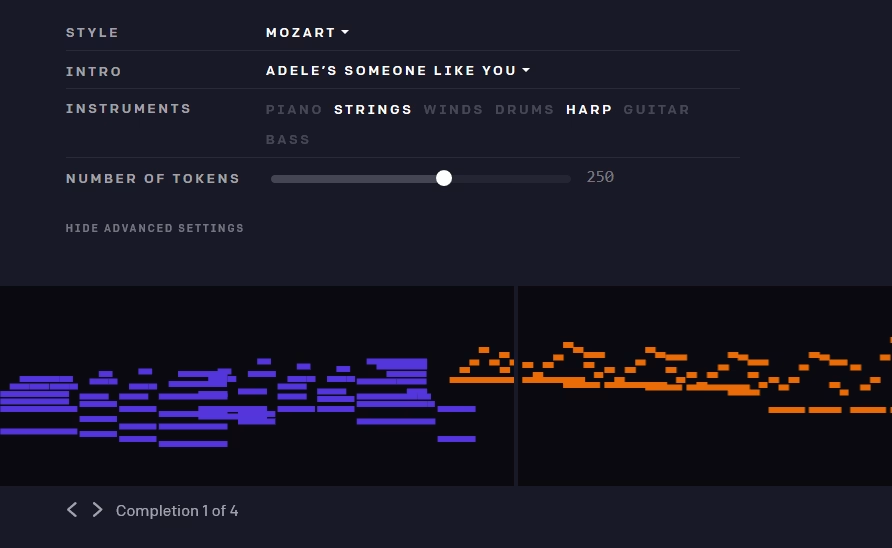
This isn’t OpenAI’s first rodeo with music AI. In 2019, they released MuseNet, a neural network that could generate 4-minute compositions with 10 different instruments. In 2020, they launched Jukebox, a more advanced model that generated music as raw audio. 4
Both were eventually shut down. MuseNet went offline in December 2022 and hasn’t come back. OpenAI admitted that while musicians found Jukebox “an interesting research result,” they “did not find it immediately applicable to their creative process”.
Translation: musicians thought it was neat but basically useless for actual creative work.
Now OpenAI is back with their third attempt, except this time they’re partnering with Juilliard and have 800 million potential users ready to flood the market with AI-generated tracks.


What Happens Next
OpenAI’s entry into AI music generation is going to accelerate an already dire situation for working musicians. The company could integrate music generation directly into ChatGPT or bundle it with Sora 2, enabling users to create complete AI-generated content (video plus soundtrack) in minutes.
For OpenAI, this is about revenue diversification and user engagement. For musicians, it’s about survival.
Northwestern University’s Center for Advancing Safety of Machine Intelligence warned: “When AI can create songs that sound nearly identical to those produced by real artists, it undermines the effort, creativity, and livelihoods of musicians everywhere”.
Cornell University’s student newspaper articulated what should be obvious: “AI doesn’t understand human emotion. It doesn’t have the lived experiences that often give music its soul”. 5
The answer is no. But that won’t stop tech companies from trying to convince us otherwise while raking in billions.
As Kate Bush asked: “In the music of the future, will our voices go unheard?” If OpenAI and companies like it have their way, the answer is probably yes, drowned out by an infinite flood of algorithmically generated slop that sounds just good enough to replace the real thing. 6
Human musicians have been fighting back with silent albums, open letters, lawsuits, and boycotts. But they’re up against companies worth hundreds of billions of dollars that see creativity as just another thing to automate, monetize, and scale. Welcome to the future of music. It sounds like shit, but at least it’s cheap.
Note: OpenAI has not officially confirmed its music generation product. This article is based on reports from The Information and other credible technology news sources.
- https://www.musicbusinessworldwide.com/suno-and-udio-face-another-lawsuit-from-indie-artists-accusing-them-of-stream-ripping-and-market-harm/ ↩︎
- https://www.reddit.com/r/musicians/comments/1jpvdzc/musicians_fight_back_against_ai_with_silent_album/ ↩︎
- https://www.reddit.com/r/musicians/comments/1f9iudz/utterly_depressed_by_the_emergence_of_ai/ ↩︎
- https://blog.staccato.ai/The-Origins-of-AI-Music ↩︎
- https://www.cornellsun.com/article/2024/12/the-problem-with-ai-generated-music ↩︎
- https://www.bbc.com/news/articles/cwyd3r62kp5o ↩︎
* generate randomized username
- COMMENT_FIRST
- #1 Lord_Nikon [12]
- #2 Void_Reaper [10]
- #3 Cereal_Killer [10]
- #4 Dark_Pulse [9]
- #5 Void_Strike [8]
- #6 Phantom_Phreak [7]
- #7 Data_Drifter [7]
- #8 Zero_Cool [7]