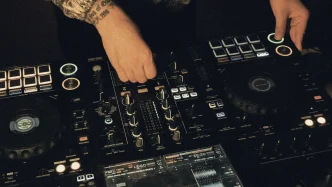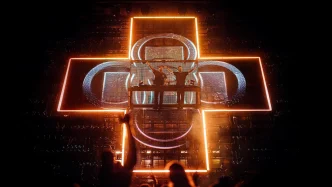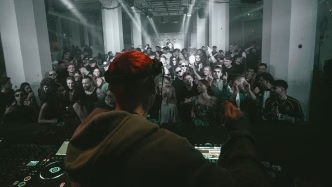

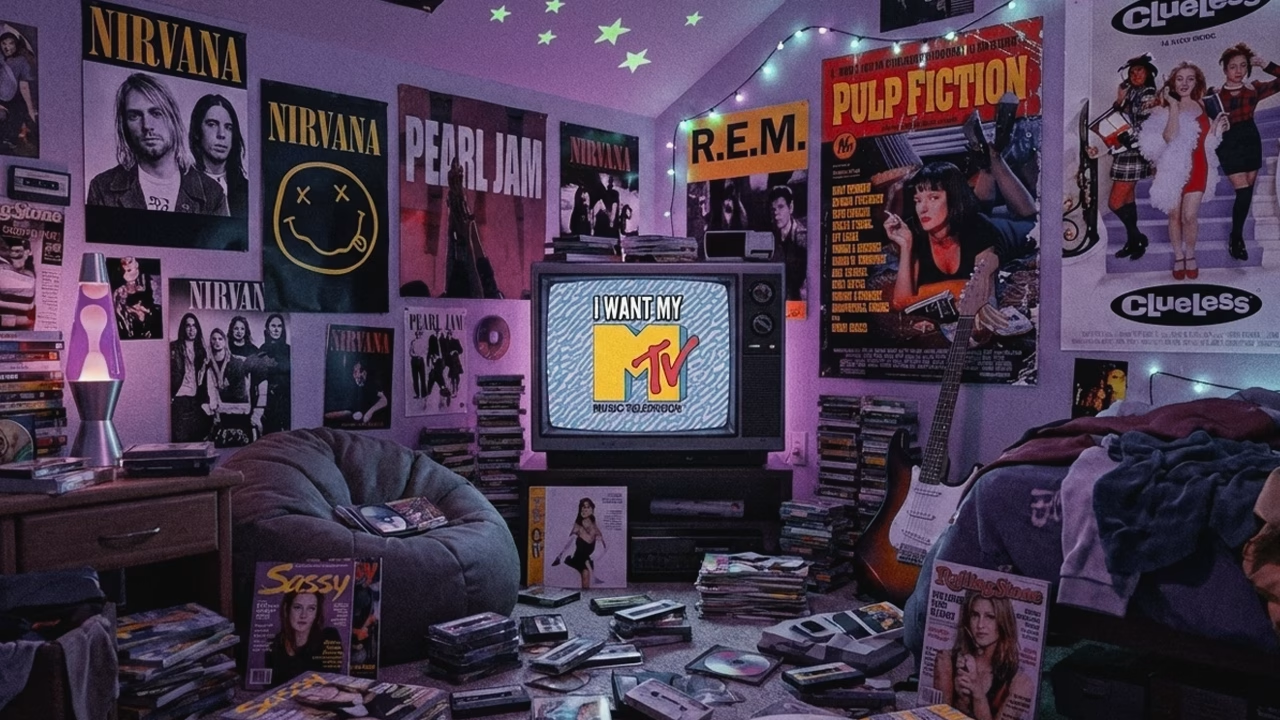
It’s 1996. Mainstream television is a wasteland of post-grunge posturing, pop princesses, and boy bands vying for the top spot on TRL. But if you were an insomniac wired on dial-up internet and angst, the sonic revolution wasn’t happening in the daylight. It was broadcasting at 2:00 AM. Enter MTV’s AMP, a late-night transmission that served as a Trojan horse, smuggling the sounds of 90s rave culture straight into the heart of the corporate media machine.
Created by Todd Mueller and Burle Avant, AMP wasn’t just a television show; it was an awakening. For a brief window, MTV funded an avant-garde masterpiece that changed the trajectory of electronic music in the United States.
Late-Night Transmissions: The Aesthetics of MTV’s AMP
Before algorithm-generated playlists sanitized our listening habits, musical discovery required patience, a lack of sleep, and a blank VHS tape. The structural conceit of AMP was its rejection of the traditional MTV format. There were no caffeinated VJs throwing to commercial breaks. Instead, the show operated as a continuous mixtape of audio-visual stimuli.
Drawing from the underground ethos of Beau Tardy’s Manhattan public access program TV w/ Ray Cathode, the visual aesthetic of AMP was a fever dream of 90s rave culture and digital art. Directors pushed the limits of early CGI, non-linear editing, and VHS glitch aesthetics to visually interpret tracks that lacked a lead singer to put in front of the camera. As a viewer, you weren’t just watching a music video; you were being submerged in a cyberpunk atmosphere. It was a space where the biomechanical nightmares of Aphex Twin transitioned into the urban decay of The Future Sound of London.
MTV Rewind: The 33,000+ Video Archive Restoring Music History
Curating the 1990s Electronic Music Rebellion
The historical weight of AMP lies in its curatorial mastery. The show treated MTV electronic music history with respect, refusing to talk down to its audience.
Sure, the network leaned on the “big beat” crossover hits that defined the 1997 electronica boom—think The Chemical Brothers’ “Block Rockin’ Beats” or The Prodigy’s “Voodoo People”. But Mueller and Avant also dragged the cerebral counterpoint of IDM (Intelligent Dance Music) out of the underground. Suddenly, the complex, syncopated rhythms of Autechre, Orbital, and Squarepusher were being beamed into American living rooms.
For youths devoid of a warehouse party scene, this programming was a revelation. It rewired the musical tastes of a generation, teaching them that music didn’t need lyrics to possess emotional and intellectual depth. If you want to experience the energy of this curation firsthand, digital archivists have preserved the history. There’s an archive of some of the episodes over at Archive.org that you can watch right now.
The Physical Artifact: Astralwerks and the AMP Compilation
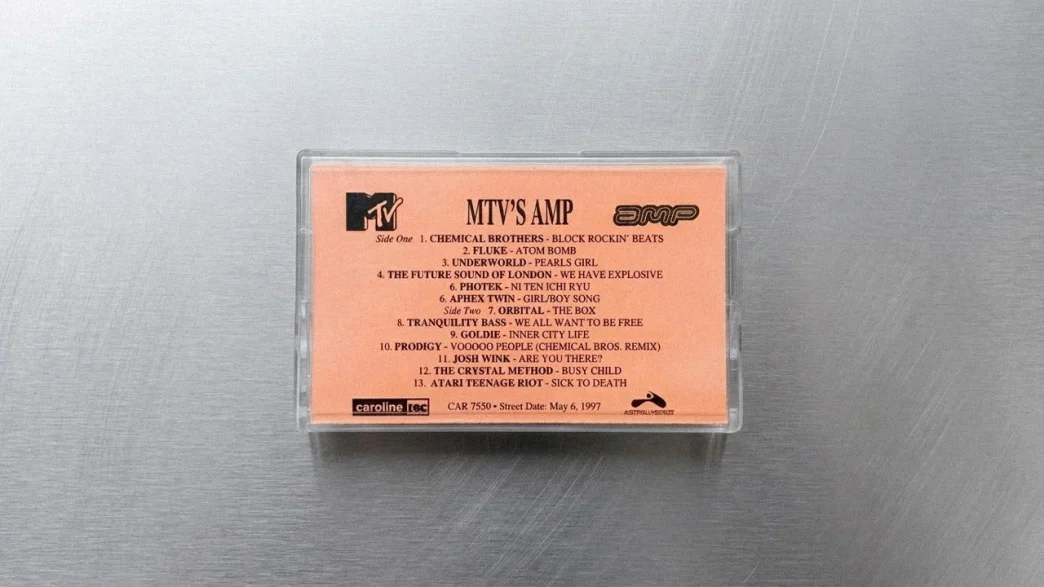
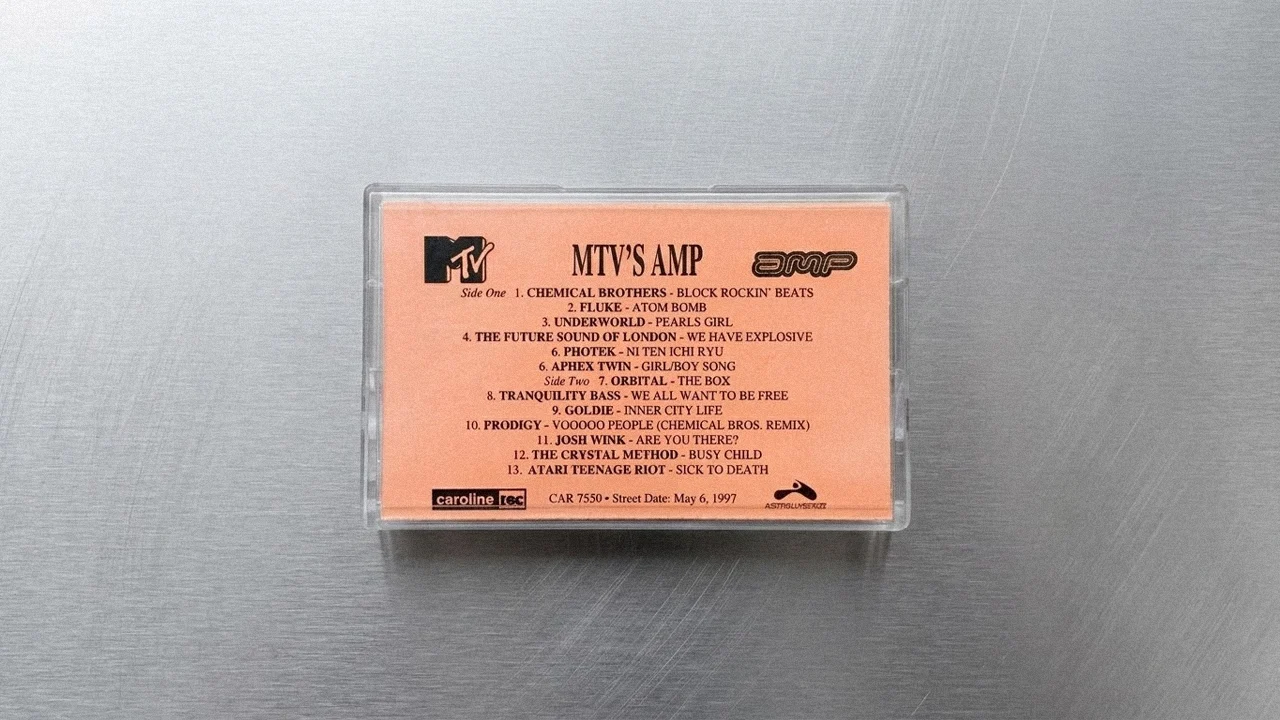
In an era before streaming platforms democratized access to obscure subgenres, cultural capital was physical. You either had the record, or you didn’t. Recognizing the cult following the late-night show had cultivated, MTV partnered with independent label Astralwerks to drop the official MTV’s Amp compilation CD in May 1997.
This 60-minute disc was a masterclass in genre-blending and remains a vital relic of 90s electronic music nostalgia. It functioned as a physical primer for the North American market, weaving together the drum and bass of Photek’s “Ni Ten Ichi Ryu,” the jungle of Goldie’s “Inner City Life,” and the trance of Underworld’s “Pearl’s Girl”. Fans and critics still hold the compilation in high regard, viewing it as a snapshot of the era’s electronic variety.
The Transition to AMP 2.0 and Enduring Nostalgia
Of course, corporate suits inevitably ruin everything. By 1998, both Mueller and Avant had departed the show, and MTV network executives stripped the program of its artistry, rebranding it as the sterile AMP 2.0. Gone were the chaotic video mixes and the underground grit; in their place was just another block of promotional music videos. MTV retired the program in 2001.

But the damage was already done—in the best way possible. Today, search queries for 90s rave culture and 90s electronic music nostalgia prove that the sounds AMP championed were never a passing fad. The show acted as a cultural bridge, validating a subculture and laying the visual and auditory groundwork for the global dance music festivals of today. AMP proved that if you give the youth something weird and challenging, they won’t just watch it—they’ll let it change their lives.
Sources & Further Reading
MTV’s Amp & 90s Electronica
- Show Archives: Complete MTV Amp Series (Internet Archive), Amp (TV Series) Overview (Wikipedia)
- Commercial Releases: MTV’s Amp Compilation (1997) (Discogs), MTV’s Amp 2 (1998) (Wikipedia)
- Cultural Context: Xennials & Electronica Discovery (Reddit), 90s Rave Nostalgia (OCPR)
- Genre Guides: Influential Electronic Styles (Berklee)
* generate randomized username
- COMMENT_FIRST
- #1 Lord_Nikon [12]
- #2 Void_Reaper [10]
- #3 Cereal_Killer [10]
- #4 Dark_Pulse [9]
- #5 Void_Strike [8]
- #6 Phantom_Phreak [7]
- #7 Data_Drifter [7]
- #8 Zero_Cool [7]