


In the golden age of the algorithm, music has become a utility, a seamless, boundless flow of audio tap water available for a monthly subscription fee that costs less than a single cocktail in Lower Manhattan. But while the consumer basks in the “all-you-can-eat” buffet of the DSP (Digital Service Provider) era, the creators are starving. For the modern DJ and electronic producer, the stream is no longer the product. It is merely the advertisement. The real business? It’s hanging on a rack, pressed into limited-edition wax, and dropping at 4 PM sharp on a Monday.
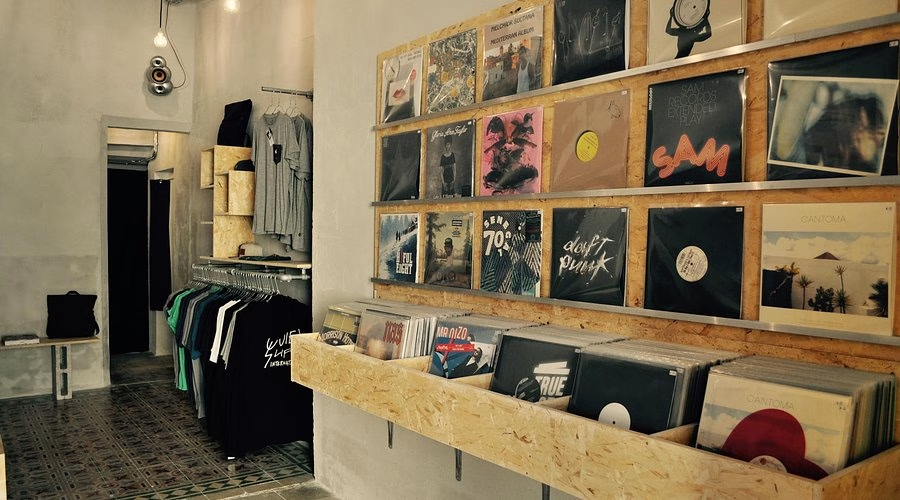
Welcome to the Merchandise-First Economy, a structural inversion of the music industry where the mp3 is a loss leader and the heavyweight cotton t-shirt is the financial lifeline.
The Mathematics of Survival
To understand why your favorite left-field techno producer has suddenly pivoted to becoming a streetwear magnate, you have to look at the brutal arithmetic of the stream. In 2025, the average payout from a platform like Spotify hovers grimly between $0.003 and $0.005 per stream. The “volume trap” is real: an artist needs to generate approximately 250 million streams to net $1 million. In contrast, selling just 28,500 premium hoodies yields the same profit.
For the independent artist, the math is even starker. Selling a single $35 t-shirt generates the same net revenue as roughly 9,000 streams. When you view the industry through this lens, the pivot isn’t just a choice; it’s an economic imperative. The “middle class” of musicians, those with 50,000 dedicated fans rather than 50 million passive listeners, can no longer afford to rely on recorded music as a revenue stream. They have to sell assets, not access.

Modern DJ Career Trends 2026: The Grift Behind the Booth
The Cult of the “Drop”
If the stream is ephemeral, the object is totemic. This shift has birthed a culture of “drops” borrowed directly from the hype-beast playbooks of Supreme and Nike SNKRS. It is no longer enough to release an album; one must orchestrate an event.
Take Daupe!, the UK-based label that has weaponized scarcity to an art form. Known for championing the gritty, noir-hop sounds of Griselda, Daupe! doesn’t just sell vinyl; they sell anxiety. Their releases occur at specific times, often selling out 300-unit runs in minutes. They employ “variant pricing,” where a standard black record costs £25, but a version with a Japanese “Obi strip” (musically identical) commands a premium and flips for hundreds on the secondary market. By strictly limiting supply, they bypass the “passive listening” of the playlist and force an active, credit-card-in-hand engagement.
This isn’t just retail; it’s psychological warfare. It exploits the “scarcity heuristic,” triggering a FOMO loop that turns fans into collectors and collectors into evangelists.
World-Building as a Business Model
The most successful pivots go beyond simple scarcity; they build entire aesthetic universes. 100% Electronica, the label run by George Clanton, is the masterclass in this “aesthetic-first” strategy. Rising from the internet-native soil of Vaporwave, a genre obsessed with visual nostalgia, Clanton realized that the vibe was the product.
The label monetizes its community through everything from “100% ElectroniCON” festivals to niche physical formats like MiniDiscs and cassettes, which have seen an unlikely resurrection. In 2023, cassette sales in the U.S. reached 436,400 units, an eightfold increase in a decade. For Lo-Fi Hip Hop artists, whose music is often consumed passively as “study beats,” the cassette tape serves as a physical anchor for a digital ghost, transforming a background listener into a brand patron.
Similarly, the Belfast duo Bicep has transitioned from a music act to a lifestyle brand. Their merchandise isn’t slap-dash promotional gear; it’s high-design streetwear that signals membership in a specific subculture. By crowdsourcing designs and maintaining a rigid “Club Culture” aesthetic, they’ve turned their merch table into a fashion house.
The Anti-Spotify Infrastructure
Underpinning this entire economy is Bandcamp, the anti-hero of the streaming wars. While the major DSPs obscure fan data, Bandcamp hands the keys back to the artist. The platform’s “Bandcamp Friday” initiative, which waives revenue shares for 24 hours, has generated over $154 million for artists since 2020, with $19 million paid out in 2025 alone.
This direct-to-consumer pipeline allows artists like Four Tet to bypass the industry machinery entirely. By releasing music and merch directly to fans, Kieran Hebden retains up to 85% of the revenue, compared to the pittance offered by traditional label deals. It is a reclamation of agency, a declaration that while the platform may own the distribution, the artist owns the relationship.


The Flight to Quality
As we move deeper into 2025, the market is saturating. Every DJ has a tote bag; every producer has a Patreon. The winners of this new economy will be those who treat their merchandise with the same rigor as their mastering chain. The days of the “logo slap” on a cheap Gildan tee are over.
We are witnessing a “flight to quality,” where the physical object must justify its existence in a cluttered world. Vinyl sales have grown for 18 consecutive years, overtaking CDs not just in cool factor but in raw revenue ($1.4 billion vs $541 million). This proves that fans want to pay for music, but they just want something to hold while they do it.
In the end, the pivot to merchandise is a survival mechanism for a post-scarcity digital world. DJs have realized that if the music is going to be free, the experience must be premium. The track is the flyer. The t-shirt is the ticket. And the real revenue is in the liner notes you can actually touch.
Frequently Asked Questions
- Is streaming really that unprofitable, or is this just industry alarmism? The math is unfortunately quite literal. To generate $4,000 in revenue, an artist needs approximately one million streams on Spotify. To generate that same $4,000 via merchandise, they only need to sell about 115 hoodies. For the vast majority of non-superstar DJs, the stream is essentially a marketing loss leader used to drive traffic toward the physical product.
- Should I use Print-on-Demand (POD) or hold my own inventory? It depends on your risk tolerance. POD allows you to sell merch without upfront costs or boxes of unsold shirts cluttering your apartment, but your profit margins are significantly thinner. Holding inventory offers higher margins and quality control, but if you misjudge the demand for a specific design, you are stuck with the cost.
- Isn’t the vinyl resurgence terrible for the environment? There is no way to sugarcoat it; vinyl production is dirty. The PVC used to press records accounts for 50% of the manufacturing emissions, and the industry generated an estimated 23,750 tons of CO2 in 2023 alone. However, innovations like “Green Vinyl” (which uses injection molding instead of pressing) aim to reduce these emissions by over 60%, suggesting a slightly greener future for the format.
SOURCES & REFERENCES
- Spotify Payout Rates (2025): Revisions Music – https://www.revisionsmusic.com/how-much-does-spotify-pay-per-stream-in-2025/
- Cassette Sales Data (2023): Luminate Analytics via AMRA & Elma – https://www.amraandelma.com/cassette-marketing-statistics/
- Bandcamp Friday Payouts: Music Business Worldwide (Dec 2025) – https://www.musicbusinessworldwide.com/bandcamp-fridays-hit-154m-in-payouts-since-2020-with-19m-paid-in-2025-alone/
- Vinyl Sales Growth (18 Years): Accio Market Analysis – https://www.accio.com/business/vinyl-record-sales-trend
- Vinyl Revenue vs CDs: Taylor Corporation Market Data – https://www.taylor.com/blog/increased-vinyl-sales-and-the-vinyl-revival
- Vinyl CO2 Emissions (2023): UR Pressing Sustainability Report – https://www.urpressing.com/client-resources/blogs/sustainability-in-the-vinyl-record-industry/
* generate randomized username
- So, the future of music is...fast fashion? I guess i should start practicing my "drops" to secure that limited-edition vinyl no one will actually listen to. At least my DJ dreams will keep me stylish and only slightly in debt. what a time to be alive.
- #1 Lord_Nikon [12]
- #2 Void_Reaper [10]
- #3 Cereal_Killer [10]
- #4 Dark_Pulse [9]
- #5 Void_Strike [8]
- #6 Phantom_Phreak [7]
- #7 Data_Drifter [7]
- #8 Cipher_Blade [6]