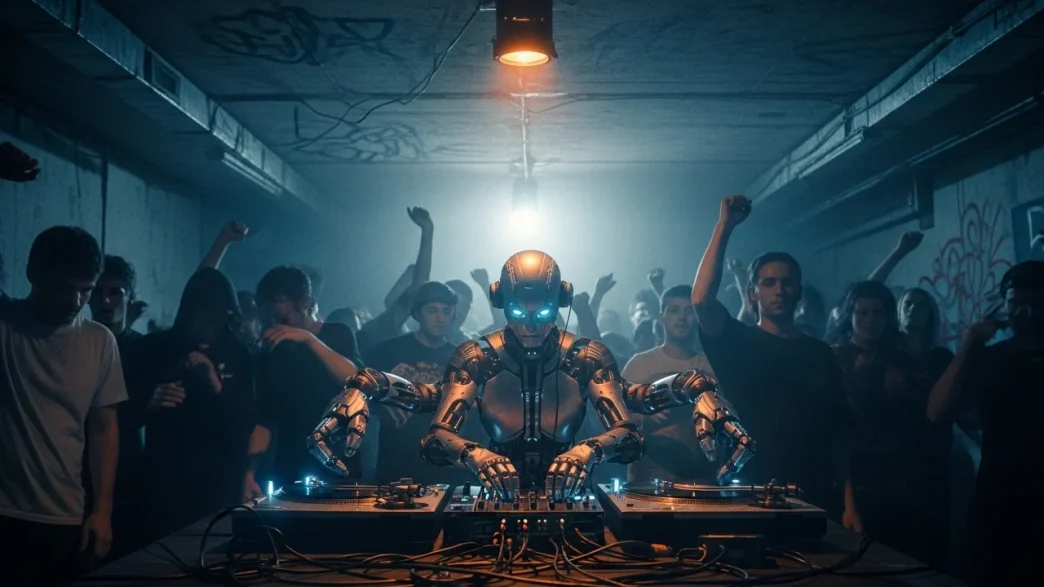
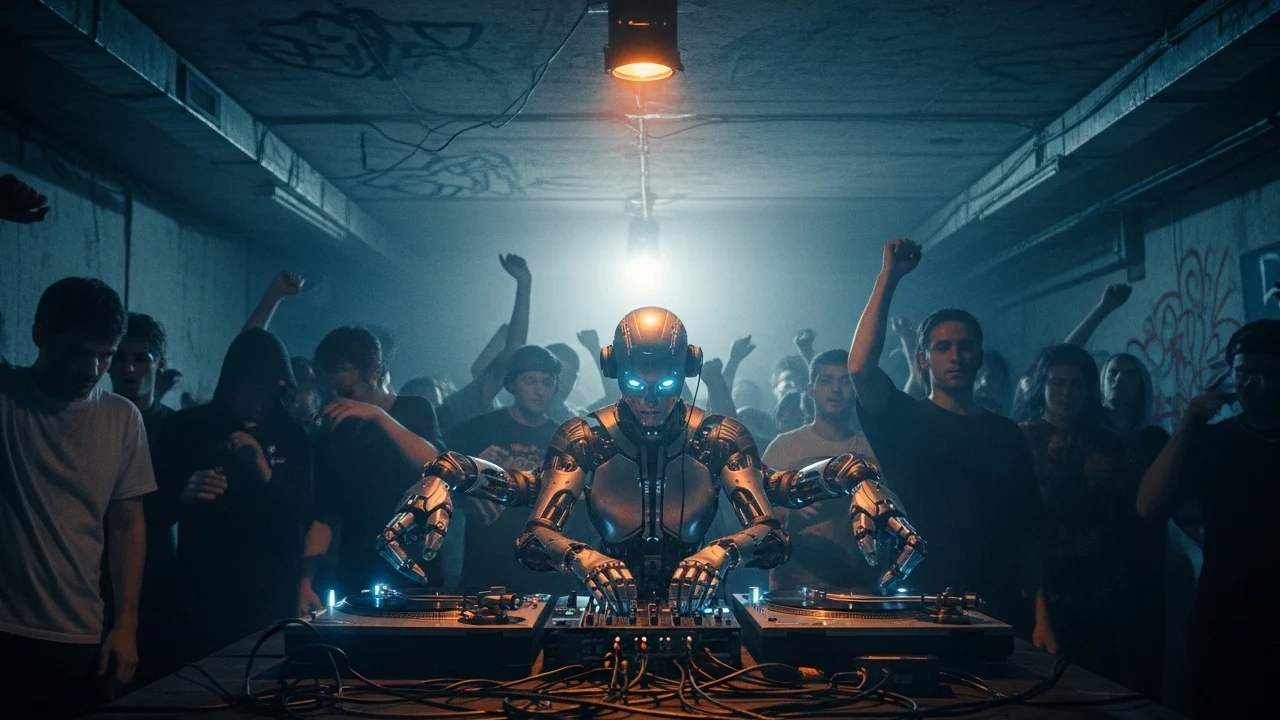

For the last twenty years, music purists have wasted their breath screaming about technology. They claimed that digital beat-matching made DJs lazy. They argued that if you didn’t touch the pitch fader, you weren’t “working.” But while we were distracted by those petty arguments, a research team from Sabanci University was busy building the machine that makes the human DJ obsolete.
At the 20th Audio Mostly Conference in Portugal last June, researchers unveiled “DJ-AI.” This system doesn’t just mix songs. It uses generative AI to compose new music that bridges the gap between tracks. It doesn’t need a human to blend the audio. It hallucinates a perfect transition on its own. And the most terrifying part? The audience prefers it.
Is Graph-Based Optimization Turning Music into a Math Equation?
To understand how bleak this is, you have to look at how the machine sees music. It doesn’t hear a song. It sees a node on a graph.
The DJ-AI system treats a music library like a math problem. It uses a logic called Depth-First Search. This is the same kind of code used to solve puzzles or route delivery trucks. It treats your favorite songs like stops on a delivery route, looking for the most efficient path from Point A to Point B.

The $10 Million Bot Farm: Inside The First Criminal Prosecution Of AI Streaming Fraud
It ignores the gut feeling of a DJ. Instead, it uses MERT embeddings, which are deep learning tools that analyze the texture of the sound. It calculates the “optimal” path through a playlist before a single note is played. It turns a DJ set, which should be a spontaneous conversation with the crowd, into a pre-calculated formula.
The 70.5% Stat: Why Do We Prefer Soulless AI Transitions?
The transition is the only real job a DJ has left. It is the moment where two songs clash, fight, and eventually resolve. It is supposed to be messy. It is a subtractive art, meaning you take away bass, you cut frequencies, you make space. The friction is the point.
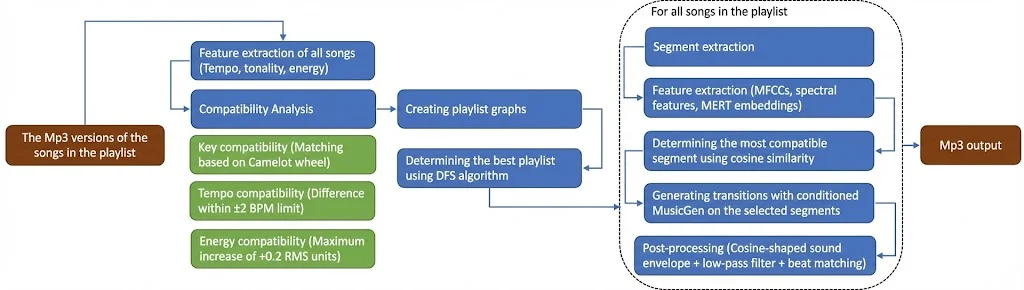
DJ-AI decides that friction is bad. Instead of mixing, it uses MusicGen, a Meta AI tool, to generate a “bridge.” If Song A and Song B don’t match, the AI just writes a new, fake piece of music to connect them. It is additive mixing. It pastes over the cracks with computer-generated filler.
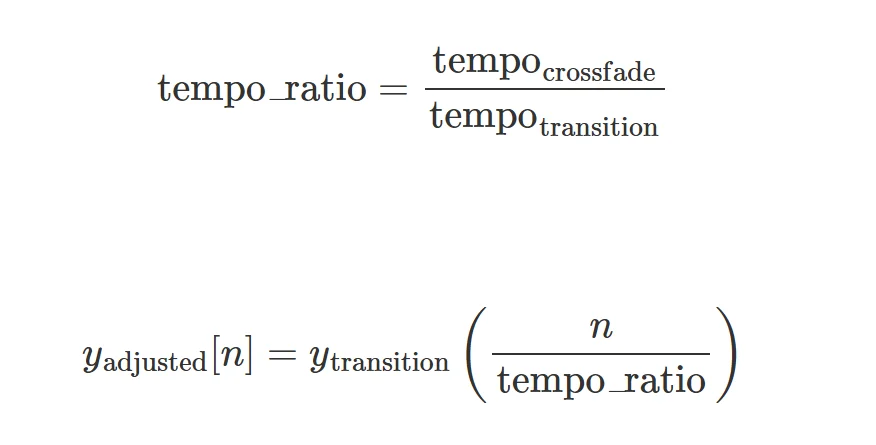
The researchers tested this on real people. The results were depressing. When listeners compared human crossfades to these AI-generated bridges, they preferred the AI 70.5% of the time.
Even worse, they said the AI felt more “natural.”
This number isn’t a success; it is an indictment of modern ears. We have been so conditioned by smooth, algorithmic playlists that we now think a soulless, computer-generated bridge sounds more “natural” than a human hand on a mixer. We have become allergic to the “clash.” We don’t want to hear the DJ work anymore. We just want a seamless, endless gray sludge of sound.
Meet the “Vibe Manager”: Will AI Demote DJs to Supervisors?
If the computer picks the songs (Graph Optimization) and the computer plays the mix (MusicGen), what is the human doing?
The researchers use a fancy term for this: “non-contact bodywork.” It’s a polite way of saying “standing there.”
The theory claims that the DJ’s job is just to manage the energy of the room. But if DJ-AI handles the technical work, the DJ is demoted. The DJ of 2026 isn’t a performer. They are a middle manager for an algorithm. They are just a “Vibe Manager,” watching the crowd and telling the software to “go faster” or “go slower.”
The “liveness” of the show is gone. You aren’t watching a musician; you are watching someone supervise a laptop.
Are Generative Frameworks Ruining the Fun?
There is a sad irony here. We used to complain that electronic music was too robotic. But when we finally built a robot that could DJ, we decided we liked it better than people.
The 70.5% preference for DJ-AI proves that we don’t care about the craft. We don’t care about the risk of a bad mix or the thrill of a weird key change. We just want the background noise to never stop. The AI bridge is perfect, smooth, and completely empty. The drop isn’t coming. The bridge is just getting longer, and we are too bored to notice.

Frequently Asked Questions
What is the DJ-AI framework presented at Audio Mostly 2025?
DJ-AI is a novel automated DJing system presented by researchers from Sabanci University. Unlike traditional auto-mixers that simply fade volume, DJ-AI uses Graph-Based Optimization (specifically Depth-First Search) to organize playlists and Generative AI (MusicGen) to create new audio bridges between songs.
Why did listeners prefer AI transitions 70.5% of the time?
In blind listening tests, participants preferred DJ-AI transitions over traditional amplitude-based crossfades 70.5% of the time because they felt more “natural.” The generative model eliminates the harmonic and rhythmic clashes typical of human mixing by synthesizing a bridge that perfectly modulates between the two tracks.
How does MusicGen work in the DJ-AI system?
MusicGen is a transformer-based model from Meta used by DJ-AI to perform “additive mixing.” Instead of layering two tracks on top of each other (subtractive mixing), the system analyzes the melody and rhythm of the outgoing and incoming tracks and generates a brand new piece of audio to bridge the gap seamlessly.
What is “non-contact bodywork” in the context of AI DJing?
“Non-contact bodywork” is a sociological concept describing how DJs manipulate the physical state of a crowd (heart rate, movement, sweat) without physical touch. As AI automates the technical labor of beatmatching, the DJ’s role shifts almost entirely to this “bodywork,” effectively turning them into a “Vibe Manager” who directs the algorithm based on crowd energy.
Will AI replace human DJs by 2026?
While AI likely won’t fully replace the “superstar” DJ personality, the DJ-AI framework suggests a future where the technical skill of mixing is obsolete. The role will likely evolve into a supervisory position where the human curates the vibe while the machine handles the execution, raising questions about the authenticity of “live” performance.
Sources
- Kınay, O., Tekdemir, M. B., Gökyılmaz, G., Yavuz, E., Ay, B., & Balcısoy, S. (2025). DJ AI: Optimizing Playlist Alignment and Generating Transitions with Generative and Embedding Models. Proceedings of the 20th Audio Mostly Conference.(https://research.sabanciuniv.edu/52373/1/AI_DJ_AM2025.pdf)
- Holmes, H., Crossley, N., & Park, G. (2023). ‘If God is a DJ’: Heritage Rave, the Ageing Raver and the Bodywork of the DJ. ResearchGate.(https://www.researchgate.net/publication/378710943_’If_God_is_a_DJ’_Heritage_Rave_the_Ageing_Raver_and_the_Bodywork_of_the_DJ)
- Copet, J., et al. (2023). Simple and Controllable Music Generation (MusicGen). Meta AI Research.(https://github.com/facebookresearch/audiocraft)
* generate randomized username
- COMMENT_FIRST
- #1 Lord_Nikon [12]
- #2 Void_Reaper [10]
- #3 Cereal_Killer [10]
- #4 Dark_Pulse [9]
- #5 Void_Strike [8]
- #6 Phantom_Phreak [7]
- #7 Data_Drifter [7]
- #8 Cipher_Blade [6]