In November 2025, Ottawa’s electronic music community welcomed Plantains&Caviar, a new weekly event series that’s doing something surprisingly radical: centering Black DJs in a scene that built itself on their innovations while systematically erasing them. Every Sunday at City Afterlight, the Konekt collective runs free parties featuring emerging DJs who rarely get booked at the city’s bigger venues. On the surface, it sounds like just another night out. But dig deeper, and you’re looking at direct pushback against decades of cultural appropriation.
According to the event founder, Plantains&Caviar represents something deeper than just a party series:
So grateful to be announcing my new residency at City Afterlight. Starting September 28th, Plantains & Caviar will be hosted every Sunday from 8-Late. This is a full circle moment for me. I touched a pair of CDJ’s for the first time in this venue. As I grew more comfortable, I fell in love with the space, the people, the ambiance, and most of all, the feeling of experimenting with music. This will be an outlet for personal discovery of black culture & influence in the music scene. I’m ecstatic for what’s to come. Above all else, I hope this space fosters connection, conversation, community & creativity.- princia.c
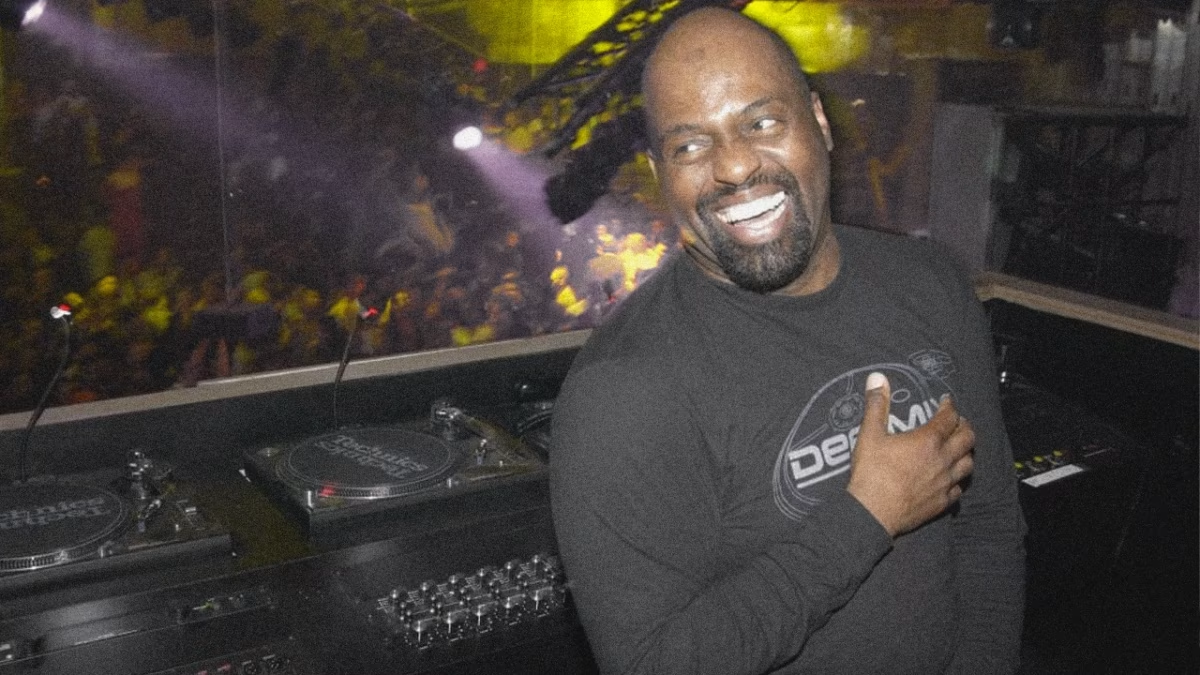
House music was born in 1980s Chicago, specifically in the Black and queer clubs where DJ Frankie Knuckles, known as the “Godfather of House,” remixed disco and soul records over drum machines in what was essentially a creative act of resistance. Knuckles wasn’t inventing something from nothing. He was taking the music of his community, transforming it, and creating safe spaces where Black and queer people could escape a homophobic, racist world. That sound spread globally, built empires, and became one of the most profitable genres in history. But somewhere along the way, whiteness colonized it. Today, if you scan lineups at major festivals and clubs, you’d think house and techno were created in Berlin, not the Bronx and Detroit.
The numbers are damning. Only 5% of dance music tracks in production are made exclusively by women and non-binary artists. On festival lineups? Just 28% of DJs identify as women or genderqueer, and almost none headline. The top-earners remain overwhelmingly white men like Calvin Harris, David Guetta, and Tiësto, artists who profited from a genre they didn’t create. Meanwhile, the artists from the communities that invented electronic music are struggling for bookings, getting tokenized with warm-up slots, and paid less than their white counterparts for the same work.
This erasure didn’t happen by accident. It’s systemic. “Techno has been whitewashed to the point where people would never consider it as being Black Music,” explains electronic music producer MCR-T. The result: a global electronic music industry worth billions, built on Black innovation, run by white gatekeepers.
Why Frankie Knuckles’s Warning Against Ego is the Soul of House Music
AI Is Making It Worse
Just when things seemed like they might shift, technology arrived to supercharge the problem. In November 2025, an AI musical artist topped the U.S. Billboard charts for the first time. Generative AI has made producing music absurdly simple, text prompts now generate full instrumentals, and platforms like Suno AI and Udio let anyone create convincing tracks in seconds. The democratization sounds good in theory. In practice, it’s targeting Black artists.
“What do we see first? Drake, The Weeknd, Kendrick Lamar, that is, Black artists,” notes music producer Mason Taylor. “I think the obvious answer is people come to Black artists for the creativity. We’re the most creative ones.” Black artists are being deepfaked and replicated without consent or compensation. Their likenesses and styles become training data. Their cultural production gets commodified, again, by people outside the community.
More than 50,000 AI tracks now upload to streaming platforms daily, a 400% increase since January 2025. Many are fraudulent cash grabs. Others are disturbing: AI-generated renditions of dead Black musicians, synthetic versions of living artists’ voices used without permission. The copyright system, historically rigged against Black artists, offers almost no protection.
“If you look at the industry right now, imitation is becoming the real thing,” says Grammy-nominated artist Syleena Johnson. “This is what we’ve allowed. This is what we’ve facilitated. This is what wins.” What wins, in other words, isn’t the original creators, it’s the technology, the algorithm, the white company profiting off their absence.
The Scene Is Collapsing Anyway
The irony? The clubs where this music gets played are closing en masse. Berlin’s Watergate, one of the world’s most iconic techno venues, shut down at the end of 2024, citing unsustainable rents and collapsing tourism. The venue had survived three decades of electronic music evolution. It couldn’t survive rising costs and new housing developments. Management said what everyone’s thinking: “The days when Berlin was flooded with club-loving visitors are over.”
This isn’t unique to Berlin. Across Europe, nightclubs are dying. The UK lost 37% of its clubs between 2020 and 2024, 1,700 venues down to 787. At that rate, the country will have zero nightclubs by 2030. Rising rents, labor costs, stricter regulations, noise complaints from gentrifying neighborhoods, it’s the classic urban death spiral. Venues get priced out, real estate investors move in, and the community that built the culture gets scattered.
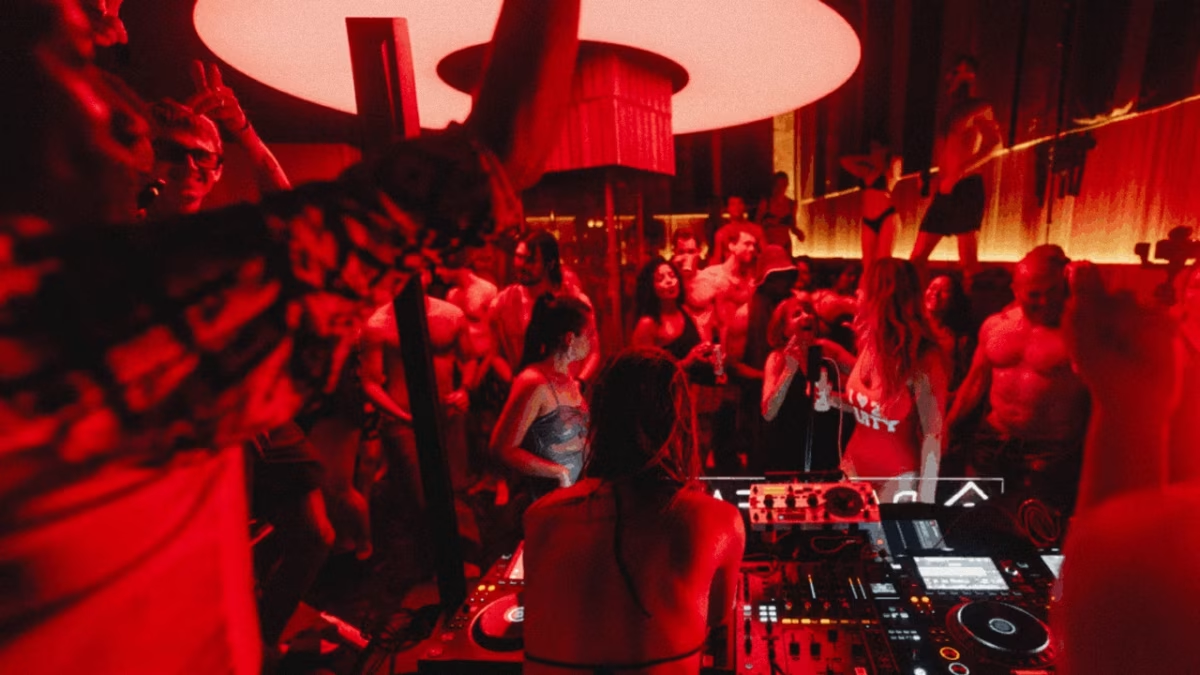
Morning Raves, Sauna Clubs, and the Soft Clubbing Scene You’re Already Missing Out On
Meanwhile, Gen Z is redefining what partying even means. More than 61% of young people say they want to drink less to prioritize sleep, fitness, and mental health. Soft clubbing, alcohol-optional, wellness-focused raves, exploded in 2025, with sober-curious event attendance up 92%. Morning dance parties replaced 4 a.m. ragers. Cold plunges got DJ sets. It’s not hedonism, it’s optimization.
The point: the infrastructure of electronic music is crumbling, the original creators are invisible, and the technology that could amplify them instead extracts their culture. Into this mess, Plantains&Caviar exists.
What Plantains&Caviar Actually Does
It’s not flashy. Free entry. Emerging DJs. Pan-African electronic music. Names like @djdynamiite, @j_hamms, @temiiolawoye, and @princia.c, artists who probably wouldn’t get booked at the bigger rooms, who might struggle for recognition in a city where the scene still defaults to whiteness. The collective isn’t running a charity, they’re running restoration. They’re making space for the people the industry systematically excludes.
This approach has precedent. In Los Angeles, Rave Reparations offers 50% discounts or free tickets for Black, Brown, and queer people. London’s INFERNO creates queer-only spaces. Future1000, a program by DJ Jaguar, trained 1,000 women and genderqueer people to DJ by 2022, not charity work, but deliberate skill redistribution. These initiatives understand that inclusion isn’t about tokenism. It’s about reconstruction.
The broader movement, Make Techno Black Again, acknowledges the obvious: electronic music belongs to Black communities, always has, and the scene needs to stop pretending otherwise. Archiving practices by DJs and producers now function as direct resistance to cultural amnesia. Vinyl collection documentation, oral histories, sonic preservation, it’s all labor to prevent erasure.


The Real November Story
November 2025 exposed electronic music’s fundamental contradiction. The industry celebrated the Anyma and Solomun collaboration, festival expansions into Asia, and AI’s “democratization” of production. Simultaneously, Berlin’s most famous club died. AI threatened Black artists’ livelihoods. Women and queer DJs remained systematically underpaid and underbooked.
Plantains&Caviar doesn’t solve these problems. It won’t save nightclubs or stop AI appropriation or dismantle the copyright system that enables exploitation. What it does is create a single Sunday night where emerging Black DJs know they’ll play. Where their music gets amplified. Where the history of electronic music gets acknowledged correctly, not as a European creation, but as Black innovation that the world borrowed, profited from, and forgot to credit.
That’s not radical by most standards. By the standards of an industry built on forgetting where it came from, it’s revolutionary.
FAQs
What is Plantains&Caviar Ottawa?
Plantains&Caviar is a free weekly event series launched in November 2025 at City Afterlight in Ottawa. Hosted by the Konekt collective every Sunday, it features emerging Black DJs performing Pan-African electronic music and directly addresses underrepresentation in the scene.
Why is Black representation important in electronic music?
House and techno were invented by Black and queer communities in 1980s Chicago and Detroit, yet the industry remains overwhelmingly white and male-dominated. Black artists created a multi-billion dollar genre but struggle for bookings, fair pay, and recognition while white artists profit from their innovations.
How is AI threatening Black musicians in electronic music?
Over 50,000 AI tracks upload to streaming platforms daily using Black artists’ voices and styles without consent or compensation. AI deepfakes and synthetic renditions of Black musicians are proliferating while the copyright system offers almost no protection for original creators.
Sources:
- Capital Current – New Ottawa event series creates safe space for Black rave culture
- Mixmag – MCR-T interview on Black music in techno
- EDM House Network – New EDM Friday Releases November 2025
- Eventbrite – Gen Z’s “Soft Clubbing” Proves the Party Isn’t Over
- Racism.org – Lift Ev’ry Voice and Sing: Tracing the Legacy of Appropriation
- Refinery29 – When Artificial Intelligence Makes Black Music, Who Really Wins?
- CDA Magazine – Anyma and Solomun Release Till I Die
- NSS Magazine – The Decline of Nightclubs: Nightlife Crisis in Europe
- IASPM – DC25: Preserving and Archiving Electronic Music
- Taylor & Francis – Records as records: excavating the DJ’s sonic archive
- Rolling Stone India – Asia’s Unmissable Music Festivals 2025
- This Is Gendered – Rave
- Instagram – Plantains&Caviar and emerging DJs
- Section Yellow – Soft Clubbing: 10 Ways Gen Z Is Redefining Nightlife
- KJ Archives – EDM’s roots in Black America: Chicago House
- Euronews – Breaking Rust: AI artist tops US chart for first time
- Carnegie Hall Timeline – History of House
- Digital Music News – Deezer Says 50000+ AI Tracks Are Being Uploaded Daily
- WTTW Chicago Stories – House Music: A Cultural Revolution
* generate randomized username
- COMMENT_FIRST
- #1 Lord_Nikon [12]
- #2 Void_Reaper [10]
- #3 Cereal_Killer [10]
- #4 Dark_Pulse [9]
- #5 Void_Strike [8]
- #6 Phantom_Phreak [7]
- #7 Data_Drifter [7]
- #8 Zero_Cool [7]