
If you were around for the chaotic, HTML-broken glory of the Myspace era, you remember the promise. It was a messy, glitter-graphic utopia where a band could upload a track, code a player into their profile, and, crucially, send you wherever they damn well pleased. The hyperlink was the currency of the early social web, a free wormhole connecting a kid in a bedroom to a ticket vendor, a merch store, or a blog review. It was the “Open Web,” and for the music industry, it was the closest thing to a digital democracy we ever had.
- Meta's "Pay-to-Link" Policy: Meta is restricting professional accounts to two external links per month, with additional links requiring a "Meta Verified" subscription, impacting independent music industry professionals and promoters disproportionately.
- The Impact of the Algorithm: Meta's algorithm penalizes external links, prioritizing "Time on Platform" and favoring native content, which hinders the ability of artists, particularly DJs due to copyright restrictions, to effectively share their work and drive traffic to external platforms.
- Shift Towards "Owned Data": Due to the limitations, the music industry is shifting towards strategies focused on direct communication, such as newsletters and SMS messaging, to maintain control over audience engagement and bypass algorithm restrictions on social media platforms.
As of December 2025, that era is definitively, legally, and algorithmically dead.
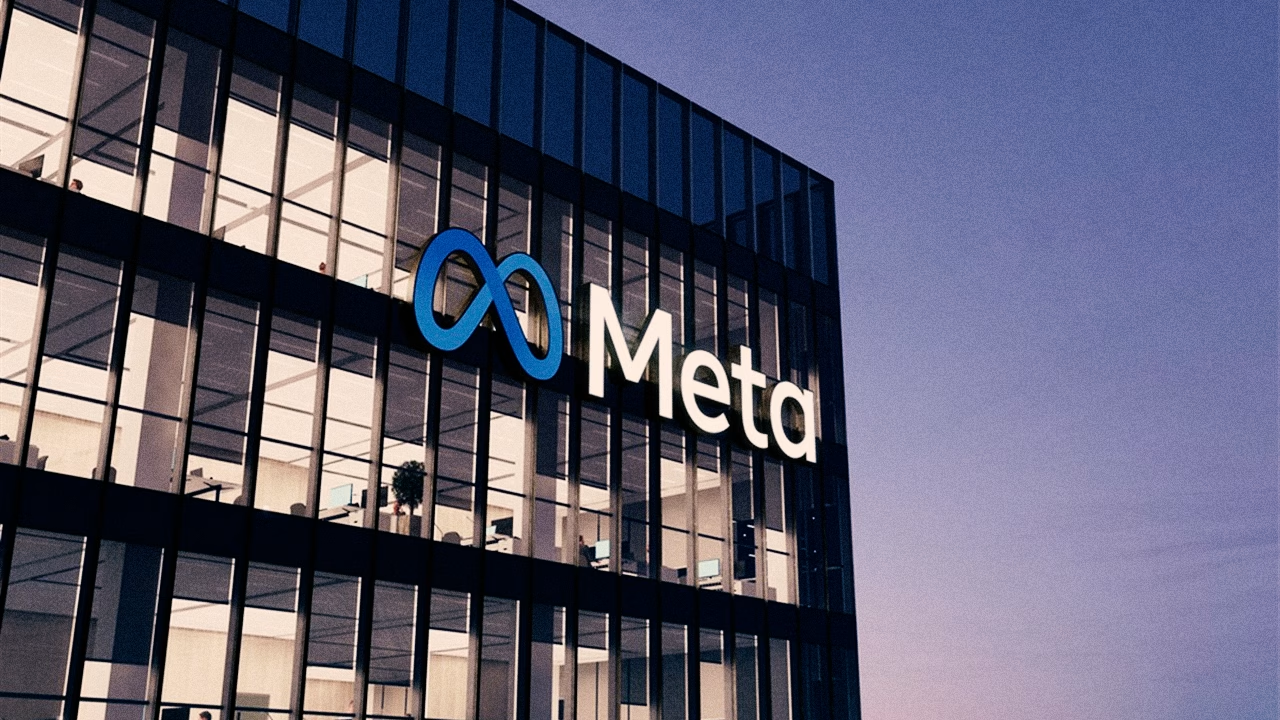
Meta, the corporate monolith formerly known as Facebook, has initiated a test that feels less like a feature update and more like an eviction notice for the independent working class of the music industry. The new policy is deceptively simple: Professional accounts, such as your favorite indie label, that techno DJ you saw in Berlin, or the local promoter trying to fill a basement club, are now restricted to posting exactly two external links per month. Want to post a third link to your new Bandcamp release? That will be $14.99 a month, please. Welcome to the era of the “Pay-to-Link” internet. 1
This isn’t just a policy tweak; it is the final stage of what author Cory Doctorow termed “enshittification”, the slow, inevitable decay of online platforms where value is first harvested from users, then business customers, until the only thing left is a friction-filled husk designed to extract rent. For the music ecosystem, the “Two-Link Limit” is a catastrophic restructuring of the digital economy, turning the once-open highway of social traffic into a private toll road where only the verified can survive.

Comfort Kills Creativity: Why the Art of DJing is About Risk
How the squeeze actually works
To understand the absurdity of the current moment, you have to look at the granular mechanics of Meta’s new “test.” As of mid-December, professional pages and profiles in the US and UK began receiving notifications that their ability to link out, to leave the walled garden, was being capped.
The rules are Kafkaesque in their specificity. You get two “organic” posts with links per calendar month. Use one for your tour announcement and one for your new single, and you are effectively silenced for the next 28 days. To unlock unlimited linking, you must subscribe to “Meta Verified”, a service that costs between $11.99 and $14.99 per month for individuals, and up to $499 for complex business assets.
Meta’s justification is the standard corporate boilerplate about “reducing spam” and “promoting native content”. They argue that 98% of feed views already come from posts without links, implying that users want to stay trapped in the scroll. But for artists, this statistic is a self-fulfilling prophecy. We don’t post links because we hate them; we don’t post them because the algorithm has spent the last five years punishing us for doing so. 2
In 2023, posts with external links saw their reach throttled by about 50%. By late 2025, data suggests that penalty has deepened to nearly 80%. The algorithm is designed to prioritize “Time on Platform.” An external link is a leak in the hull of the USS Zuckerberg. It lets attention escape to Spotify, to Ticketmaster, to Pitchfork. By capping links and charging for the privilege, Meta is essentially taxing the exit doors.
The portfolio tax is coming for indies
The impact of this policy is not evenly distributed. For a major label like Universal or Sony, a $14.99 monthly fee per artist page is a rounding error, a microscopic line item in a marketing budget that rivals the GDP of a small island nation. But for the independent sector, this fee represents a “Portfolio Tax” that threatens to bankrupt the middle class of music marketing.
Consider a mid-sized independent label managing a roster of 40 active artists. In the old world, managing these pages was a matter of time and creativity. In the new Meta regime, unlocking the basic functionality of the internet for that roster costs upwards of $7,000 a year. That is the budget for a music video, a tour van repair, or a press campaign. It is money that is no longer going into art; it is going into rent.
For the independent promoter or the “bedroom” DJ, the situation is even bleaker. These are the “street teams” of the digital age, relying on high-volume sharing to move tickets and build buzz. A promoter who needs to share ticket links for five different club nights a week is now functionally obsolete on the platform unless they pay. The “guerrilla” marketing tactics that built scenes from 90s rave culture to 2010s SoundCloud rap, such as spamming flyers, sharing Mixcloud links, or dropping tracks in groups, are being legislated out of existence.

The indignity of ‘Link in Comments’
If you want to see the indignity of the modern digital artist, look no further than the comment section. For years, savvy users have tried to outsmart the algorithm by posting a photo and writing “Link in Comments”. It was a desperate hack, a way to signal to the machine, “Look, I’m just sharing a picture, not trying to leave!”
Meta, in a twist of benevolence that feels entirely calculated, has exempted “links in comments” from the two-link limit. But this exemption is a trap. The user experience of digging through a comment thread, filtering out spam bots and “Great vibe!” auto-replies to find a ticket link, is atrocious. It introduces massive friction, and in the attention economy, friction is death.
Furthermore, the algorithm has evolved. It can now read the text in your image and your caption. If it detects “Link in bio” or “Link in comments,” it often applies a “semantic penalty,” classifying the post as “engagement bait” and suppressing it anyway. The artist is left performing a digital pantomime, trying to sell a product without ever using the words “buy,” “ticket,” or “link.” It is marketing by way of interpretive dance, performed for an audience of bots. 3
Why DJs can’t just ‘stay native’
Meta’s defense is that creators should focus on “native content”, meaning videos and audio uploaded directly to Facebook and Instagram. For a pop star lip-syncing to their own track, this works. For a DJ, it is a legal minefield that usually ends in silence.
DJs exist in a copyright gray zone. Platforms like Mixcloud and SoundCloud have spent years negotiating complex licensing deals that allow long-form mixes to exist legally. Facebook has not. If a DJ attempts to “stay native” by uploading a 60-minute techno set directly to Facebook Video to avoid the link cap, the platform’s Content ID system will almost certainly flag it. The video will be muted, blocked, or the account will be struck. 4
This leaves the DJ in an impossible bind. They cannot link out to the legal platforms (Mixcloud) because of the two-link cap. They cannot upload natively because of copyright filters. The result is the erasure of DJ culture from the social timeline. We are seeing a pivot to “Mini-Mixes”, 15-second clips that fly under the radar, but the art form of the long-mix, the journey, is being pushed back underground, off the social web and into the dark web of Discords and private Telegram channels.
Enter the smart link industrial complex
In response to these constraints, a secondary industry has boomed: the “Smart Link” aggregators like Linkfire, ToneDen, and Linktree. These tools have become the necessary middlemen of the music business. Since you only get one “Link in Bio” or two “Power Links” a month, that link has to do everything. It has to be a Swiss Army knife: a ticket seller, a Spotify streamer, a merch store, and a newsletter sign-up form all at once.
There is a grim irony here. The internet was designed as a decentralized web of infinite connections. We have broken it so thoroughly that we now rely on centralized landing pages to act as traffic cops for our own content. And even these tools are not safe. The “Two-Link Limit” test currently has exemptions for “supported affiliate links,” but the definition of “supported” remains terrifyingly opaque. Does a major label’s Linkfire URL count as supported? Probably. Does an indie artist’s homemade landing page? Probably not. We are moving toward a tiered internet where corporate-sanctioned traffic flows freely, and independent traffic pays the toll. 5
The verified caste system
The introduction of “Meta Verified” creates a literal caste system on the platform. The blue checkmark, once a signifier of public interest or authenticity, is now simply a receipt. It proves you have $14.99 and a credit card.
For the artist, the value proposition is cynical but compelling. The subscription includes “impersonation protection”, a feature that arguably should be a basic right on any secure platform, not a premium add-on. In an era of AI deepfakes and rampant scamming, Meta is effectively selling artists protection from the platform’s own inability to police itself.
Moreover, Meta has hinted that verified subscribers will receive “increased visibility” in search and recommendations. This is the quiet part said out loud: Organic reach is over. If you want to be seen, you must pay. The “Feed” is no longer a meritocracy of coolness; it is a billboard, and the rent is due monthly.
Your Favourite DJ Is Dying (Eventually): Inside EDM’s Brutal Ageism Problem
The strategy for 2026: Burn the ships
So, where does this leave the music industry as we stare down the barrel of 2026? The smart money is on a retreat from the front lines. The most forward-thinking managers and labels are realizing that building a business on “rented land”, social media platforms that can change their terms of service on a whim, is a fool’s errand.
The strategy now is “Owned Data.” The newsletter is having a renaissance not because it’s sexy, but because it’s safe. An email list cannot be algorithmically throttled. A text message (SMS) has a 98% open rate compared to Facebook’s 2% organic reach. We are seeing a return to the “Web 1.0” tactics: direct communication, physical QR codes in clubs, and the desperate hoarding of phone numbers.
Artists are treating social media not as a community hub, but as a funnel. The goal is no longer to “build a following” on Facebook; the goal is to siphon that following off Facebook as quickly as possible before the next tax hike. The “Two-Link Limit” is the signal to burn the ships.
The silence of the feed
The tragedy of the “Two-Link Limit” isn’t just financial; it’s cultural. The social web was the engine of music discovery for a generation. It was how we found the weird, the new, the counter-cultural. By disincentivizing external links, Meta is homogenizing the internet. We are being trained to consume only what is served to us on the platter of the Feed: native video, algorithmic recommendations, and paid boosts.
The “Open Web” was a messy, chaotic party where anyone could grab the aux cord. The new “Zero-Click” web is a VIP lounge. The music is playing, the drinks are expensive, and if you want to tell your friends where the real afterparty is, you’re going to have to pay the bouncer.
Strategic Takeaways for the Industry:
- The Pulse Strategy: Subscribe to Meta Verified only during key campaign months (album cycles, tour on-sales) to unlock links, then cancel. Treat it as ad spend, not a utility.
- The Hub Model: Never link to a single destination. Use aggregators (Linktree/Linkfire) to ensure your two monthly links offer maximum “surface area” for conversion.
- The Pivot to Owned: Aggressively move fans to Email and SMS. These are the only channels immune to “enshittification”.
- Native First: Accept that Facebook is now a broadcast TV channel, not a web browser. Post native video (Reels) to build brand, but do not expect it to drive traffic.
Frequently Asked Questions
1. Does the two-link limit apply to my personal profile? The restriction specifically targets “Professional Mode” profiles and Business Pages. If you are using a standard personal profile without Professional Mode enabled, you are currently exempt from the limit. However, most serious artists and promoters use Professional Mode to access analytics and monetization tools, meaning they will be forced to choose between data access and link freedom.
2. Can I get around the limit by posting links in the comments? Yes, technically. Meta has explicitly stated that links placed in the comments section do not count toward your monthly allowance. However, this comes with a “hidden” cost: user friction. Comments are often collapsed or hidden by default, forcing fans to click multiple times to find the link. Furthermore, the algorithm may still penalize the main post if it detects “engagement bait” language like “Link in comments” in the caption.
3. Are links to major platforms like Spotify or Bandsintown exempt? Generally, no. The exemptions are currently limited to Meta-owned properties (Instagram, WhatsApp) and “supported affiliate links.” While the definition of “supported” is vague, standard links to Spotify, Bandsintown, or your own website count against your two-link cap. Unless you are using a specific partner program that Meta has whitelisted, you should assume every external click will cost you one of your two slots.
* generate randomized username
- Two links? Seriously? Meta's just squeezing every last drop from creators. i bet musicians will just find workarounds, like link aggregators or just plain ditching facebook. This "pay-to-link" thing seems like a desperate move that'll backfire spectacularlly.
- This is an intresting development for musicians and the music industry. i can see how limiting external links will impact reach, especially for smaller artists who rely on social media for promotion. Will b curious to see how this "test" plays out long term tho.
- Oh, goody. i guess the open web was just a limited-time offer? i'm sure this two-link limit will totally foster organic growth and not at all funnel everyone into Meta's already overflowing money pit. How innovative of them...really! This si totally going to help those artists.
- Only two links, huh? guess my dreams of becoming a hyperlinking virtuoso are officially dashed. so much for my ambition to connect the entire internet to my cat's soundcloud. at least i have til december 2025 to enjoy the free reach. i should make hte most of it.
- Oh great, first my uncle starts sharing conspiracy theories, now facebooks charging bands to share their music. I guess its back to myspace! i just hope tom is doing okay, lol. Maybe i'll even learn HTML again.
- this is the worst shit ive read for awhile, meta fking facebook
- Please be advised that this feature is currently undergoing pilot testing in the UK and US markets
- When are people going to realize open source options are the best tools for long term survival. Migrating to Mastodon and Bluesky takes power away from FB and X, and gives user full control of data without corporate imposed limits and fees to suck you dry.
- #1 Lord_Nikon [12]
- #2 Void_Reaper [10]
- #3 Cereal_Killer [10]
- #4 Dark_Pulse [9]
- #5 Void_Strike [8]
- #6 Phantom_Phreak [7]
- #7 Data_Drifter [7]
- #8 Cipher_Blade [6]