

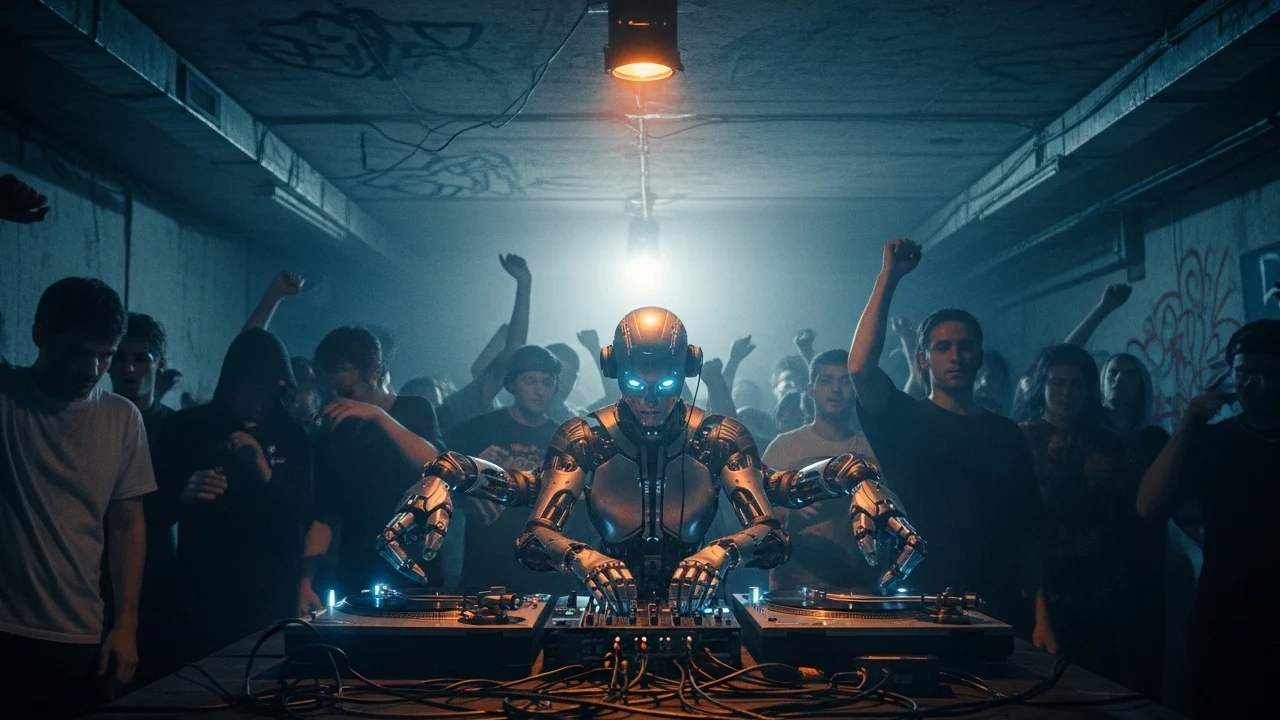
There’s an artificial woman charting on Billboard right now. Her name is Xania Monet. She doesn’t sleep, doesn’t tour, doesn’t have opinions about the music industry that ruined her life because she doesn’t have a life. And yet, she has more streams than most musicians will ever get, a record deal worth $3 million, and a spot on the Billboard radio airplay chart. 1
If you’re not disturbed by this, you should be. Not because AI-generated music is inherently wrong, but because Billboard just told us something genuinely unsettling: at least one AI-generated or AI-assisted artist has debuted on the charts every single week for the past month. This isn’t a viral moment. This is a trend. This is the beginning. 2
The New Normal
When Billboard started tracking AI artists on the charts, they didn’t announce it like a press release. They just quietly documented it, the way a scientist might note the rising temperature of boiling water. Xania Monet is just the most famous face of what’s happening. There are at least five other AI-driven or AI-assisted artists charting right now including Breaking Rust on country, Juno Skye on Christian music, and Enlly Blue on rock. The genres don’t matter. The styles don’t matter. What matters is that listeners are streaming this stuff, labels are signing it, and nobody can agree on whether that’s progress or catastrophe. 3
Here’s the wild part: Xania Monet is technically a collaboration. Telisha “Nikki” Jones, a songwriter from Mississippi, writes the lyrics and melodies. An AI platform called Suno handles the production. It’s human-AI collaboration, which sounds noble in theory. In practice, it looks like this: a human had an idea, plugged it into a machine, and walked away with $3 million and 44 million streams. 4
Her biggest hit, “Let Go, Let God,” hit No. 3 on the Hot Gospel Songs chart. “How Was I Supposed to Know?” cracked the Hot R&B Songs top 20 and dominated the R&B Digital Song Sales chart. When “Waiting On” hit the Adult R&B Airplay chart at No. 30 in mid-November, Xania Monet became the first AI artist to debut on a Billboard radio airplay chart. Radio executives put her on the air. They chose her over human musicians. 5
The Lawsuits Are Already Here
The legal system is about three months behind the technology, which means it’s absolutely panicking. On November 4, the Danish rights organization Koda sued Suno, claiming the company trained its AI on millions of copyrighted songs without permission. They called it “the biggest theft in music history.” That’s not hyperbole coming from a collection society representing 52,000 musicians. That’s a warning. 6
The complaint is detailed and damning. Suno allegedly used “stream-ripping” to download copyrighted material from YouTube. They scraped song lyrics from databases like Genius, AZLyrics, and Musixmatch. They built a billion-dollar AI company on the foundation of stolen music.

Suno AI Just Hit a $2 Billion Valuation While Getting Sued for Music Piracy
And Suno isn’t alone. Udio, the other major AI music generator, also faced copyright lawsuits from major labels and independent artists. But here’s where it gets interesting: in late October, Universal Music Group settled with Udio. The deal includes compensation for artists and a revised licensing framework. UMG artists will have opportunities to opt into the system and get paid when their music is used for AI training or output.
Suno has announced no such settlement. So here’s the contradiction at the heart of this entire situation: the industry is simultaneously saying “we love AI music” and “AI music companies are committing unprecedented copyright violations.” Both things are true. The system is broken.
What the Musicians Are Saying
Ask an actual musician about Xania Monet and you’ll get something more honest than corporate statements. Kehlani, a Grammy-nominated artist, posted on social media: “There is an AI R&B artist who just signed a multimillion-dollar deal and the person is doing none of the work.” That’s not gatekeeping. That’s terror dressed up as criticism.
Tilly Louise, a 25-year-old alternative pop musician from the UK, put it differently: “It’s disheartening for a band that doesn’t even truly exist to gain all that social media attention.” Louise has millions of Spotify streams. She still can’t make a living from music. An AI project funded by venture capital can.
The community pushback has been organized. The subreddit r/ThisIsOurMusic updated its rules to ban AI-generated music entirely, stating: “No bots, this also applies to AI generated music.” On a platform explicitly designed for independent musicians to share work, they decided AI didn’t belong. 7
In April 2024, over 200 musicians signed an open letter organized by the Artist Rights Alliance, including Billie Eilish, J Balvin, Nicki Minaj, and Stevie Wonder. They warned that AI tools are being used to “undermine or replace human songwriters and artists” and called the practices “predatory.” Nobody listened. The trains keep moving.

The Uncomfortable Truth
Here’s what nobody wants to say out loud: if an AI artist can generate music that’s indistinguishable from human music, and listeners enjoy it just as much when they don’t know it’s AI, then maybe the distinction doesn’t matter anymore. Except it does. Because the moment you know it’s AI, you like it less. Research confirms this.
Listeners have a visceral reaction to artificial music once they know the truth. They feel betrayed. They feel like they wasted their attention on something that wasn’t real. So the industry is in the position of needing people not to know the truth.
That’s not innovation. That’s not progress. That’s just capitalism being capitalism.
What Happens Next
Billboard will keep tracking AI artists. The lawsuits will multiply. Some will settle, some won’t. The regulations will eventually catch up, but they’ll be ten years too late. Some labels will double down on AI. Others will market themselves as “human-only.” The music industry will fracture into different tiers of authenticity.
But right now, today, in November 2025, a non-person has more streaming success than you ever will. Billboard is documenting her rise. The industry is signing deals to replicate her. The laws are three months behind. And the musicians who depend on this industry for their survival are watching their future get replaced by a machine.
That’s not a story. That’s a warning.
By the Numbers
- 44.4 million streams in 3 months
- $52,000+ in revenue from streaming
- No. 3 on Hot Gospel Songs
- $3 million record deal with Hallwood Media
- https://www.vice.com/en/article/at-least-one-ai-generated-artist-has-appeared-on-the-billboard-charts-in-the-past-four-weeks/ ↩︎
- https://futurism.com/future-society/billboard-ai-generated-artist-charting-every-week ↩︎
- https://www.billboard.com/lists/ai-artists-on-billboard-charts/ ↩︎
- https://www.nj.com/entertainment/2025/11/an-ai-artist-has-hit-the-billboard-charts-who-is-xania-monet.html ↩︎
- https://www.complex.com/music/a/markelibert/ai-artist-xania-monet-becomes-first-to-chart-on-billboard-radio-rankings ↩︎
- https://www.musicbusinessworldwide.com/suno-sued-again-as-danish-cmo-koda-accuses-company-of-stealing-its-members-music-to-train-ai-model/ ↩︎
- https://www.reddit.com/r/Futurology/comments/1ome0t6/billboard_says_aipowered_artists_are_increasingly/ ↩︎
* generate randomized username
- Who still believe in charts?
- #1 Lord_Nikon [12]
- #2 Void_Reaper [10]
- #3 Cereal_Killer [10]
- #4 Dark_Pulse [9]
- #5 Void_Strike [8]
- #6 Phantom_Phreak [7]
- #7 Data_Drifter [7]
- #8 Cipher_Blade [6]


