

Hey there. As a music business graduate from Full Sail University, a current student at Berklee Online, and a working DJ and producer, I’ve had a front-row seat (and often a spot behind the decks) for a transformative period in music history. The last 20 years, from 2004 to 2024, weren’t just an evolution for electronic music. We’ll draw the line at the close of 2024, as the history of the current year is still being written, allowing us to look back on a complete and seismic chapter. They were a revolution. The ground shifted beneath our feet, rewiring everything from the gear we use and the sounds we create to the way we build careers and connect with fans. We’ve gone from hauling crates of vinyl to carrying libraries on a USB stick, from underground raves to billion-dollar festivals, and from Myspace pages to TikTok algorithms that can create a superstar in 48 hours.
This is the story of how technology, culture, and business collided to redefine what it means to be a DJ and a fan. We’ll break down this shift into four key areas: the tech that changed the game, the genres that defined the sound, the new money behind the industry, and the cultural forces that reshaped the community. Let’s drop the needle on the last two decades.
A 20-Year Timeline of Key Milestones in Electronic Music & DJing (2004-2024)
| Year | Key Technological/Business Milestone | Key Genre/Cultural Moment |
| 2004 | Serato Scratch Live is released, popularizing DVS technology. | Beatport is founded, creating a digital marketplace for DJs. |
| 2005 | Tomorrowland festival is founded in Belgium. | Dubstep begins to gain traction online via forums and blogs. |
| 2007 | SoundCloud is founded, creating a new platform for artist discovery. | Native Instruments releases the VST synthesizer Massive. |
| 2008 | Serato releases Video-SL, allowing DJs to mix video files. | The “SoundCloud Era” begins to take shape, fostering new genres. |
| 2010 | Boiler Room is founded, popularizing the intimate DJ livestream format. | The “American EDM Boom” begins, led by artists like Swedish House Mafia. |
| 2011 | Electric Daisy Carnival (EDC) moves to Las Vegas, cementing its mega-festival status. | Skrillex’s “brostep” sound brings dubstep to the US mainstream. |
| 2013 | Pioneer’s XDJ-AERO introduces wireless music loading for DJs. | Kygo’s remixes popularize Tropical House, offering a softer alternative to Big Room EDM. |
| 2015 | The EDM “bubble” begins to burst, leading to festival cancellations like TomorrowWorld. | Future Bass and Melodic Trap rise in popularity on SoundCloud. |
| 2016 | Cercle is founded, elevating the DJ livestream to a cinematic art form. | The resurgence of techno and house music gains momentum in the underground. |
| 2019 | Beatport launches Beatport LINK, a streaming service for DJs. | TikTok’s influence on music virality becomes a dominant force. |
| 2020 | Pioneer DJ releases the CDJ-3000, removing the CD drive entirely. | The COVID-19 pandemic forces a massive, global shift to DJ livestreaming. |
| 2022 | Vinyl record sales surpass CD sales in the U.S. for the first time since 1987. | Amapiano, Afro House, and Hard Techno see significant growth on streaming platforms and Beatport. |
| 2024 | The global Electronic Dance Music (EDM) market is valued at over USD 10 billion. | AI-powered music tools become integrated into platforms like SoundCloud. |
Part I: A Revolution in Technology
The tools of the trade define the art form. Over the past 20 years, the DJ booth has transformed from an analog command center into a digital cockpit. This revolution didn’t just change how DJs play music. It altered who could become a DJ, what a live performance could be, and the sounds that define our genres.
1. The DVS Takeover: How Serato and Traktor Saved Turntablism
In the early 2000s, DJ culture was at a crossroads. The art form was built on the physical skill of mixing vinyl, but the future was digital, with MP3s offering way more convenience. This created a split. DJs had to choose between the craft of vinyl, with all its limits, or the digital world, which meant losing the hands-on control that defined the art. The solution was a game-changer:
Digital Vinyl Systems (DVS). Pioneered by software like Final Scratch (2001) and perfected by Serato Scratch Live (2004), DVS was a brilliant compromise. The system used special time-coded vinyl records or CDs that, when played on traditional turntables or CDJs, could control digital music files on a laptop. This gave DJs the best of both worlds: the feel and manipulation of their Technics SL-1200s with access to a digital library. DVS was a cultural bridge that prevented a fracture in the community. It allowed a generation of vinyl purists to step into the digital age without abandoning their skills or their record-playing hardware, ensuring that the art of turntablism would survive in a world without record crates. 1
2. The Rise of the CDJ King: Pioneer DJ’s Path from CD Player to Industry Standard
While DVS was saving turntablism, another piece of hardware was conquering the DJ booth: the Pioneer CDJ. Though the first model appeared in 1994, the CDJ-1000, released in 2001, became a legend. It was the first CD player to accurately emulate the feel of a vinyl turntable, complete with a large, touch-sensitive jog wheel that allowed for scratching and precise cueing.
Throughout the 2000s and 2010s, Pioneer DJ kept innovating, with models like the CDJ-2000NXS adding USB playback and integration with their Rekordbox music management software. This evolution led to the 2020 release of the CDJ-3000, a player that removed the CD slot entirely, a symbolic move that cemented the shift to digital files on USB drives. This established an 2 industry standard. Nearly every professional club and festival booth in the world is equipped with Pioneer CDJs. This created a powerful network effect. Promoters needed them, so DJs had to learn them, and new DJs wanted to practice on them. But this standardization also created a huge economic barrier, since a professional setup costs thousands of dollars, shaping the careers of DJs for a generation.

3. The Controller Revolution: How All-In-One Gear Democratized DJing
The high cost of a professional Pioneer setup left a gap in the market, which was filled by the all-in-one DJ controller. In the late 2000s, companies like Pioneer, Numark, and Denon began producing single units that combined two jog wheels, a mixer, and an audio interface, all powered by a laptop. Suddenly, the barrier to entry for DJing crashed. Instead of spending thousands, an aspiring DJ could get started with a model like the Pioneer DDJ-400 for a few hundred dollars.
This revolution democratized the art form on a huge scale, leading to a rise in “bedroom DJs” and an influx of talent from every corner of the globe. However, this accessibility had a downside: market oversaturation. The number of people who could DJ grew faster than the number of available professional gigs. According to research from Audience Strategies, 76% of electronic music artists do not consider their careers financially sustainable, with 82% needing to take jobs outside of music. This super-competitive environment meant that technical skill alone was no longer enough to build a career. The democratization of the tools fueled the need for DJs to become marketers and social media brands to stand out in a crowded field. 3
4. Ableton Live Goes Live: The DAW Leaves the Studio and Hits the Stage
Traditionally, the line between a music producer and a DJ was clear. Producers worked in the studio, and DJs performed in the club. Ableton Live, a Digital Audio Workstation (DAW) first released in 2001, blurred that line. Its game-changing “Session View” allowed for a non-linear, clip-based approach to music creation, a format that was perfect for live performance. Producers could now take the component parts of their studio tracks, like drum loops, basslines, and synth melodies, and reconstruct, remix, and manipulate them on the fly in a live setting. This was a new, hybrid form of electronic performance. This innovation encouraged a wave of producers to leave their studios and take to the stage, creating a new category of electronic artist: the producer-performer. This shift had a huge impact on the music landscape, fueling the growth of the festival circuit, which now had a new type of “live” headliner to book alongside traditional DJs. 4
5. The VSTs That Defined a Decade: The Sonic Impact of Synths like Massive and Serum
The sound of an era is often defined by its instruments. For the electronic music of the late 2000s and early 2010s, that instrument was often a piece of software. Native Instruments’ VST synthesizer, Massive, released in 2007, became the soundtrack for the explosion of dubstep and electro-house. Its wavetable synthesis engine and easy-to-use modulation made it the tool for creating the “wobbles,” “growls,” and leads that defined the sound of the EDM boom. 5
The adoption of a single tool like Massive led to a period of sonic homogeneity. For a time, it felt like every new dubstep track was built from a similar palette of sounds. However, this shared toolkit also created a global, digital classroom. With countless producers using the same synth, an online community of tutorials and forums emerged, boosting the skill level of a generation. Later, VSTs like Xfer Records’ Serum would build on this foundation, offering a more visual approach to sound design that made complex synthesis more accessible. These VSTs didn’t just provide new sounds. They provided a common language that a generation of producers used to learn, innovate, and define the sound of a decade.
Part II: A Kaleidoscope of Genres
The technological revolution of the 2000s was the catalyst for an explosion of new sounds. Genres were born on internet forums, rose to global domination on festival stages, and then fragmented into different sub-styles. The last 20 years have been a cycle of boom, bust, and rebirth, constantly reshaping the electronic music landscape.
6. The “Wobble” Heard ‘Round the World: The Meteoric Rise and Fragmentation of Dubstep
Dubstep began its life in the early 2000s in the underground clubs of London, a dark, minimalist sound focused on deep sub-bass and syncopated rhythms. By the late 2000s, it had crossed the Atlantic and changed. In the hands of American producers like Skrillex, the genre was cranked up into a high-energy, aggressive form often dubbed “brostep”. This sound, defined by its build-ups and an oscillating mid-range bass “wobble,” exploded into the mainstream between 2010 and 2012. 6
This trajectory illustrates a “boom-and-bust” cycle. The bass drop made the genre a commercial sensation, but it also became a creative dead end. The pressure to create increasingly intense drops led to a formulaic sound and audience fatigue. The mainstream bubble burst almost as quickly as it had inflated. The genre then fragmented, with many of its biggest stars moving on to other sounds, while a dedicated community of fans and producers took the genre’s core ideas back underground to evolve in new directions.
7. The American EDM Explosion: How “Big Room” House Conquered the Mainstage
Parallel to dubstep’s rise was the “EDM Boom” of 2010-2015, a period when electronic music entered the American mainstream. The term “EDM” was promoted by the U.S. music industry as a catch-all brand to package rave culture for a new audience. The sound of this era was “Big Room House,” a style engineered for festival stages.
Pioneered by artists like Swedish House Mafia and Martin Garrix, Big Room simplified the structures of progressive house and trance into a formula. It consisted of a melodic breakdown, a snare-roll build-up, and a minimalist drop designed for maximum impact. This was less a musical movement and more a marketing strategy. It transformed the groove-based experience of club music into a series of high-impact moments for crowds of tens of thousands at festivals like EDC and Tomorrowland. While criticized by purists for its commercialism, the EDM boom was the main reason electronic music became a force in global pop culture.
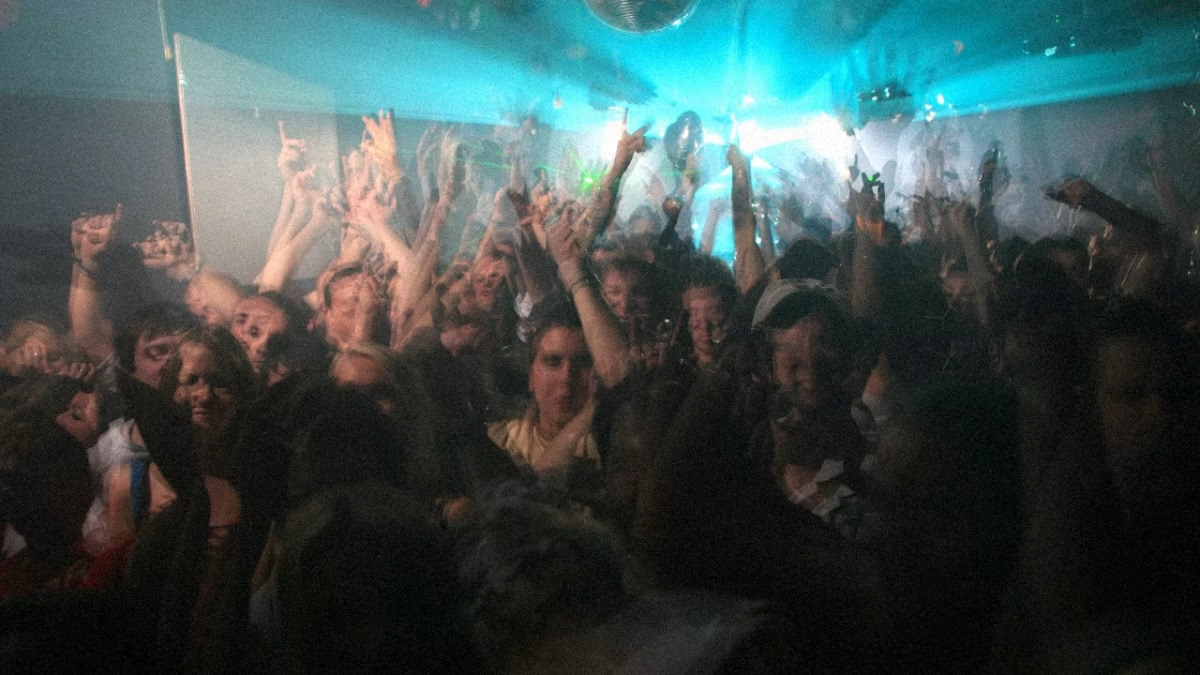
What Is ‘Rave’? From Underground Movement to Mainstream Success
8. The SoundCloud Generation: The Birth of Future Bass, Trap Hybrids, and Lo-Fi House
While Big Room anthems echoed across festival grounds, a different revolution was brewing online. The streaming platform SoundCloud, founded in 2007, became the incubator for the next wave of electronic music. Free from the commercial pressures of the mainstage, producers on SoundCloud experimented with sounds that were more complex and emotional.
This digital counter-culture gave birth to genres like Future Bass, pioneered around 2010 by artists such as Flume and Rustie, which blended the rhythmic feel of trap with lush, detuned synth chords and emotive melodies. At the same time, a genre known as Lo-Fi House emerged, which rejected the polished perfection of EDM in favor of a hazy, nostalgic aesthetic. SoundCloud’s social features allowed these niche sounds to build global communities, creating the perfect place for the genres that would define the post-EDM boom landscape.
9. The Tropical House Wave: A Sun-Soaked Detour into Mainstream Pop
By 2014, the energy of the EDM boom had created an opening for a break from the intensity. That came in the form of Tropical House, a subgenre of deep house that became a huge hit. Popularized by producers like Kygo and Thomas Jack, the style was defined by slower tempos (around 100-120 BPM), melodies, and the use of instruments like steel drums, pan flutes, and saxophones.
The term itself was reportedly coined as a joke, but its impact was significant. Hits like Kygo’s “Firestone” and pop collaborations like Justin Bieber’s “What Do You Mean?” made Tropical House a phenomenon. It served as the perfect break from the intensity of the preceding years. Its laid-back vibe was more accessible to daytime radio and pop audiences than a dubstep drop. In doing so, Tropical House 7 separated “electronic music” from the “rave” for many people, paving the way for a deeper integration of electronic production across the pop music spectrum.

No-Phone Policies at Clubs: Enhancing the Vibe or Restricting Fans?
10. The Great Revival: How Techno and House Reclaimed the Underground (and the Mainstream)
Every action has an equal and opposite reaction. The perceived commercialism of the EDM boom created a demand for something more authentic within the electronic music community. This led to a huge comeback for the genres that started it all: house and techno. Beginning in the mid-2010s and accelerating into the 2020s, a new generation of fans and artists rediscovered the groove-focused power of these original sounds. 8
This wasn’t just nostalgia. It was a cultural reset. The revival was driven by a desire for the communal experience of the club over the spectacle of the festival mainstage. A new wave of headliners like Charlotte de Witte and Amelie Lens brought a faster style of techno to the forefront, while subgenres like tech house and afro house dominated Beatport’s charts and dancefloors worldwide. Platforms like Boiler Room were instrumental in this shift, broadcasting the energy of the underground to a global audience. This revival represented a clear shift away from the DJ-as-superstar model of the EDM era and a return to the music and the dancefloor as the central focus.
Part III: The New Music Economy
The technological and genre shifts of the last 20 years were mirrored by an upheaval of the music industry’s business model. The way music is sold, consumed, and monetized was broken and rebuilt. This new economy created opportunities for some and financial challenges for others, reshaping the career path of every DJ and producer.
11. The Streaming Paradigm: How Spotify Changed How We Listen and How Artists (Try to) Get Paid
The rise of streaming services, with Spotify leading the charge, is the biggest economic game-changer of the last two decades. For consumers, the model was a revolution, offering access to music for a low monthly fee. By 2021, 9 streaming accounted for 83% of all recorded music revenue in the United States, saving an industry that had been decimated by piracy.
However, for artists, the picture is more complex. The per-stream payout is incredibly low, often fractions of a cent. This makes it difficult for anyone outside of top-tier artists to earn a sustainable living from their recordings alone. This has forced a strategic shift. Recorded music is no longer the primary product to be sold. It has become a marketing tool. The goal of a Spotify release is now to build an audience and serve as an advertisement for the real revenue streams: live performance fees, festival bookings, and merchandise sales. The song is the business card, not the business itself.


12. The Festival Gold Rush: The Transformation of Raves into Billion-Dollar Businesses
As revenue from recorded music declined, the importance of live performances shot up, fueling the “festival gold rush.” Events like EDC in Las Vegas, Tomorrowland in Belgium, and Ultra in Miami evolved from parties into global brands. The global EDM market was valued at over USD 10 billion in 2024, with a projected compound annual growth rate of 7.74%.
This created a powerful cycle. Festivals needed superstar DJs to sell hundreds of thousands of tickets, which drove headliner performance fees into the hundreds of thousands, and sometimes millions, of dollars per set. In turn, for a DJ to achieve that superstar status, they needed the exposure that only a mainstage slot at one of these mega-festivals could provide. This feedback loop put a ton of money and power at the top of the industry, creating a landscape where a handful of elite artists and promoters like Live Nation control a large share of the revenue, making it difficult for mid-tier artists to break through. 10
13. The Decline of the Download: Beatport’s Evolution from MP3 Store to DJ Ecosystem
For most of the 2000s and early 2010s, Beatport was the digital record store for the working DJ. Founded in 2004, it provided a marketplace for high-quality MP3 and WAV files at a time when consumer platforms like iTunes didn’t cut it for pros. A DJ’s digital crate was built through hours and dollars spent on the platform.
However, as the culture shifted from ownership to access, Beatport smartly changed its model. Recognizing that modern DJs valued workflow efficiency and selection over a personally owned library, the company launched Beatport LINK in 2019. This subscription service allows DJs to stream Beatport’s catalog directly into their performance software. This strategic pivot from being a retailer of digital assets to a provider of a streaming service reflects a change in the profession. The value is no longer just in the rarity of the tracks you own, but in your skill at curating and mixing from a massive cloud-based library. 11
14. The Sample Subscription Service: How Splice Changed the Production Workflow Forever
What Beatport did for DJing, Splice did for production. Before Splice, producers had two main options for sourcing sounds: design them from scratch on synthesizers or purchase sample packs. Splice disrupted this model by offering a cloud-based library of royalty-free loops, one-shots, and synth presets on a subscription basis. 12
This “pay-as-you-go” model for sounds democratized access to a professional-quality sonic palette. It sped up the creative process, allowing a producer to sketch out a track with quality ingredients in a fraction of the time. This has shifted the core skillset of many modern producers from sound design to being a great curator, which is the art of finding the perfect kick, snare, and loop from millions of options. Splice’s “Rent-to-Own” model for VSTs also made expensive software like Serum accessible to producers on a budget. While this has accelerated creativity, it has also sparked debates about originality, as popular Splice loops have become common all over the charts.
15. The Changing Role of the Record Label: From Gatekeeper to A&R Service
In the age of physical media, record labels were the gatekeepers of the industry. They controlled the means of production, distribution, and marketing. The internet and the rise of digital distributors like TuneCore and DistroKid broke that monopoly, allowing any artist to get their music onto global platforms. 13
In response, the role of the modern electronic music label has evolved. With distribution now a commodity, their focus has shifted to marketing and brand building. Labels like Anjunadeep, Afterlife, and Spinnin’ Records now function more like marketing agencies for artists. Their primary job is to cut through the noise of a saturated market by leveraging their influence to secure placements on major Spotify playlists, land premieres on blogs, and get their artists booked for key shows. They are no longer just selling records. They are investing in an artist’s brand, acting as venture capitalists in a world where attention is everything.
Part IV: Culture, Community, and Clicks
The final transformation of the last 20 years has been cultural. The internet and social media didn’t just change the tools and the business. They rewired the relationship between artists, fans, and the music itself. The DJ booth, once an isolated space, is now a node in an interconnected global network.
16. The SoundCloud Era: A New Blueprint for Artist Discovery and Community Building
SoundCloud’s impact was huge. From the late 2000s to the mid-2010s, it was the heart of underground music culture. Its strength was its social architecture. Unlike the top-down model of the traditional music industry, SoundCloud created a bottom-up way for people to find music.
The “repost” button was a key feature. An unknown artist could be discovered by a more popular artist or a blog, who would repost their track, exposing it to a new audience. This could create a chain reaction, allowing a song to go viral within a community without any industry involvement. This bottom-up system outsourced the A&R process to the community itself. By the time major labels took notice of an artist blowing up on SoundCloud, that artist often arrived with a formed sound, a dedicated fanbase, and data to prove their appeal, giving artists more power.
17. The TikTok Effect: How 15-Second Clips Reshaped Songwriting and Virality
If SoundCloud built the blueprint for online music communities, TikTok mastered virality. In the late 2010s and early 2020s, it became the biggest way people found new music.
TikTok’s algorithm doesn’t care about who you are. It only cares about how users react to a short snippet of your song. A 15-second clip can turn an unknown track into a global hit, as evidenced by the fact that 84% of songs that entered the Billboard Global 200 in 2024 first went viral on TikTok.
This has had a direct impact on how music is made. Producers are now encouraged to put the best part of their track first with a catchy hook or a sound effect to grab the listener’s attention within seconds. The build-up to a chorus or drop has been replaced by the need for a payoff. The algorithm has effectively become the new gatekeeper, a non-human A&R that has altered the structure of popular music, rewarding short, catchy moments.
18. The Livestream Showcase: How Boiler Room and Cercle Redefined the DJ Set
For decades, the DJ mix was just something you listened to. Platforms like Boiler Room and Cercle transformed it into a visual medium, creating two different styles that define modern DJ culture. Boiler Room, founded in 2010, pioneered the intimate livestream. Their camera angle, placed behind the DJ and looking out at a small, dancing crowd, captured the energy of an underground party and broadcast it globally. It sold the experience of “being there.”
Cercle, founded in 2016, offered another fantasy: the DJ as an artist in a cinematic location, from the Great Pyramids of Giza to a hot air balloon over Turkey. Using drones and high-end cameras, Cercle turned the DJ set into a beautiful art film. Together, these two platforms 14 established that the visual presentation of a DJ set is now important. They created visual templates of raw authenticity versus aspirational spectacle, which countless DJs and channels now emulate, proving that in the social media age, the look is just as important as the sound.
19. The Rise of the DIY Artist: From Bedroom Producer to Global Headliner
The result of all these technological and economic shifts has been the rise of the independent, Do-It-Yourself (DIY) artist. With affordable software like Ableton, sound libraries like Splice, global distribution through platforms like DistroKid, and marketing via social media, it is now possible for an artist to manage every aspect of their career from their bedroom.
This has transformed the modern musician into a do-it-all entrepreneur. To succeed, an artist must now be not only a musician and producer but also a social media manager, graphic designer, video editor, and publicist. The barriers to making and releasing music are gone, but the challenge of getting noticed in a saturated market is significant. This creates a paradox: while the tools are more democratic than ever, the range of non-musical skills required to build a sustainable career may be greater than at any point in history. Successful DIY artists are often as adept at brand-building and digital marketing as they are at making beats.
20. The DJ as a Social Media Brand: The Shift from Performer to Content Creator
In today’s competitive landscape, being a technically skilled DJ is simply the bare minimum. It is no longer a guarantee of a career. The final change of the last 20 years is the evolution of the DJ from a performer to a content creator. Platforms like Instagram, TikTok, and Twitch demand a stream of content that goes far beyond the music itself. 15
This has changed the DJ-fan relationship from a performer-audience dynamic to a creator and community model. Fans no longer just follow a DJ for their mixes. They follow for their personality, their lifestyle, their behind-the-scenes glimpses, and their sense of humor. This direct engagement builds a sense of community and loyalty that is stronger than passive listenership. In the new music economy, this community is an artist’s most important asset, as it is the engine that drives ticket sales, merchandise purchases, and long-term career sustainability.
The Next 20 Years of the Beat
The journey from 2004 to 2024 has been one of huge transformation. We witnessed a wave of democratization, as technology tore down the old walls of the music industry, giving anyone with a laptop the tools to create and distribute music. This decentralization, however, was followed by power shifting back to new gatekeepers. The streaming platforms, social media algorithms, and corporate festival promoters now shape our listening and live experiences.
Looking ahead, the forces of change show no signs of slowing. Artificial intelligence is already beginning to influence music discovery and creation, with some software offering track suggestions or production assistance.
Virtual and augmented reality promise new ways to experience live performance, potentially allowing artists to play for global audiences in immersive, digital venues. The one certainty is that the beat will go on, and the artists, producers, and fans who define this culture will continue to adapt, innovate, and find new ways to connect through the language of electronic music. The last 20 years were a revolution, and the next 20 look just as unpredictable.
- https://www.bounceonline.co.za/the-evolution-of-dj-equipment-from-vinyl-to-digital-revolution/ ↩︎
- https://djcity.com.au/blog/the-history-of-djing/ ↩︎
- https://www.attackmagazine.com/features/long-read/the-1-reality-what-the-numbers-tell-us-about-dj-economics/ ↩︎
- https://www.vice.com/en/article/ableton-live-history-interview-founders-berhard-behles-robert-henke/ ↩︎
- https://blog.native-instruments.com/massive-past-presets-future/ ↩︎
- https://www.berklee.edu/berklee-now/news/electronic-music-genres-a-guide-to-the-most-influential-styles ↩︎
- https://library.fiveable.me/music-of-the-modern-era/unit-6/2010s-pop-electronic-dance-music-fusion/study-guide/1lFiRlcU74iqb9cG ↩︎
- https://houseoftracks.com/faq/is-techno-making-a-comeback ↩︎
- https://illustratemagazine.com/the-impact-of-streaming-platforms-on-the-music-industry-how-spotify-apple-music-and-others-have-changed-the-game/ ↩︎
- https://artsandculture.google.com/story/techno-capitalism-the-globalization-of-electronic-music-groove/0gWRpH5K6L8ADQ?hl=en ↩︎
- https://www.music-hub.com/en-blog/beatport-a-haven-for-electronic-musicians ↩︎
- https://finalmartin.com/splice-pros-and-cons/ ↩︎
- https://doubleclap.dance/why-record-labels-still-matter-in-edm-or-do-they/ ↩︎
- https://blog.pioneerdj.com/dj-culture/how-dj-streams-changed-everything/ ↩︎
- https://www.zipdj.com/social-media-and-music/ ↩︎
* generate randomized username
- COMMENT_FIRST
- #1 Lord_Nikon [12]
- #2 Void_Reaper [10]
- #3 Cereal_Killer [10]
- #4 Dark_Pulse [9]
- #5 Void_Strike [8]
- #6 Phantom_Phreak [7]
- #7 Data_Drifter [7]
- #8 Zero_Cool [7]


