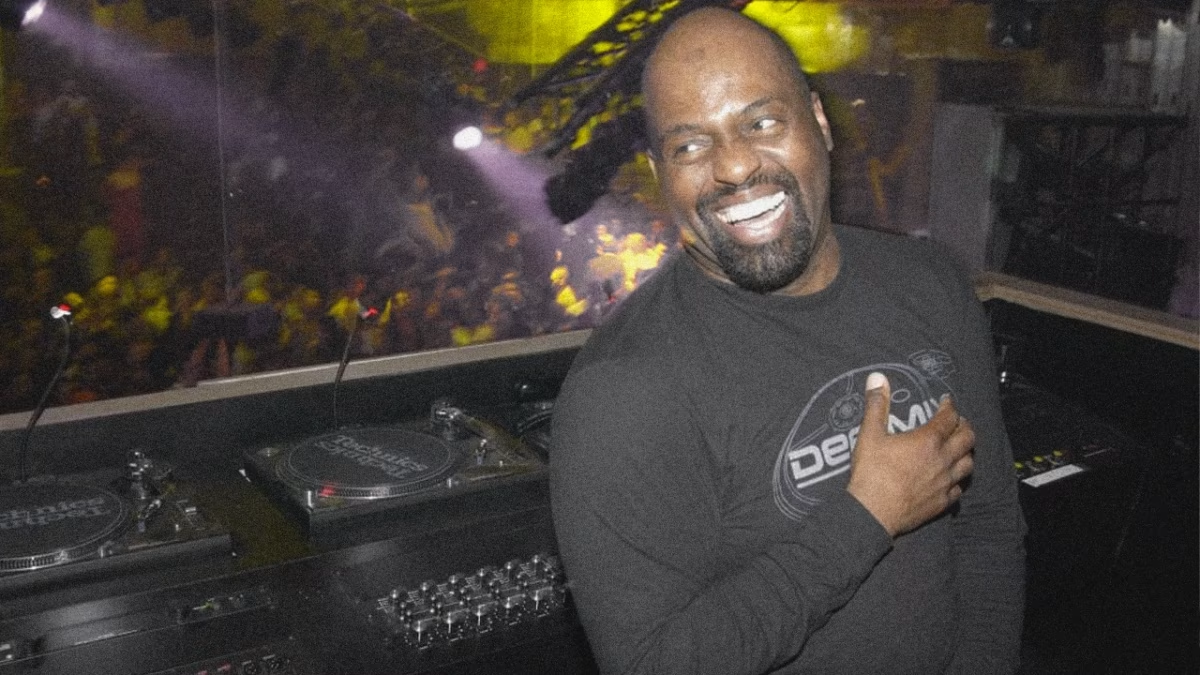

The Gospel According to Frankie
Frankie Knuckles, known as the “Godfather of House Music,” once gave a warning: “The minute you think you’re greater than the music, you’re finished.” This quote from Knuckles (born Francis Nicholls, 1955-2014) is more than just career advice. It’s a core principle for the culture he helped build. Knuckles was a Grammy-winning remixer and a producer for artists like Michael Jackson and Diana Ross. A street in Chicago is named in his honor. He described himself as a “man of music,” showing his devotion to the art form over any individual, including himself.
This idea of humility came from the social and cultural struggles that defined his life and his sound. The quote is both a personal rule for staying creative and a political statement for a culture born from marginalized groups. To understand why it’s timeless, you have to look at the history of house music, a story about creating safe spaces, defiance, and collective joy. It means looking at how he applied this philosophy in his sets at The Warehouse and understanding why, in an era of superstar DJs, his warning against ego is more relevant than ever.
The Architect of a Sanctuary
Frankie Knuckles’s philosophy was shaped by his surroundings. When he moved to Chicago in 1977, he found a city deeply divided by race. He saw his mission as changing that, and his venue, The Warehouse, became the place to do it. The cultural climate was hostile. This peaked on July 12, 1979, with “Disco Demolition Night” at Comiskey Park, 1where a crate of disco records was blown up on a baseball field. Many saw this not as a protest against a music genre, but as a public display of the 2racism and homophobia aimed at the Black, Latino, and gay communities that had made disco their own. Disco clubs had been safe havens, and this event was an attack on that sanctuary. 3
In response, a new sound formed in the underground. Knuckles called it “disco’s revenge,” a declaration of cultural resilience. From 1977 to 1982, The Warehouse became the physical embodiment of this idea. For its patrons, mostly gay, Black, and Latino, it was a place of refuge and community where people found “hope, acceptance, and transcendence”. It became one of Chicago’s first integrated social spaces, and the genre that emerged, “house music,” was named directly after it. The technical innovations were driven by this social mission. As disco’s popularity faded and labels stopped producing dance tracks, Knuckles had to innovate to “keep his dance floor interested”. Using reel-to-reel tape decks and newly affordable Roland drum machines, he re-edited older soul and funk records, extending breaks and looping grooves. This was a practical solution to sustain his community’s sanctuary. The music was a tool for survival, and that 4 mission was always greater than his ego.

A Servant to the Dance Floor
Knuckles’s DJing showed his philosophy in action. He aimed not to be a star but to guide the crowd’s energy.
The DJ as Conductor, Not Star
He often spoke of reaching a point where “the whole room becomes one.” This unity was impossible if the DJ placed himself above the crowd. “I try to keep myself in the same place that the audience is, which is on the dance floor,” he said in a 1988 interview. “You’ve got to feel the same thing they’re feeling.” This rejected the typical performer-audience divide and reflects a modern DJ ethos: “it’s their party, not yours.”
The Club as Church, The Music as Spirit
The Warehouse was often compared to a “church,” a sacred space for patrons excluded from traditional religious institutions. Knuckles acted as a “priest” facilitating a collective, spiritual experience where the music was the central focus. His sets were a dialogue with the crowd, not a monologue. He famously trusted “women’s ears” to guide the musical direction and used “environmental things,” like fading in the sound of a train or a rainstorm, to deepen the shared experience. His focus was always on the collective journey, not on himself.


A Warning Against the Idol of Ego
The quote is a critique of the relationship between ego, craft, and technology. It positions the artist as a channel for a force larger than themselves.
Humility as a Professional Mindset
The phrase “greater than the music” directly targets artistic arrogance. It implies that music is an entity that the artist serves. This idea is present in the title of one of his productions, “Let the Music Use You,” which frames the creative process as an act of surrender. Knuckles himself focused more on melody than many of his peers, who he felt were often “beat crazy and beat heavy”. He was “always looking for just the right song that has something to say,” a philosophy that valued the music’s message over technical skill.
Contrast with the “Superstar” Spectacle
This approach is the opposite of the “superstar DJ” culture that came with the commercialization of electronic music. That culture often centers on the DJ as a celebrity, using pyrotechnics and stage shows to get a reaction. One critic called this a “circus performance” that manipulates the audience rather than building the “symbiotic relationship between you and the dance floor” that Knuckles valued. To think you are “greater than the music” is to shift the focus from the collective experience to the individual performer. This can lead to a “homogenization of sound,” where artists avoid creative risks for commercial formulas, a state that could be described as being “finished.” Knuckles, a technological innovator, also warned about how technology could feed the ego. He said that while technology lets anyone make tracks, “not everybody is a songwriter”. This is echoed by modern DJ purists who see tools like the “sync button” as a threat to the craft because they remove basic skills.
The Quote’s Resonance in a Commercialized World
Decades later, Frankie Knuckles’s warning is still a key principle in modern music culture. The rebranding of underground dance music into the single term “EDM” was an industry strategy to “sanitize and repackage” rave culture for mass consumption, often watering down the music’s core values and putting profit before artistry. Knuckles’s quote acts as a moral compass, encouraging creators to serve the music rather than the market. The quote also addresses the “whitewashing” of house music, where the contributions of its queer, Black, and Latino founders are often ignored. The industry’s focus on a narrow group of mostly white, male headliners hides the genre’s origins as a form of resistance. To think you are “greater than the music” is to ignore this history and treat house music as a product, separate from the social struggles that gave it meaning. Appropriation is an act of ego, taking from a culture without acknowledging its creators. In a digital world of curated online personas, authenticity has become a central value in club culture. Knuckles’s philosophy is the ultimate statement on this value. He teaches that true art comes from serving the music and the moment, not from building a brand or following trends. 5
The Music Is Everything
From one simple sentence comes a philosophy that captures the spirit of a cultural movement. The power of Frankie Knuckles’s warning, “The minute you think you’re greater than the music, you’re finished,” comes from the specific context in which it was born. It is the wisdom of an artist who built a sanctuary with sound, who turned social hostility into joy, and who saw his role as a servant to the dance floor.
His words now apply to any creative field. The moment any artist or leader puts their ego above their work, their message, or their community, their creativity starts to fade. They become “finished.” His legacy is a reminder that the best creations come from devotion, not self-promotion. It is summarized by another of his statements: “The music is everything to me.” This spirit of service continues to fill the world’s best dance floors, an unfinished groove from a warehouse in Chicago.
- https://www.chicago.gov/content/dam/city/depts/zlup/Historic_Preservation/Publications/The_Warehouse_Report.pdf ↩︎
- https://defected.com/news/post/interview-simon-meets-frankie ↩︎
- https://www.wttw.com/chicago-stories/house-music ↩︎
- https://timeline.carnegiehall.org/genres/house ↩︎
- https://defected.com/news/post/interview-simon-meets-frankie ↩︎
* generate randomized username
- COMMENT_FIRST
- #1 Lord_Nikon [12]
- #2 Void_Reaper [10]
- #3 Cereal_Killer [10]
- #4 Dark_Pulse [9]
- #5 Void_Strike [8]
- #6 Phantom_Phreak [7]
- #7 Data_Drifter [7]
- #8 Cipher_Blade [6]


