

The stereotype persists: underground nightlife belongs to the young. Walk into any warehouse party or intimate club, and yes, you’ll see plenty of 20-somethings. But look closer at who’s actually running things: who’s throwing the parties, who knows every venue’s history, who remembers the original vibe before commercialization wiped it clean and you’ll often spot someone with more life experience than their current era of clubbers.
Recent research confirms what longtime dancers already know: people in their 40s and beyond are the stabilizing force keeping underground dance culture alive and authentic. This isn’t about nostalgia. It’s about expertise, community knowledge, and the kind of cultural responsibility that only comes from decades of participation.
The Demographics Tell a Story
A groundbreaking 2025 study published in scholarly research found that older women participating in electronic dance music scenes overwhelmingly reported a sense of belonging that transcends age. The research, which centered on women aged 40-59 in active dance communities, revealed something fascinating: age itself becomes irrelevant once musical connection takes priority.
One participant, aged 56, captured this perfectly: “I have never felt out of place going to a club or party. I have met people of all ages and become friends with them. On the dance floor, age is just a number and music brings us all together.” 1

Age-Restricted 30+ Raver Clubs Are Popping Up
This isn’t an isolated experience. The data shows that 64% of women aged 40-49 in these communities felt complete acceptance, irrespective of age. For comparison, entry barriers to nightlife culture have historically centered on age discrimination, but that’s changing as older participants redefine what participation looks like.
Why Venues Struggle (And Who Keeps Them Alive)
The commercial pressures facing independent nightlife are real. As of December 2024, the UK alone has lost 33.2% of its nightclubs compared to pre-pandemic levels, with only 2,264 nightclubs, late-night bars, and casinos remaining. In the United States, nearly 66% of independent music venues were unprofitable in 2024 despite contributing $86 billion in economic output. 2
When traditional venues close, the response from the underground community is revealing. Rather than fade, communities adapt. Pop-up spaces, warehouse parties, and intimate back-room events proliferate because experienced operators know how to navigate the regulatory landscape, secure temporary spaces, and maintain authentic atmospheres without the overhead crushing their margins.
These operators are rarely in their 20s. They typically have years of scene knowledge, existing networks, and enough financial stability to absorb initial losses while building loyal audiences. They’ve learned, through trial and error across decades, how to preserve community culture while keeping operations sustainable.
The Knowledge Transfer Problem Nobody’s Talking About
Dance music education isn’t academic. It’s experiential. How to read a crowd. When to shift the energy. Which artists understand genuine underground sensibilities versus those chasing commercial appeal. The production quality differences between a lazy corporate event and meticulously crafted community party. These skills transfer through mentorship, and that mentorship has depth.
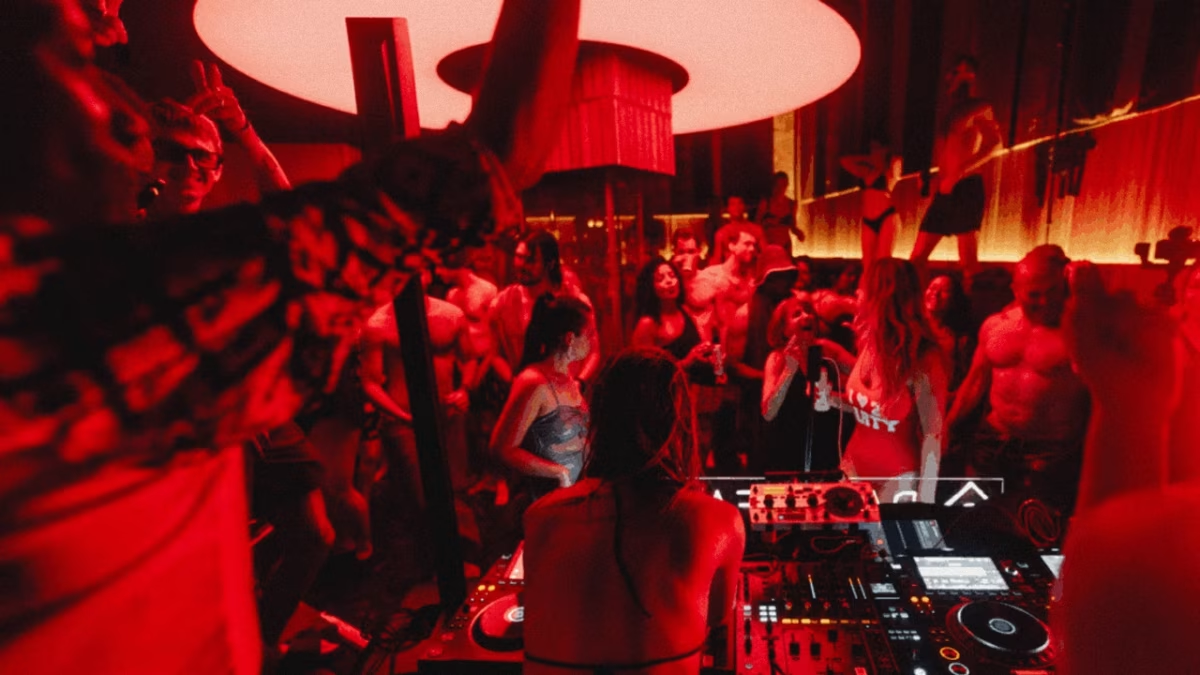
Morning Raves, Sauna Clubs, and the Soft Clubbing Scene You’re Already Missing Out On
Research on cultural participation for older adults reveals that community engagement, especially music-based activities, generates bidirectional knowledge exchange. Older participants contribute historical context, operational wisdom, and strategic thinking. Younger participants bring fresh perspectives and digital-native promotion skills. When this cross-generational flow works, scenes thrive. 3
The problem: this transfer process is fragile. As independent venues close and experienced promoters burn out from financial pressure, the institutional knowledge walks out the door. There’s no formal documentation of “how underground nightlife actually works.” It lives in the heads and networks of people who’ve been doing this for 20+ years.
Resisting Commercialization Requires Staying Power
Gentrification in major music cities (Berlin, London, New York, Barcelona) hasn’t killed underground culture. But it’s transformed it. As real estate developers target entertainment districts and wealthy residents demand “quieter neighborhoods,” independent venues face impossible operational pressures. 4
The venues that survive this aren’t random. They’re operated by people who’ve already experienced one or two rounds of scene displacement, who understand the long game, and who’ve built relationships with regulatory bodies and property owners across years of operation. A 25-year-old promoter might throw incredible parties. A 45-year-old promoter has the resilience and network required to keep throwing them when everything else is collapsing.
This resilience manifests in specific ways: rotating secret locations, building deep relationships with property owners in less-desirable neighborhoods, creating financial buffers, and understanding the regulatory gray zones where underground culture actually operates. These aren’t skills acquired quickly.
The Real Threat to Underground Culture
The danger isn’t that younger people don’t care about authentic dance culture. Many do, passionately. The danger is the loss of continuity. The break in the chain of knowledge, networks, and operational experience that allows scenes to survive external pressure.
When independent venues collapse at rates like 33% over a few years, and when 66% of remaining venues operate at a loss, the experienced operators who know how to survive in this economy become indispensable. They’re not gatekeeping. They’re actually absorbing financial and operational risk that ensures the scene continues to exist.


Intergenerational Dance Floors Work Better
Research on intergenerational cultural participation shows measurable benefits for both older and younger participants. For older dancers, there’s increased social connection, enhanced physical engagement, and a sense of purpose and belonging. For younger participants, there’s access to knowledge and networks that would otherwise take years to develop independently. 5
The most vibrant underground scenes tend to be the ones with clear generational bridges: where 45-year-old DJs train 28-year-old producers, where veteran promoters take emerging promoters under their wing, where the history is actively taught rather than left to chance discovery.
The Bottom Line
The next time you’re at an underground party that feels genuinely special (where the energy is perfect and the community feels tight), pay attention to the infrastructure. Look at who’s making decisions. Often, you’ll find that the people ensuring that night actually happens have been doing this for decades.
They’re not relics. They’re the reason the scene survives.
As cities continue to commercialize entertainment districts and independent venues face unprecedented financial pressure, the knowledge and networks of experienced operators become more valuable, not less. The future of underground dance culture doesn’t rest on who’s the youngest on the dance floor. It rests on who knows how to keep the dance floor existing when every economic and regulatory force says it shouldn’t.
- https://journals.sagepub.com/doi/pdf/10.1177/13607804231207257 ↩︎
- https://pmc.ncbi.nlm.nih.gov/articles/PMC9967954/ ↩︎
- https://www.frontiersin.org/articles/10.3389/fnagi.2024.1508074/full ↩︎
- https://www.frontiersin.org/articles/10.3389/fpsyg.2020.561126/pdf ↩︎
- https://www.ntnu.no/ojs/index.php/ps/article/download/5004/4561 ↩︎
* generate randomized username
- Interesting, but does one study really prove Gen X is *sustaining* the scene? I wonder if the focus on older women might skew the results. i bet younger generations still contribute significantly, even if they're not 'running' everything. Where's *their* research?
- #1 Lord_Nikon [12]
- #2 Void_Reaper [10]
- #3 Cereal_Killer [10]
- #4 Dark_Pulse [9]
- #5 Void_Strike [8]
- #6 Phantom_Phreak [7]
- #7 Data_Drifter [7]
- #8 Zero_Cool [7]



Fun article but “A groundbreaking 2025 study published in scholarly research” is suspect.