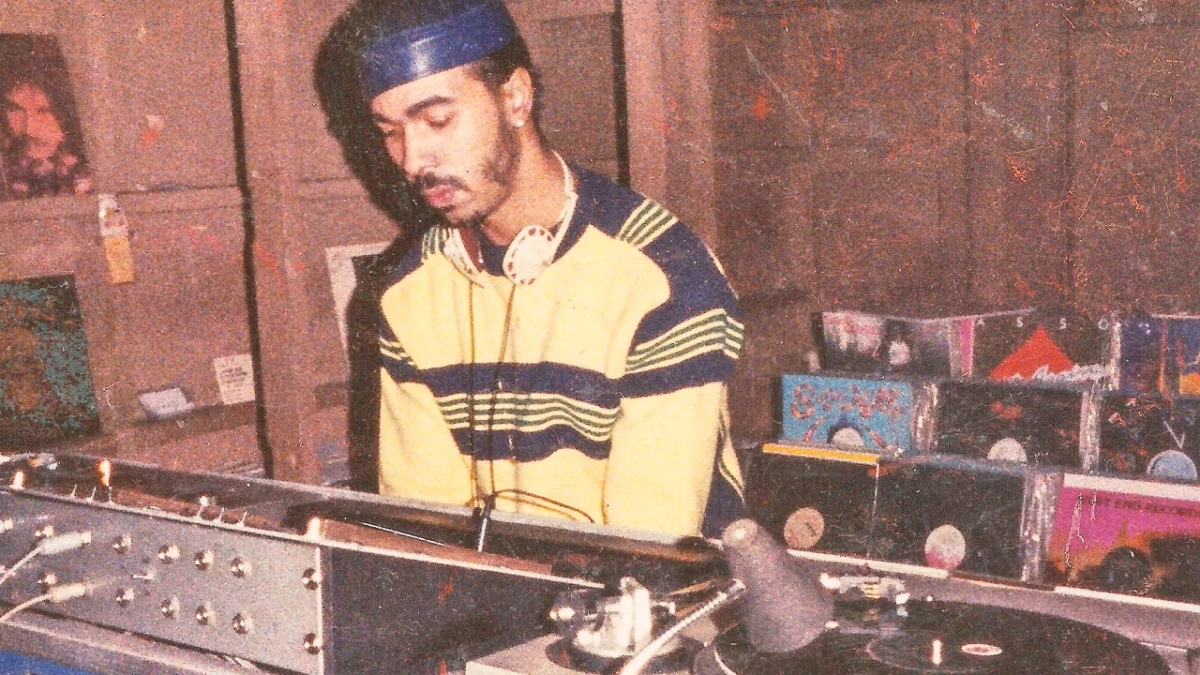

Ever found yourself on a dance floor wondering how we got from disco to the earth-shaking bass drops of today? The history of electronic dance music is a fascinating story of innovation, culture, and the simple need to move. It’s a family tree of sound where every genre is connected. Let’s take a casual stroll through the origins of the sounds that define the modern club, rave, and festival scene.
- House Music Origins: Emerging from Chicago's underground disco scene, House music, pioneered by Frankie Knuckles, provided a soulful and rhythmic foundation for future electronic genres, fostering community and innovation.
- Techno's Innovation: Born in Detroit, Techno, cultivated by The Belleville Three, blended industrial sounds and electronic influences, creating a futuristic and mechanical reflection of the city's technological landscape.
- Global Evolution: Electronic music genres have continually evolved across continents, with Trance focusing on melodic euphoria, Drum & Bass revolutionizing breakbeats, Dubstep emphasizing bass and space, and Trap merging hip-hop with EDM, demonstrating electronic music's dynamic and globally connected nature.
House: The Soulful Beat of Chicago
It all starts in Chicago in the early 1980s. After a mainstream backlash declared disco “dead,” the groove went underground. In a club called The Warehouse, a DJ named Frankie Knuckles—now known as the “Godfather of House”—started experimenting. He took soulful disco and funk records, extended their percussive breaks, and layered them with the steady, hypnotic pulse of a drum machine. 1
The result was a sound that was both new and familiar. The name “house” itself is believed to be a shortened version of “Warehouse,” as people would go to record stores asking for the music they heard at the club. With its four-on-the-floor kick drum and soulful vocals, house music created a sanctuary for Chicago’s Black, Latino, and gay communities, laying the foundation for everything to come. 2
Techno: Detroit’s Futuristic Machine-Funk
While Chicago was finding its groove, a different sound was revving up in post-industrial Detroit. In the mid-1980s, three high school friends known as “The Belleville Three”—Juan Atkins, Derrick May, and Kevin Saunderson—were soaking up the futuristic sounds of German electronic pioneers like Kraftwerk and the cosmic funk of Parliament-Funkadelic from a local radio show. 3
They fused these influences with the danceable structure of Chicago house, creating a sound that was mechanical, repetitive, and futuristic—a reflection of their city’s automated, industrial soul. Juan Atkins famously described it as “music that sounds like technology.” The name “techno” was solidified in 1988 with a UK compilation titled Techno! The New Dance Sound of Detroit, forever linking the term to the Motor City’s machine-driven rebellion.
Trance: The Euphoric Sound of Europe
As the ’80s turned into the ’90s, the electronic pulse crossed the Atlantic and landed in Germany, where it evolved into something more melodic and emotional: trance. Pioneered in Frankfurt clubs by DJs like Sven Väth, trance took the repetitive nature of techno and infused it with soaring melodies and atmospheric layers designed to create a state of euphoria. 4
The genre is famous for its “build-up and breakdown” structure. A track slowly builds tension, then strips away the beat for a moment of pure, suspended melody before the drums crash back in for a massive release of energy. The name says it all—the music was designed to put the listener into a trance-like state on the dancefloor.
Drum & Bass: The UK’s High-Speed Breakbeat Revolution
In the early ’90s, the UK’s rave scene was a high-energy mix of sounds. Out of this, a uniquely British genre called jungle emerged, which would soon evolve into drum and bass (DnB). Producers in cities like London and Bristol started taking the fast, sampled drum loops (breakbeats) from old funk records—most famously the “Amen Break”—and infused them with the deep, rumbling sub-bass of Jamaican sound system culture. 5
The result was a sound defined by its contrast: lightning-fast, complex drum patterns (around 170-180 BPM) paired with slow, heavy basslines. Pioneers like Goldie and Roni Size pushed the sound forward, creating everything from smooth, jazz-infused “liquid” DnB to dark, sci-fi-inspired “neurofunk.”
Dubstep: South London’s Bass-Heavy Mutation
Fast forward to the early 2000s in South London. A new sound began to bubble up from the UK garage scene. Producers like Skream and Benga started stripping garage tracks down to their bare essentials, focusing on space, atmosphere, and deep sub-bass inspired by Jamaican dub music. 6


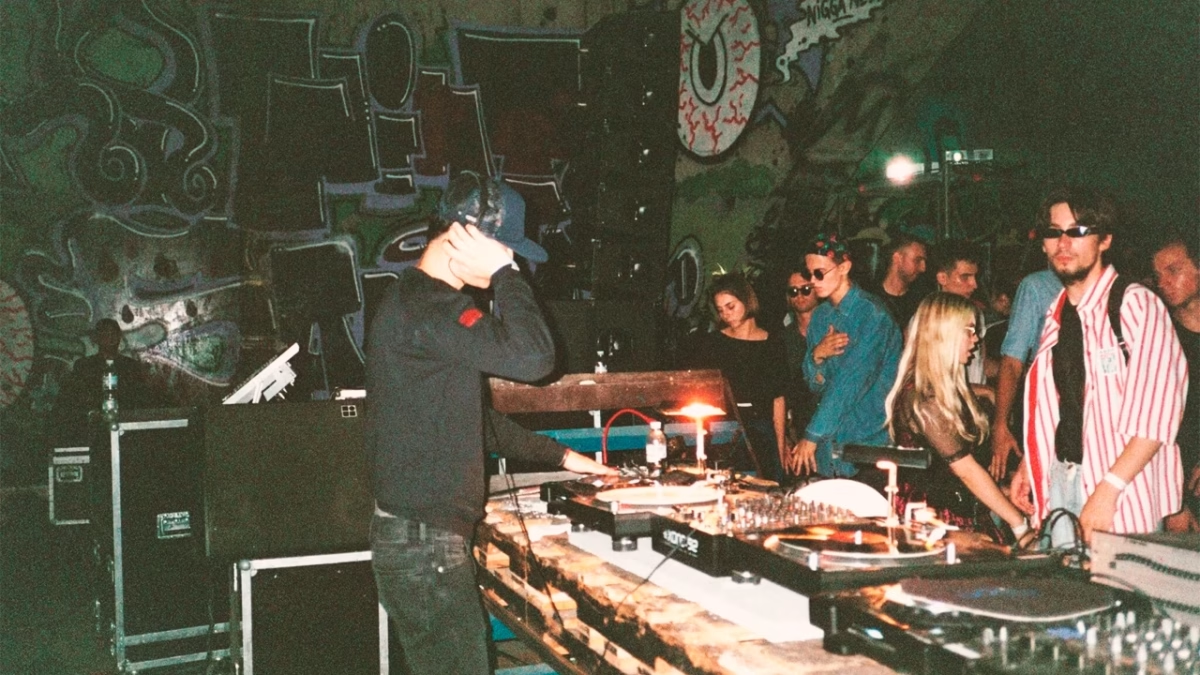
The defining rhythm of dubstep is its “half-time” feel. Though the tempo is around 140 BPM, the kick and snare hit at half that speed, creating a slow, lurching groove that’s perfect for head-nodding. This spacious rhythm left plenty of room for the genre’s most famous feature: the “wobble bass,” a sound created by rhythmically manipulating a bass note’s texture.
Trap: From Southern Hip-Hop to Global EDM
Trap’s story has two distinct chapters. It began in the early 2000s as a gritty subgenre of Southern hip-hop in Atlanta. Rappers like T.I., Jeezy, and Gucci Mane told stories about life in the “trap” (a house for selling drugs) over beats defined by booming Roland TR-808 kick drums, crisp snares, and fast, stuttering triplet hi-hats. 7
Then, around 2012, electronic music producers like TNGHT, RL Grime, and Baauer took that sonic toolkit and adapted it for the dance floor, creating “EDM trap.” They kept the 808s and triplet hi-hats but added the build-ups and massive “drops” of dance music. The viral sensation of Baauer’s “Harlem Shake” in 2013 launched the genre into the global mainstream, making it one of the most dominant sounds of the last decade. 8
From a Chicago warehouse to a global phenomenon, the evolution of electronic music is a testament to how technology and culture constantly reshape sound. Each genre, while distinct, is part of an unbroken loop of influence, forever building on the beat that came before.
- https://6amgroup.com/articles/all/house-music-guide-history-subgenres-clubs-and-artists ↩︎
- https://www.choosechicago.com/blog/music/the-history-of-house-music-in-chicago/ ↩︎
- https://www.awakenings.com/en/artists/the-belleville-three/1528/ ↩︎
- https://undergroundtrance.com/trance-history/ ↩︎
- https://www.transformationsjournal.org/wp-content/uploads/2017/01/Transformations03_Quinn.pdf ↩︎
- https://surgesounds.com/post/dubstep-evolution-complete-guide-to-bass-music-history ↩︎
- https://downersclub.com/2023/12/04/guide-trap-music-origins-evolution-influence/ ↩︎
- https://en.wikipedia.org/wiki/EDM_trap_music ↩︎
* generate randomized username
- COMMENT_FIRST
- #1 Lord_Nikon [12]
- #2 Void_Reaper [10]
- #3 Cereal_Killer [10]
- #4 Dark_Pulse [9]
- #5 Void_Strike [8]
- #6 Phantom_Phreak [7]
- #7 Data_Drifter [7]
- #8 Cipher_Blade [6]


