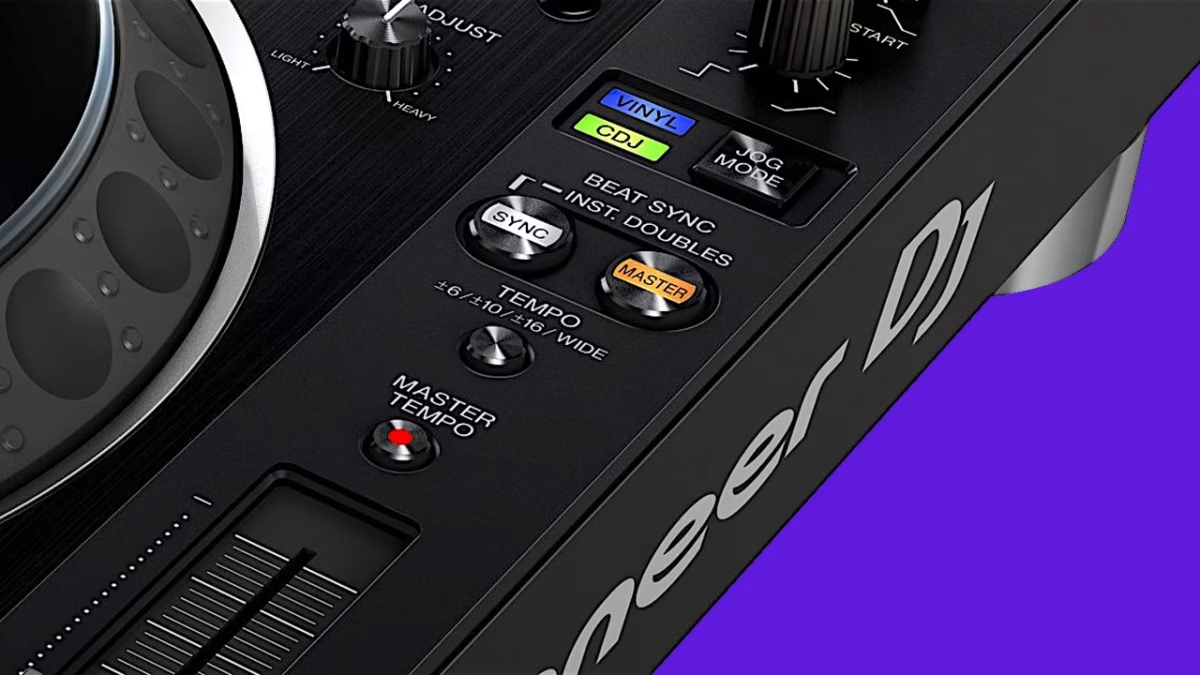

In the world of DJing, no piece of technology has caused more arguments than a small, innocent-looking button labeled “SYNC.” For over a decade, this button has been at the center of a fierce debate, pitting traditional skills against modern convenience. So, what’s the big deal? Is using the sync button cheating, and how many DJs actually use it? Let’s break it down.
What Is the Sync Button and Why Do People Argue About It?
Before sync, the core skill of a DJ was “beatmatching”—manually adjusting the speed (tempo) of two records so their beats lined up perfectly for a smooth transition. This took countless hours of practice and a good ear. The sync button automates this process, instantly matching the tempo and aligning the beats of two tracks with a single press.
This is where the fight starts.
- The “Purist” Camp: Many DJs who learned on vinyl see sync as a shortcut that devalues the craft. They argue that learning to beatmatch by ear is a rite of passage. To them, relying on a button is “cheating” and misses the point of the art form.
- The “Pragmatist” Camp: On the other side, many argue that beatmatching is just one small, mechanical part of DJing. They believe the true art lies in track selection, reading the crowd, and creative mixing—skills a button can’t replicate. For them, sync is just a tool, like a calculator for a mathematician, that frees them up to focus on more creative techniques like mixing on three or four decks, or adding loops and effects.
Ultimately, the person who matters most—the one on the dancefloor—doesn’t know or care if sync is being used. They just want to dance to good music. The debate is almost entirely an internal one among DJs themselves.
So, Who Actually Uses the Sync Button?
The reality is that the use of sync is highly situational.
- Beginners: For newcomers, the sync button can be a fantastic learning tool. It removes the initial frustration of manual beatmatching, allowing them to focus on learning about song structure and phrasing. However, most experienced DJs agree that beginners should still learn to beatmatch by ear to be versatile and prepared for any situation, like equipment failure.
- Professional DJs: You might be surprised to learn that many of the world’s top DJs use sync. Artists like Carl Cox, Richie Hawtin, and Laidback Luke have been known to use it, not as a crutch, but as a way to perform more complex sets that would be nearly impossible otherwise. When you’re juggling four tracks at once, sync ensures everything stays locked together, giving you the freedom to be more creative.
- Genre Matters: Sync works flawlessly with electronically produced music like techno and house, where the beat is a perfect, computer-generated grid. But for genres with live drummers like funk, disco, or classic rock, the tempo naturally fluctuates. Trying to use sync on these tracks without careful preparation can result in a messy “trainwreck” of sound.


The Verdict: How Many DJs Prefer Sync?
While there are no exact statistics on preference, the answer is clear from the market. The sync button is now a standard feature on virtually every piece of digital DJ gear, from entry-level controllers to professional club setups. DJ controllers, all of which have sync, dominate the market, accounting for over 34-38% of equipment sales. With over 65% of professional DJs preferring digital controllers, it’s safe to say the vast majority of DJs have access to and use sync in some capacity.
The modern consensus is a hybrid approach. Most working DJs today know how to beatmatch manually but will use sync strategically when it makes sense—for a complex transition, a quick mix, or to free up mental space during a long set. The “hate” for sync is now largely seen as an outdated, gatekeeping mentality.
The global DJ market, especially in major hubs like North America and Europe, has embraced this technology, making it an integral part of modern DJing. The real skill of a DJ has never been about pushing a button or a pitch fader; it’s about the human element of knowing the right song to play at the right time to create an unforgettable experience.
* generate randomized username
- COMMENT_FIRST
- #1 Lord_Nikon [12]
- #2 Void_Reaper [10]
- #3 Cereal_Killer [10]
- #4 Dark_Pulse [9]
- #5 Void_Strike [8]
- #6 Phantom_Phreak [7]
- #7 Data_Drifter [7]
- #8 Cipher_Blade [6]