

How brilliant is Nile Rodgers, the rhythm guitarist behind the dance tracks of the last fifty years? Nile Rodgers is the foundational pillar of modern dance music. His syncopated rhythm guitar technique effectively laid the biological grid for the quantized loops that run every club track today. The impact Nile Rodgers had on electronic dance music culture is monolithic. Having spent over 18 years turning knobs in studios and holding a music business degree from Full Sail University, I can definitively state that the approach Nile Rodgers takes to frequency management and rhythmic pocketing remains the gold standard for producers globally. From early underground disco to top tier music collaborations that dominate mainstage festivals today, Nile Rodgers did not just participate in the culture. He engineered its framework.
So How Does Nile Rodgers Actually Do It?
Let us analyze the mastery that makes the sound of Nile Rodgers so enduring. His signature playing style relies heavily on the left hand fretting and muting while the right hand anchors on the bridge, producing a percussive attack. Instead of strumming full barre chords, Nile Rodgers focuses obsessively on two or three note triads. This minimalist approach is a masterclass in mix clarity. By playing less, he leaves pockets of space for synthesized basslines and kick drums to dominate the floor. As an audio engineer, I constantly remind artists that overcrowding the frequency spectrum is the death of a groove.
His tone is crystalline and articulate. Nile Rodgers famously plays a vintage guitar and insists on amplification utilizing ten inch speakers rather than the standard twelve or fifteen inch cones. The smaller speaker yields a faster transient response required for fast paced dance tracks. In the studio, he often bypasses the amplifier entirely, plugging directly into a recording console. This direct injection pushes the high and high mid frequencies forward. It ensures his guitar slices through dense electronic mixes like a scalpel. He applies fast compression to tame the dynamics and secure the rhythm firmly onto the grid. This precision effectively functioned as a human step sequencer long before digital drum machines commanded the industry.

Did Daft Punk Just Make a Fan Video Official for “Human After All”?
Shifting the Paradigm of Modern Club Music
Beyond kinetic technique, the brilliance of Nile Rodgers lies in his ability to mold his analog funk into any electronic subgenre. He operates on a principle he calls Deep Hidden Meaning. This concept dictates that every track must possess a core truth that gives the rhythm substance beneath a glossy surface. This rigor elevates standard pop arrangements into resonant club anthems.
His ability to navigate uncharted waters is unparalleled. When collaborating, Nile Rodgers employs a strategy of celestial navigation. He relies on fixed musical truths to guide artists while allowing them the freedom to explore their ideas. This approach allowed him to transform folk demos into dance rock hits and morph underground club cuts into pop milestones. His genius is rooted in foregrounding human musicianship while forcing technology to bend to that objective.
A Legacy Beyond the Dance Floor
While his recent work dominates modern club systems, the foundation of his catalog includes some of the most successful pop, rock, and soul records of all time. Long before the rise of modern disc jockeys, Nile Rodgers was producing massive mainstream hits. Here is a selection of his essential non-electronic collaborations:
- Chic with Le Freak (1978) and Good Times (1979): He provided the definitive bass and guitar interplay that defined an entire era of nightclubbing.
- Sister Sledge with We Are Family (1979): A masterful piece of pop songwriting that cemented his status as a premier hitmaker.
- Diana Ross with Upside Down and I’m Coming Out (1980): He pushed traditional R&B into heavily syncopated territory.
- David Bowie with Let’s Dance (1983): He stripped back folk elements to produce a massive commercial smash.
- Madonna with Like a Virgin (1984): He brought underground club sensibilities to the very forefront of global pop.
- Duran Duran with The Reflex (1984) and Notorious (1986): A testament to his ability to blend live rhythm sections with early sampling technology.
- The B-52s with Love Shack (1989): He injected authentic vintage groove into a massive alternative radio hit.
Rescuing the Dance Floor from Digital Sterility
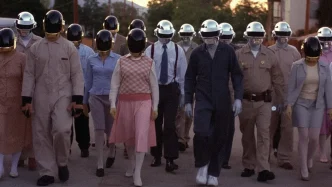
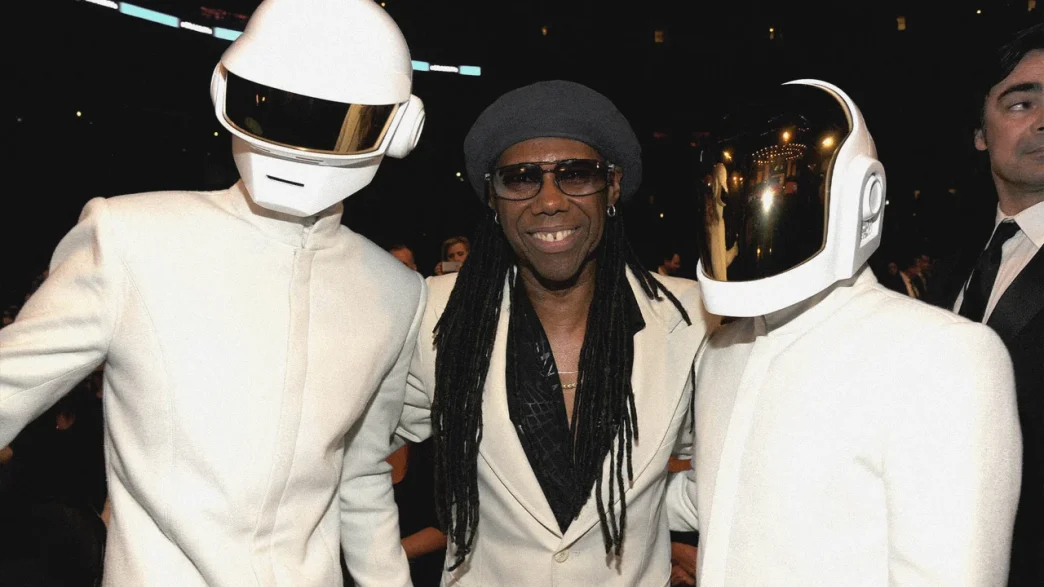
The nature of club culture reached a breaking point a decade ago when the scene suffered from digital fatigue. Electronic music had become compressed and lifeless. A legendary masked duo sought to reverse this trajectory by recording an album focused entirely on live instrumentation. They brought our maestro into the studio not merely as a session player, but as a conceptual anchor for their massive release. He provided the rhythm guitar on their biggest hit that catalyzed a global shift away from aggressive synthesizer drops and back toward analog warmth.
Following this triumph, Nile Rodgers became the ultimate collaborator for a new generation of electronic producers. He entered the studio with a progressive house pioneer to meld festival beats with organic syncopation on massive anthems. He engaged in writing camps at legendary studios with alternative pop producers like SG Lewis to validate their homages to early club culture. He recently teamed up with house giant Oliver Heldens to blend techno bass frequencies with funk rhythms. The analog lines of Nile Rodgers elevate highly engineered global pop productions into undeniable dance floor fillers. Even contemporary pop superstars bring him in to authenticate their tributes to post seventies dance music, proving his guitar work remains a vital cultural force.


A Roster of Elite Electronic Collaborations
To truly understand his reach across the dance spectrum, one only needs to look at the volume of his studio partnerships. He has seamlessly adapted his analog funk to fit almost every subgenre of club music. Here is a definitive list of his impactful electronic dance music collaborations:
- Daft Punk on Get Lucky and Lose Yourself to Dance (2013): Nile Rodgers provided the rhythm guitar that anchored their Grammy winning album, sparking a massive disco house revival.
- Avicii on Lay Me Down (2013): A seamless blend of festival energy and syncopated funk.
- David Guetta (2013): They engaged in studio sessions that channeled the energy of classic pop production into commercial house.
- Disclosure (2015): Nile Rodgers contributed his studio expertise to the electronic duo, helping to bridge the gap between garage and pop formats.
- Sigala and John Newman on Give Me Your Love (2016): A testament to his ability to craft recognizable hooks for dance anthems.
- SG Lewis on One More (2021): Nile Rodgers added vintage groove to an escapist record, validating the producer’s homage to classic dance floors.
- Beyonce on Cuff It (2022): He supplied the undeniable groove that anchored her massive homage to the roots of dance music.
- Oliver Heldens on I Was Made For Lovin You (2022): He blended his guitar style with house basslines and gospel vocals for a heavy club stomper.
- Purple Disco Machine on Honey Boy (2024): Nile Rodgers elevated an electronic pop track into an international hit, proving his ongoing dominance in the disco house scene.
Why We Still Can Not Stop Moving
The streaming metrics validate the absolute endurance of Nile Rodgers. His classic tracks maintain millions of active listeners alongside his modern releases. This proves that authentic organic rhythm never expires. From underground basement parties to massive international festival stages, his precise syncopation commands the physical body to move.
The legacy of Nile Rodgers is not just about the staggering number of records sold. It is about an uncompromising dedication to the pocket. He bridges the gap between the human soul and machine perfection. Whenever you feel compelled to step onto a dance floor, you are responding directly to the rhythmic foundation Nile Rodgers poured decades ago.
Sources & Further Reading
- Guitar World: The Secrets Behind Nile Rodgers’ Tone
- Waves: How to Get the Nile Rodgers Chic Funk Sound
- Thirteen: Nile Rodgers’ Life Lessons and Hits
- ARP Journal: Nile Rodgers Navigating Production Space
- Dubspot: Nile Rodgers Talks Technology and Collaboration
- MusicRadar: Rodgers Working with Guetta and Avicii
- Dancing Astronaut: Oliver Heldens ft. Nile Rodgers
- Sony Music Publishing: Purple Disco Machine Deal
- Abbey Road: SG Lewis Interview
* generate randomized username
- COMMENT_FIRST
- #1 Lord_Nikon [12]
- #2 Void_Reaper [10]
- #3 Cereal_Killer [10]
- #4 Dark_Pulse [9]
- #5 Void_Strike [8]
- #6 Phantom_Phreak [7]
- #7 Data_Drifter [7]
- #8 Zero_Cool [7]