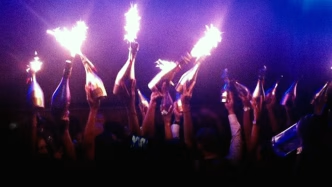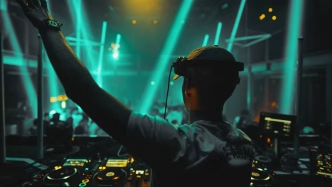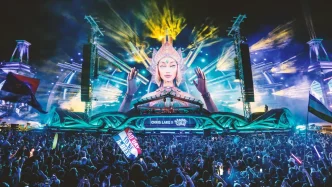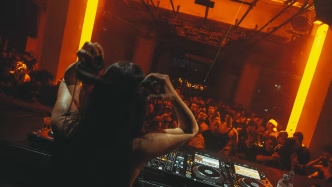

If you want to understand the existential crisis tearing apart electronic music, you don’t need to go to a warehouse in Berlin or a superclub in Ibiza. You just need to watch a viral video of a DJ frantically twisting knobs on a mixer that isn’t plugged in.
It is 2026. The electronic music industry claims to be healthier than ever, boasting a valuation of $12.9 billion. But scratch the glossy surface of that number, and you’ll find a hollowed-out profession in the middle of a nervous breakdown. The archetype of the DJ—the obsessive nerd hidden in the dark, communicating solely through basslines—has been euthanized. In their place is the “Visual DJ,” a creature bred in the petri dish of TikTok, fighting a three-front war for Followers, Money, and Influence.
The Influencer Trap: When the Grid Matters More Than the Groove
Here is the most depressing statistic you will read today: 61% of emerging DJs now explicitly believe that their social media numbers are more critical to their career than their actual musical ability.
Let that sink in. The skill of reading a room, of building a narrative arc over three hours? Irrelevant. The industry has effectively gaslit an entire generation into believing that if it didn’t happen on Instagram, it didn’t happen. Promoters, terrified of their own razor-thin margins, have stopped booking talent and started booking “convertible audiences.” They want a performer who brings a guaranteed 50 ticket sales from their follower count, not someone who can actually mix.
This “contentification” of the club has physically altered the music itself. Nuanced genres like Ambient and Chillout are dying a quiet death because they don’t work in a 15-second loop. Meanwhile, high-octane genres like Trance and Hard Dance saw a 29% spike in uploads leading into this year. Why? Because they are loud, fast, and provide the instant dopamine hit required to stop a thumb from scrolling past. We are literally engineering the art form to satisfy the attention span of a goldfish.
The AI Threat: Text-to-Banger
In 2026, the threat isn’t just other DJs; it’s the machine. With the explosion of generative AI, “someone who can make music” now describes everyone with a keyboard. As industry CEO Geraldo Ramos predicted, the definition of a musician has fundamentally shifted. The market is flooding with functional, AI-generated sludge designed solely to game streaming algorithms, forcing human DJs to compete with bots that never sleep and never ask for a rider.

People Are Partying Less – And It’s Not Just About Missing Out on Fun
The Pay-to-Play Nightmare and the $500 Opening Slot
While the “Superstar DJs” fly private to Dubai, the working class of the industry is being liquidated by predatory scams. A viral discussion thread on Reddit exposed emails from festival promoters explicitly charging artists for the privilege of working.
The rate? $500 for a 15-minute slot. Want 45 minutes? That will cost you $1,200. They frame it as “exposure,” promising billboards and press releases, but let’s call it what it is: a tax on hope.
This is the “K-shaped” recovery in action. The top 1% of DJs are raking in millions, while the middle class has evaporated. In the UK alone, one-third of nightclubs have shut their doors in the last few years, erasing the minor leagues where artists used to cut their teeth. Without those venues, the only ladder left is the digital one, which costs money to climb. 1
2026 DJ Fee Breakdown (The Reality Check)
If you aren’t paying to play, here is what you are actually earning in the trenches:
- Club Opener: $50 – $150 (often paid in drink stubs).
- Wedding DJ: $1,000 – $3,000 (The only stable income left).
- Corporate Event: $500 – $1,500.
- Headline Festival Act: $10,000 – $100,000+ (Reserved for the 1%). 2

Electronic Music Industry Revenue: $12.9 Billion Market and DJ Payment Reality Check
The Black Market of Sound: Buying Your Career for $299
If you can’t mix, and you can’t produce, don’t worry—you can just buy your way in. The ghost production market is booming, operating as the industry’s dirty open secret.
In 2026, you can log onto sites like Anonymous Tracks or House of Tracks and purchase a “club-ready” Techno or Tech House track for anywhere between $199 and $1,999. These tracks come with a contract transferring 100% of the rights to you. You slap your name on it, upload it to Spotify, and pretend you spent weeks in the studio.
It creates a zombie ecosystem where “producers” who have never touched a synthesizer are touring off the backs of ghostwriters who can’t afford rent. It’s the Milli Vanilli scandal, but industrialized and automated.
The Merch-Industrial Complex
So, how do actual musicians survive if they aren’t rich kids or scammers? They stop being musicians and start being garment merchants.
Streaming royalties are a joke. You have to be in the top 0.4% of artists to even afford rent on Spotify earnings. The math is brutal: selling a single t-shirt nets you the same profit as roughly 9,000 to 10,000 streams. Consequently, the modern DJ isn’t an artist; they are a streetwear brand that occasionally releases audio as marketing collateral for their hoodie drop.
This financial pressure is fueling a massive mental health crisis. “Burnout” is the defining condition of the era, with 52% of young DJs reporting anxiety directly linked to the pressure of maintaining a digital persona. You aren’t just a DJ anymore; you’re a video editor, a copywriter, a community manager, and a therapist to your Discord server.


The Authenticity Wars: Phone Bans and Purity Spirals
Naturally, because every action has an equal and opposite reaction, a pretentious counter-culture has emerged to fight the digital rot. The “No Phone” movement is sweeping through Ibiza and Berlin like a new religion. Venues like Hï Ibiza and Amber’s in Manchester are slapping stickers over camera lenses, treating the dancefloor like a crime scene that cannot be documented.
It’s a clever bit of marketing masked as moral superiority. By banning phones, clubs create FOMO (Fear Of Missing Out). They turn the night into a scarce resource. If you can’t see it on Stories, you have to buy a ticket. It also stops the crowd from looking like a sea of zombies holding glowing rectangles, which is undeniably a vibe killer.
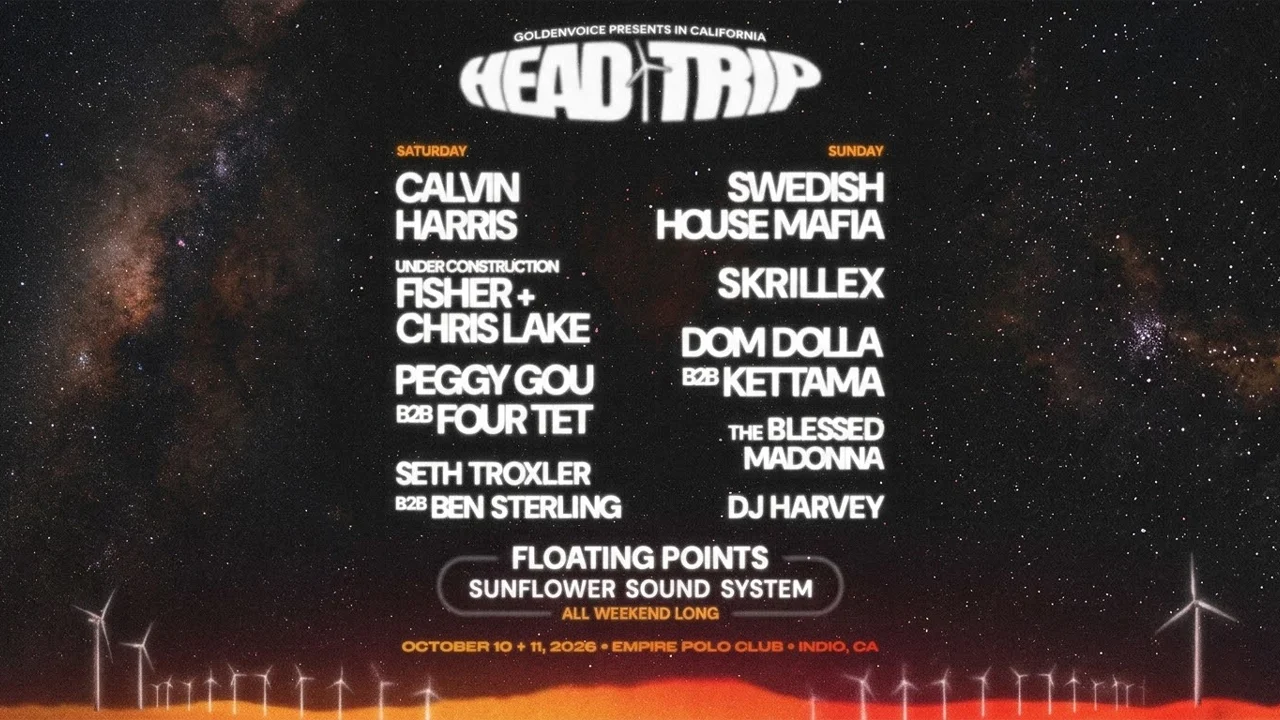
Then there are the “Listening Bars”—essentially libraries with liquor licenses. Places like Spiritland or Echo Room where you sit in silence and worship a $10,000 turntable. It’s the safe space for the “Tastemaker,” the DJ who wants to prove they are better than the “Influencer.” This is where the backlash against viral stars like Peggy Gou comes from. When the underground rips into a celebrity DJ for “sloppy transitions,” they aren’t critiquing technical skills; they are screaming in terror at the realization that being cool is now more profitable than being good.
The Verdict
So, what’s important to modern DJs? Survival.
The industry has mutated into a landscape where Influence is the only currency that buys you freedom, Money is found in merch rather than music, and Followers are the entry fee to the club. The tragedy is that in the rush to optimize for the algorithm, we forgot to optimize for the dancefloor. The party is bigger than ever, but the vibe? The vibe is buffering.
- https://www.optimistdaily.com/2025/04/manchesters-phone-free-nightclub-revives-the-rave-spirit-for-a-new-generation/ ↩︎
- https://www.hypebot.com/hypebot/2025/12/8-predictions-for-2026-from-around-the-music-industry.html ↩︎
* generate randomized username
- Okay, boomer. i mean, is anyone REALLY surprised? This is just capitalism doing its thing. blaming tiktok is lazy. also, that 12.9 billion valuation probably factors in the social media aspect, so its kinda a moot point youre making.
- Is the valuation really "healthy," or just inflated by influencer marketing budgets? i suspect a lot of that $12.9 billion isn't going to the actual artists, but to agencies specializing in fake engagement. The focus on "convertible audiences" seems unsustainable, and ultimately damaging to the scene.
- i dunno, this feels kinda gatekeepy. like every generation says the next one is ruining everything. Maybe these "visual djs" are just adapting to a changing landscape, and we're just old and out of touch?
- #1 Lord_Nikon [12]
- #2 Void_Reaper [10]
- #3 Cereal_Killer [10]
- #4 Dark_Pulse [9]
- #5 Void_Strike [8]
- #6 Phantom_Phreak [7]
- #7 Data_Drifter [7]
- #8 Zero_Cool [7]