Burning Man has always been a trial by fire, or more accurately, by dust. But the 2025 event in Nevada’s Black Rock Desert felt different. It was a perfect storm of crises that went far beyond the usual hardships. An attendee was electrocuted in floodwaters, police arrested a man with a van full of drugs en route to the festival, and the entire event was happening under the shadow of a massive financial crisis within the Burning Man Project, the nonprofit that runs it. 1
These were not just isolated incidents. They were symptoms of deeper issues that have been simmering for years. The festival’s core principles are now clashing with the reality of managing a temporary city of 70,000 people. The convergence of safety failures, financial instability, and a growing cultural divide has pushed Burning Man to a critical inflection point. The party in the desert is facing a serious identity crisis, and its future may depend on the choices it makes right now.
Chaos on the Playa
The trouble for Burning Man 2025 started before most people even arrived. Violent dust storms with 50 mph winds ripped through the desert, crushing camps and destroying art installations. Then came the thunderstorms and heavy rain, turning the dry lakebed into a sea of mud and standing water, a grim repeat of the 2023 “mudpocalypse”. The gates were repeatedly shut down, leaving thousands stranded for hours.
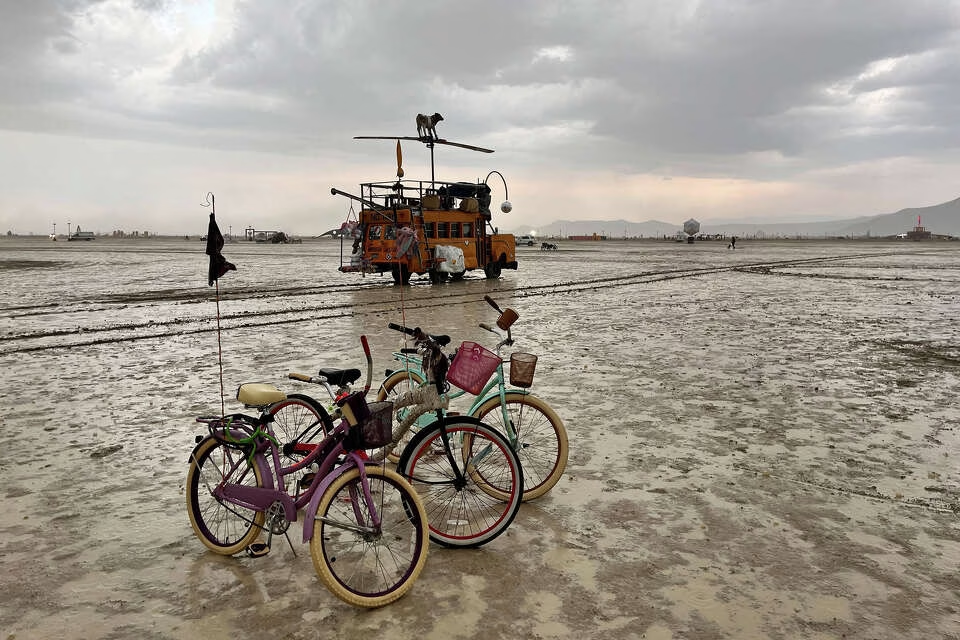
The dangerous conditions had severe consequences. On Tuesday night, a man was electrocuted after reportedly stepping into a puddle electrified by a generator 2 or other powered gear submerged in the floodwater. He had to be airlifted to a trauma center. The Burning Man organization’s official response was a generalized safety warning, urging attendees to keep electrical equipment dry. This highlighted a critical flaw. The event relies on thousands of individual power systems, many run by amateurs, in an environment prone to flash floods.
While organizers dealt with internal chaos, law enforcement was busy on the perimeter. On August 21, police arrested 48-year-old David Haynes, who said he was on his way to the festival. A search of his van uncovered what police described as a mobile drug trafficking operation, with large quantities of crack cocaine, meth, MDMA, LSD, and prescription pills packaged for sale. By mid-week, the local sheriff’s office had already made 27 arrests at the event, mostly for drug possession or sales.
Is “Radical Self-Reliance” a Liability?
At the heart of Burning Man’s ethos is the principle of “Radical Self-Reliance,” which asks participants to rely on their own resources to survive the harsh desert environment. It’s a philosophy that fosters creativity and personal responsibility. But as the event has grown, this principle is becoming a significant safety and legal risk. 3
Black Rock City is a place where injuries are common. In 2022, there were 5,376 reported injuries. In 2023, during the floods, there were 3,347, and in 2024, there were 1,524. Fatalities, while not an annual occurrence, have happened repeatedly over the years. Injuries range from “playa foot,” a chemical burn from the alkaline dust, to severe trauma from falls and vehicle crashes.
This high injury rate is tied to a culture that embraces risk, a “no guardrails” philosophy that many attendees see as part of the appeal. The organization protects itself legally with a detailed liability waiver on every ticket, forcing attendees to assume all risk of injury or death. While this may cover accidents from voluntary actions, like climbing an art installation, it’s less likely to protect the organization from “gross negligence”. A city-wide flood creating invisible electrical hazards pushes the event into more dangerous legal territory.
This “consumer” mindset puts a huge strain on the volunteer-run Emergency Services Department (ESD). In recent years, operations managers have noted an increase in people visiting medical stations for minor issues, like a paper cut, suggesting a decline in self-reliance. ESD volunteers have taken to public forums to plead with attendees to take basic precautions, a sign that the system is being stretched thin by preventable incidents. 4
Burning Through Cash
The crisis on the playa is matched by a crisis on the balance sheet. In late 2024, the Burning Man Project announced it was facing a $14 million financial shortfall. The main cause was the disastrous 2023 event. The bad press from the floods led to the 2024 festival failing to sell out for the first time in 13 years, a major blow to an organization that relies almost entirely on ticket sales. 5
The organization’s plea for donations was met with anger from many longtime participants. Critics pointed to what they see as a bloated bureaucracy with over 100 full-time employees and high executive salaries. CEO Marian Goodell’s 2023 compensation was over $378,000, with many other directors earning six-figure salaries.
Many burners feel their money is being spent on initiatives far removed from the actual event, a phenomenon they call “mission creep”. A decision to fly staff to a “Global Leadership Summit” in Estonia drew particular anger. The organization’s recovery plan involves a 10% staff reduction and other cost-cutting measures. However, the CEO has also warned that if donations don’t cover the gap, ticket prices are “likely going up,” a move that could further alienate the core community.


The Gentrification of the Desert
Ultimately, these problems are symptoms of a deeper identity crisis. Burning Man has transformed from a small, counter-cultural gathering into a global phenomenon and a networking hotspot for Silicon Valley elites and celebrities. 6
This shift is most obvious in the rise of “plug-and-play” camps. These are luxury camps where wealthy attendees can pay tens of thousands of dollars for an all-inclusive experience with RVs, private chefs, and hired staff. This model directly contradicts the principles of Radical Self-Reliance and Decommodification, creating a two-tiered city of participants versus consumers. The resentment this has caused famously boiled over in 2016 when a group vandalized the White Ocean sound camp, calling its wealthy patrons a “parasite class”.
This gentrification has had a corrosive effect. It has driven up ticket prices, making the event inaccessible for many, and has contributed to the erosion of self-reliance, straining volunteer services. The very success that made Burning Man famous has attracted a population that is often disconnected from its founding principles.
A Crossroads in the Dust
Burning Man is at a crossroads. The convergence of safety, financial, and cultural crises in 2025 was a wake-up call. The organization can no longer ignore the growing gap between its ideals and its reality. To survive, it may need to make some hard choices. This could mean restructuring its finances to focus on the Black Rock City event instead of global ambitions, evolving its safety model to be less reliant on volunteers, and taking a firm stand against the “plug-and-play” culture that has divided its community.
The future of Burning Man may depend on its willingness to get smaller, more focused, and perhaps a little more uncomfortable. The crises of 2025 could be the catalyst for a necessary transformation. For Burning Man to survive, it might first need to be reborn.
- https://pizenswitchtimes.com/2025/08/21/ypd-man-arrested-en-route-to-burning-man-with-illegal-drugs-packaged-for-sale/ ↩︎
- https://sfist.com/2025/08/27/burning-man-attendee-gets-electrocuted-and-airlifted-out-as-flooding-remains-a-problem-this-year/ ↩︎
- https://burningman.org/about/10-principles/ ↩︎
- https://www.burn.life/blog/burning-mans-culture-is-in-danger ↩︎
- https://sfist.com/2024/12/20/burning-man-admits-to-14-million-deficit-says-ticket-price-hikes-may-be-in-the-works/ ↩︎
- https://www.salon.com/2017/09/02/the-data-behind-the-gentrification-of-burning-man/ ↩︎
* generate randomized username
- COMMENT_FIRST
- #1 Lord_Nikon [12]
- #2 Void_Reaper [10]
- #3 Cereal_Killer [10]
- #4 Dark_Pulse [9]
- #5 Void_Strike [8]
- #6 Phantom_Phreak [7]
- #7 Data_Drifter [7]
- #8 Zero_Cool [7]