

In an era where “Brat Summer” and TikTok snippets dictate the charts, the true test of a DJ remains unchanged: the terrifying, exhilarating alchemy of making a room fall in love with a song they’ve never heard.
In the dimly lit and sweat-slicked corners of nightlife, a silent war is waged nightly between the comfort of the past and the shock of the future. To the uninitiated, the Disc Jockey is merely a service provider. They are a human jukebox tasked with maintaining a steady dopamine drip of familiar hits. This transactional model involves playing what is known and requested. It constitutes the “job” of DJing. It is a commercial necessity that keeps the bar tabs open. But as any veteran of the booth will tell you, the “art” lies in a far more precarious endeavor. It is the manipulation of psychology and physics to transform the unknown into the beloved. As the old adage goes: Making them dance to a hit is a job; making them love a new track is the art. 1
In 2025, this distinction has never been more vital. We live in an age of algorithmic homogeneity. Streaming platforms and social engines create “filter bubbles” that reinforce our existing tastes with ruthless efficiency. When an algorithm can predict your next favorite song with mathematical precision, the human selector’s role shifts from content delivery to cultural disruption. The DJ must act not as a mirror reflecting the crowd’s current playlist, but as a prism. They must bend perceptions to reveal a spectrum of sound the crowd didn’t know existed.
The Anxiety of the “Drop”
To understand the magnitude of this task, you have to appreciate the biology of the dancefloor. The resistance an audience feels toward an unknown track isn’t just stubbornness. It is evolutionary. The Mere Exposure Effect suggests that we are hardwired to prefer the familiar because it reduces cognitive load. A “banger” triggers a prediction-reward loop where the brain anticipates the drop, the drop happens, and dopamine is released. 2
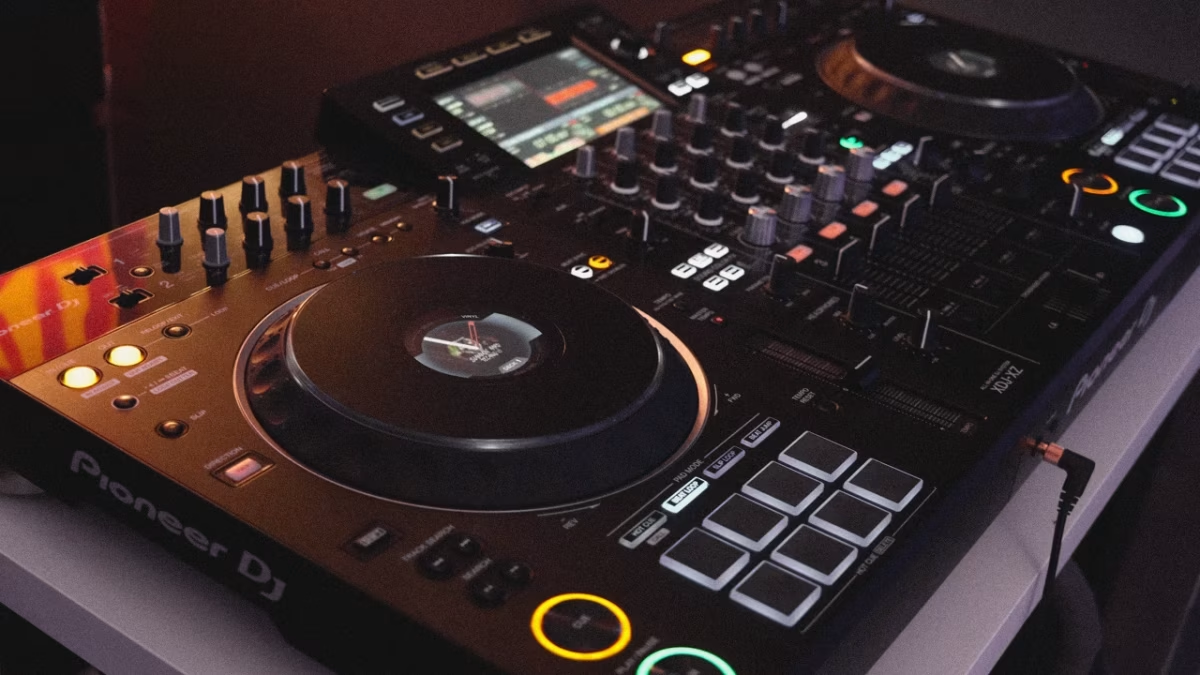
A new track represents a “prediction error.” In a high-stimulus club environment, this lack of predictability can trigger a disengagement response. This is the scientific explanation for “clearing the floor.” The art of the DJ is a form of cognitive hacking. By utilizing techniques like harmonic anchoring (sandwiching a new track between two hits) or spectral sculpting (using high-end rotary mixers to blend textures rather than beats), the DJ smuggles novelty past the brain’s defenses. 3
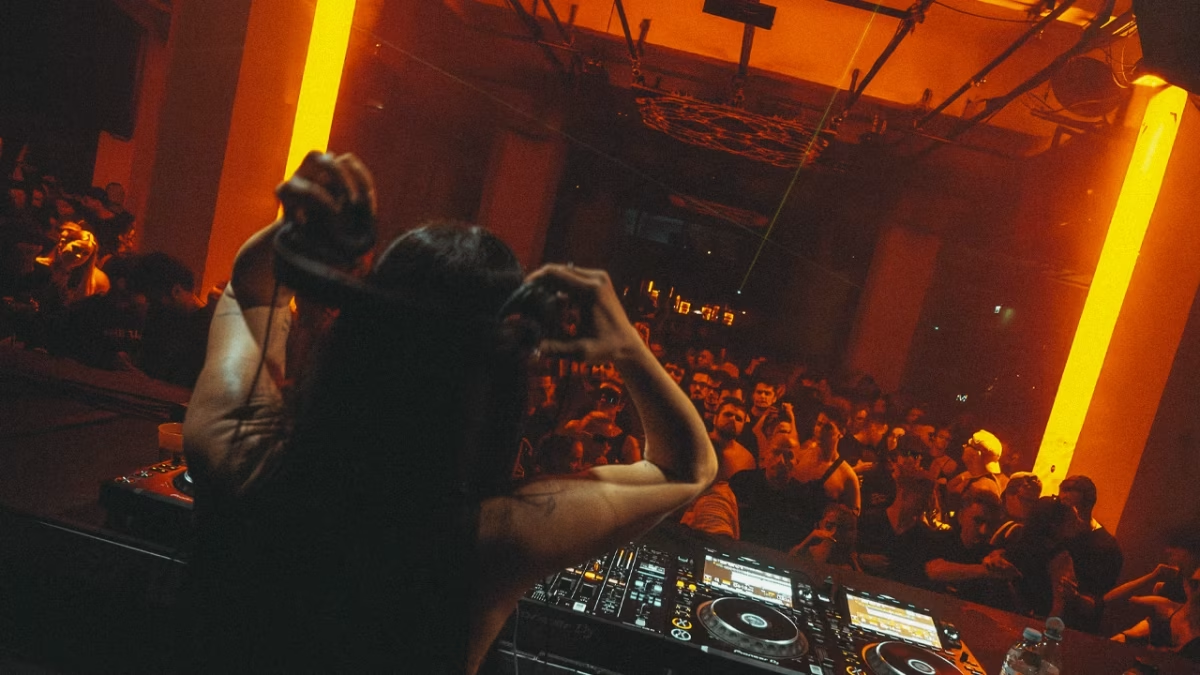
Floating Points (Sam Shepherd), a neuroscientist turned selector, exemplifies this approach. Utilizing custom Isonoe rotary mixers, Shepherd doesn’t just cut between tracks. He blurs the edges of time. He allows a new and challenging composition to emerge from the ether of a familiar groove. It is a technique that demands patience. That is a virtue increasingly rare in a “30-second clip” culture. 4
How Algorithms and “Sameness Fatigue” Are Hollowing Out Electronic Music
“Fail We May, Sail We Must”
The philosophy of the true selector is built on risk. The late and legendary Andrew Weatherall famously tattooed the mantra “Fail we may, sail we must” on his arms. It was a phrase borrowed from a young Irish fisherman he met en route to a gig in County Cork.[] It encapsulates the spiritual core of breaking music. To “sail” is to venture into the open waters of the unknown. It means leaving the safe harbor of the Top 40. 5
Weatherall understood that “clearing the floor” wasn’t a failure. It was a necessary valley in the narrative arc of the night. If you never risk losing the crowd, you never truly have them; you are merely renting their attention. This ethos is echoed by The Blessed Madonna (Marea Stamper), who argues that “freedom is risk.” In her view, the DJ’s goal isn’t to facilitate a steady state of motion. It is to engineer moments of collective discovery. It is to create the context where a room full of strangers can fall in love with a piece of music simultaneously. “I mean I fell in love with my husband in a rave,” she told Mixmag. She emphasized that the dancefloor is a space for profound emotional connection and not just physical exertion. 6
Contrast this with the “New School” reality critiqued by industry titan Carl Cox. Cox has lamented the influx of a “nasty breed” of opportunists for whom the “job” of fame and fees has eclipsed the music. “Beat matching tech, gimmicks, and reliance on playing popular music have become the common definition of what a DJ does,” Cox notes. In the commercial sector, the sync button has democratized the mechanics. However, it has done nothing for the taste. The “art” is the refusal to play it safe. It is holding the line even when the fee is high and the crowd is demanding the latest TikTok edit.
The Viral Feedback Loop: From “Blue Monday” to “Baddadan”
The mechanism of “breaking” a track has shifted tectonically over the decades. In 1983, New Order’s “Blue Monday” became the best-selling 12-inch of all time not because of radio play. It was too long for radio. It became a hit because DJs physically forced it into existence. The 12-inch format allowed for a thundering bass response that physically dominated club sound systems. It bypassed the brain and spoke directly to the body. DJs played it because it was a tool that worked. Audiences loved it because it was physically undeniable.
Fast forward to 2024, and the “break” often happens before the club doors even open. Take Chase & Status’s “Baddadan.” A drum and bass track with a gritty dancehall hook, it didn’t just climb the charts. It infiltrated the cultural consciousness via short-form video before dominating festivals. Similarly, Charli XCX’s Brat initiated a “Brat Summer” phenomenon where the club remix became the primary text. It blurred the line between internet meme and warehouse anthem. 7
However, the “dubplate culture” of exclusivity still flickers. Joy Orbison’s “Flight FM” became the inescapable sound of 2024 not through a marketing budget. It broke through the old-school method of being rinsed by influential DJs until the demand was deafening. Described as “raw yet elegant,” the track’s minimalist and bass-heavy structure allowed it to fit into sets ranging from techno to garage. It proved that even in the digital age, a track can still break the old-fashioned way: by sounding absolutely massive on a rig.

The Curator vs. The Algorithm
In 2025, the DJ’s value proposition is no longer access to music. It is the contextualization of it. We all have access to 100 million songs. What we lack is the narrative thread to connect them.
Selectors like Ben UFO represent the antithesis of the Spotify algorithm. He speaks of “collapsing the distinctions” between the accessible and the experimental. An algorithm recommends more of what you already like. A DJ like Ben UFO introduces the “Black Swan.” This is the track that statistically shouldn’t work but emotionally devastates the room. This human curation offers a serendipity that code cannot replicate. 8
This human element is under siege. The rise of “No Phone” policies at clubs like Hï Ibiza and fabric is a direct response to the algorithmic gaze. DJs are fighting to reclaim the attention span of the crowd from the dopamine loop of the scrolling screen. As James Hype noted regarding his phone-free residency, the goal is to create an “immersive setting” where the music can actually land. You cannot break a new track to a crowd that is watching a video of a different track on their phones.
The Art of Persuasion
To make a crowd dance to a hit is a job of Recall. To make them love a new track is an art of Persuasion.
As we look toward the future of club culture, the tension between the “Job” and the “Art” will only intensify. The pressure to feed the content machine is immense. Yet, the DJs who endure are the ones who build legacies rather than just careers. They are those who treat the booth not as a jukebox, but as a pulpit. They are the ones willing to endure the awkward silence of a confused dancefloor for the transcendent moment that follows. That is the moment when the confusion breaks, the beat drops, and the crowd realizes they are dancing to the future.
- https://notyourjukebox.com/2012/05/19/why-old-school-djs-are-complaining-and-you-should-too/ ↩︎
- https://stars.library.ucf.edu/hut2024/249/ ↩︎
- https://pmc.ncbi.nlm.nih.gov/articles/PMC5374342/ ↩︎
- https://www.reddit.com/r/rotarymixers/comments/p6g7m4/any_resources_or_tips_for_transitions_on_a_rotary/ ↩︎
- https://dmy.co/features/andrew-weatherall-interview-it-s-bollocks-it-s-discos-tell-me-tales-of-the ↩︎
- https://mixmag.asia/feature/the-god-squad-how-the-blessed-madonna-made-serotonin-moonbeams ↩︎
- https://www.ladbible.com/entertainment/music/chase-status-baddadan-meaning-425321-20240304 ↩︎
- ↩︎
* generate randomized username
- COMMENT_FIRST
- #1 Lord_Nikon [12]
- #2 Void_Reaper [10]
- #3 Cereal_Killer [10]
- #4 Dark_Pulse [9]
- #5 Void_Strike [8]
- #6 Phantom_Phreak [7]
- #7 Data_Drifter [7]
- #8 Zero_Cool [7]